
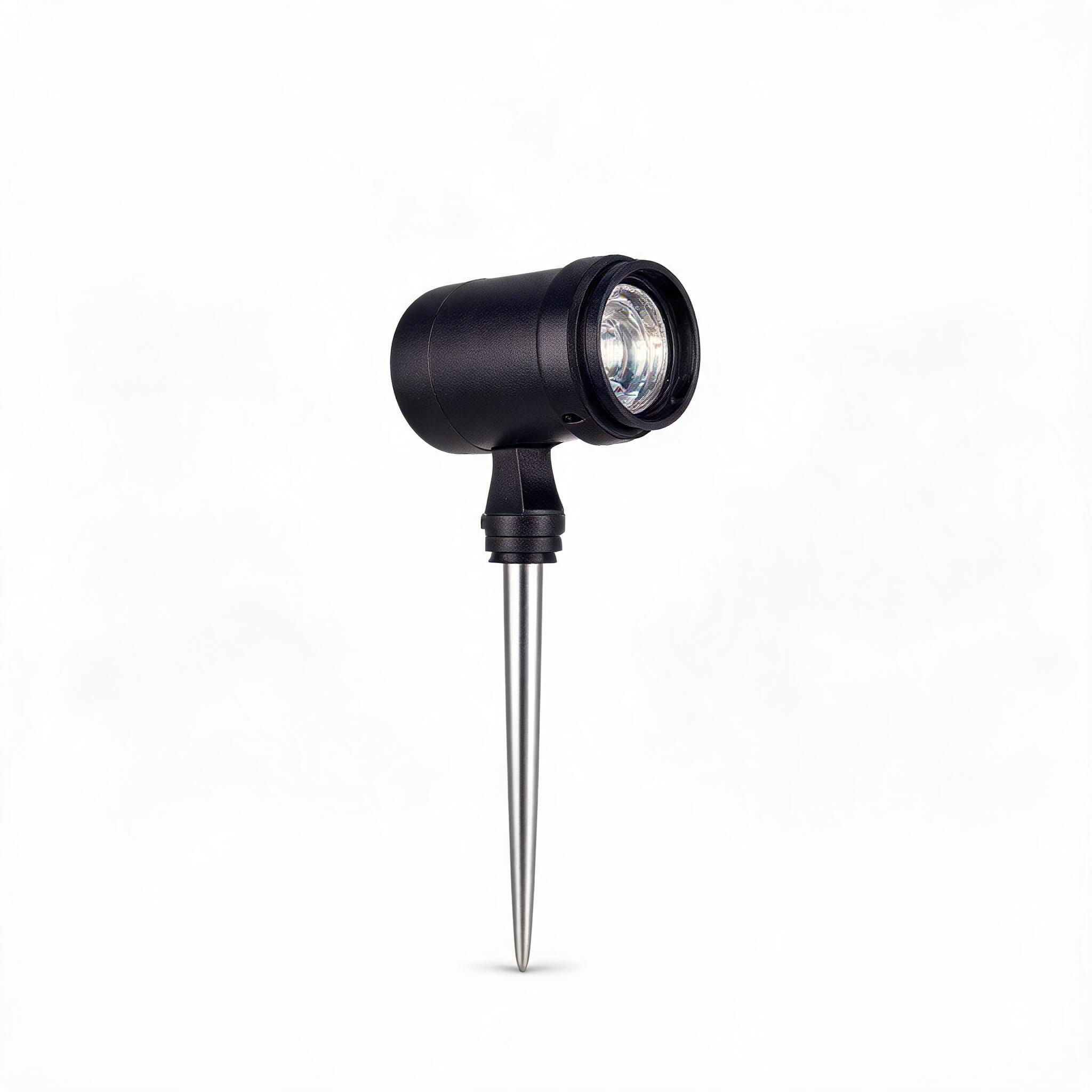
A structured buyer's guide to choosing landscape lighting: matching fixture types to lighting tasks, comparing materials and IP ratings, and evaluating manufacturers on the specs that matter.
Start with the lighting task, not the fixture
The most common mistake when purchasing landscape lighting is choosing by fixture category instead of by lighting task. Before comparing products, list what each zone of the project requires: to accent a tree, mark a pathway, wash a façade with light, illuminate a step, secure the perimeter. Each task corresponds to its own fixture type, and once the match is clear, product selection becomes straightforward.
- Accent and uplighting: floodlights with an adjustable beam angle. Narrow beams of 15°–24° for tall palms and columns; wider beams of 38°–60° for shrubs and façades.
- Pathway marking: bollards or path lights 40–60 cm high, spaced 2.5–3 meters apart.
- Wall washing: linear wall-wash fixtures or wide-beam floodlights mounted flush to the surface.
- Step and terrace safety: recessed step lights with louvered or frosted diffusers to prevent glare.
- Water features: submersible IP68 fixtures only — no compromises here.
Match wattage and lumens to the scene
Wattage shows energy consumption; lumens indicate light. In LED fixtures the two are related but not identical, so always compare lumens. Rule of thumb: garden accents — 100–300 lm, pathway lighting — 100–200 lm per fixture, tree uplighting — 300–800 lm depending on the canopy, large façades and security — from 2,000 lm.
The OKELI floodlight range illustrates this progression well: a 10 W floodlight delivers 800 lm for garden accents, the 20 W version reaches 1600 lm for medium trees and walls, and the 50 W commercial unit produces 4000 lm for large-scale accents and security applications. Choosing by lumens per task prevents both underlighting and complaints about glare from overlighting.
Beam angle: the specification most often ignored
Beam angle determines whether the light lands as a controlled accent or a blurred pool. Adjustable fixtures (15°–60°) solve the problem elegantly: one SKU serves several scenes — a major advantage for distributors who want to keep fewer variants in stock. Fixed-angle fixtures are slightly cheaper but lock you into a single effect. For projects, an adjustable angle is almost always the correct specification; we cover the full logic in our guide how to choose the beam angle of an LED floodlight.
Materials and finish: what survives outdoors
Outdoor fixtures fail from corrosion and water ingress far more often than from LED failure. Material selection is therefore a durability decision, not an aesthetic one:
- Die-cast aluminum with powder coating: the standard for floodlights and wall-wash fixtures. Strong, thermally efficient, and corrosion-resistant when properly coated.
- 304 stainless steel: a great fit for bollards and path lights in most climates. Our 40 cm steel bollard is made entirely of 304 for exactly this reason.
- 316 stainless steel: essential for coastal areas and recessed fixtures exposed to de-icing chemicals. The 9 W recessed fixture with a 316 steel frame is specified for plazas and driveways for this reason.
- Plastic and thin sheet metal: acceptable only for short-lived or temporary installations. UV degradation and corrosion make them false economy for permanent landscapes.
IP ratings from a buyer's perspective
IP65 means protection against water jets — sufficient for most above-ground fixtures. IP67 adds protection against temporary immersion, which matters for recessed fixtures, step lights in drainage areas, and any fixture at ground level. IP68 is for permanent immersion. When a supplier names an IP rating, ask under what conditions it was tested: a rating without test evidence is a claim, not a specification.
Our article IP67 vs IP65 breaks down real-world failures, including what happens to IP65 fixtures installed in the ground where nightly irrigation soaks them.
Color temperature and CRI
For landscape work, warm white 3000K remains the default choice: it flatters foliage and stone. Cool white 6500K reads as “clinical” outdoors but suits modern architectural schemes and security applications. CRI 80+ is the standard; for HoReCa projects, where food and faces are under the light, insist on it. Consistency matters too: mixing color temperatures on one site looks like a mistake, even when each fixture is good on its own.
Wired, solar, or hybrid?
Wired low-voltage systems deliver stable light and full control but require transformers, cable, and trenches. Solar fixtures eliminate trenches and electricity costs — our solar light with automatic 8–10 h mode was designed precisely for the no-trench scenario — but their brightness depends on sunlight and battery condition. Pragmatic rule: solar for pathways, boundaries, and remote zones; wired for tree uplighting, security, and anything requiring high intensity.
Evaluate the manufacturer, not just the product
Two fixtures with identical datasheets can behave completely differently over three years. When vetting a manufacturer, ask for:
- Drivers and LEDs: which brands? Are datasheets available?
- Test evidence: IP test reports, LM-80 data for the LED module, aging logs.
- OEM/ODM capabilities: can they change beam angles, cable lengths, logos, and packaging?
- MOQ and lead times: realistic figures, not sales promises.
- Warranty and claims process: who pays freight on warranty replacements?
OKELI LIGHTING publishes specifications openly — for example, the pages for the 30 W floodlight and 100 W floodlight for high masts contain full optical and mechanical parameters — because we believe buyers should compare on evidence.
A simple selection workflow
Put it all together in five steps: (1) list the lighting tasks by zone; (2) assign lumens and beam angle to each task; (3) select material and IP rating based on operating conditions; (4) choose color temperature to suit the character of the site; (5) shortlist manufacturers able to back specifications with documentation. Buyers who follow this sequence consistently report fewer on-site failures and fewer order changes.
Frequently asked questions
How many lumens are needed for pathway lighting? 100–200 lm per fixture at 2.5–3 m spacing provides even navigation without glare. More is not better: overlit pathways look institutional.
Should I choose adjustable or fixed-angle floodlights? Adjustable (15°–60°) if the project has different scenes or you are a distributor carrying one SKU for many tasks. Fixed angle only when the scene is known and repeats at scale.
What IP rating do recessed fixtures need? IP67 minimum; IP68 where drainage is poor or in planters that flood. Near roads treated with de-icing chemicals, pair with a 316 steel frame.
Is 3000K or 6500K better outdoors? 3000K for residential and hospitality landscapes; 6500K for modern façades and security perimeters. Never mix the two temperatures on one site.
What should I ask a Chinese factory before ordering? Driver and LED brands, IP test reports, LM-80 data, OEM options, MOQ, lead times, and warranty freight terms. Then order a trial batch and test it in service before confirming volume.
Next steps
Once the specification is written, request samples of two or three leading fixture types. Test them on site for a week: glare from a seated person's viewpoint, beam control on real surfaces, heat in enclosed mounting positions. Then scale the order with confidence. For a deeper cost picture, read our breakdown of how much landscape lighting costs in 2026, and see the full range on the OKELI products page.