
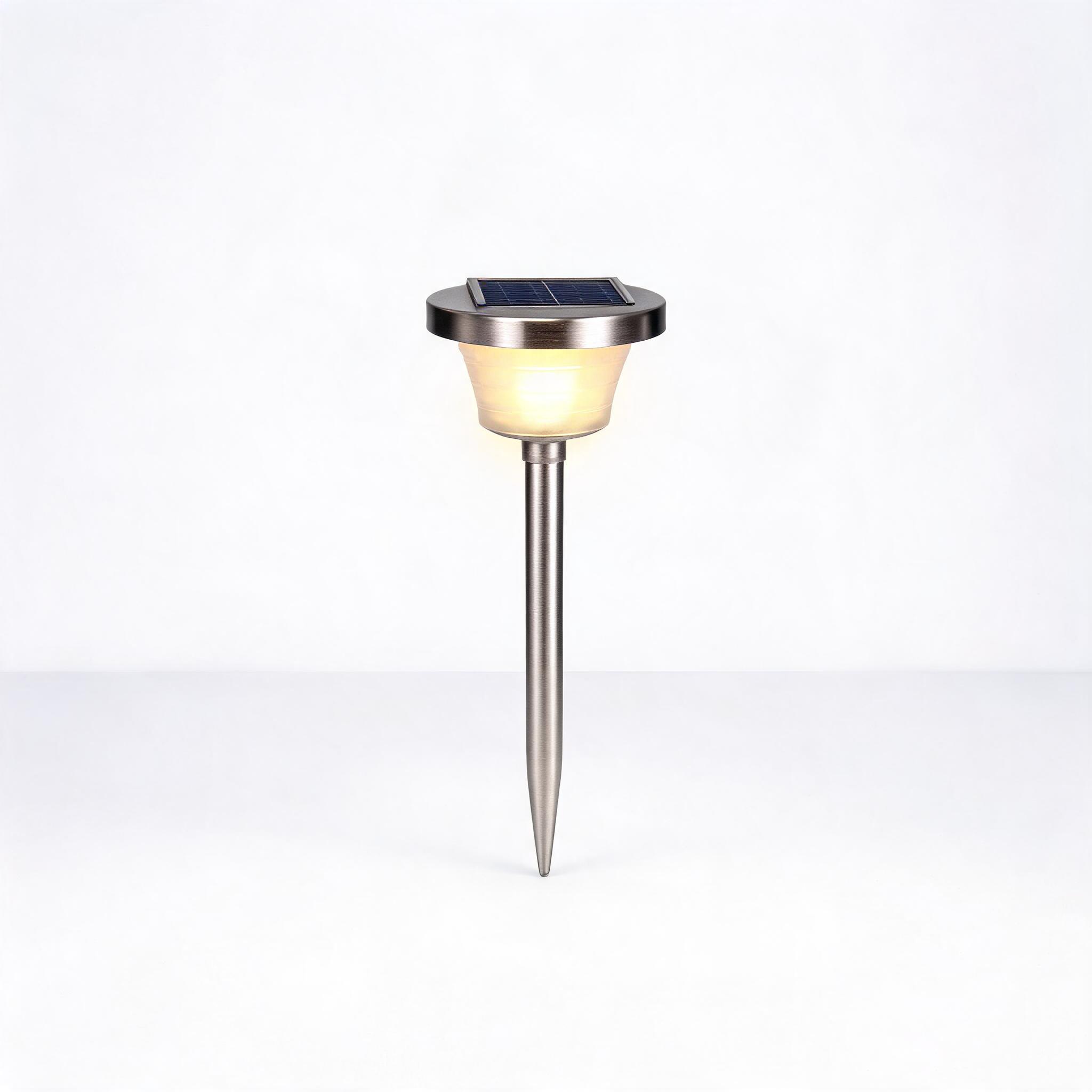
A commercial procurement guide to dusk-to-dawn solar pathway lights, covering IP67 waterproofing, 304 stainless steel construction, NiMH battery performance, and warm white vs cool white selection.
Solar Pathway Lighting - Commercial Procurement Guide
Dusk-to-Dawn Solar Pathway Lights: IP67 Waterproof Buying Guide for Commercial Projects
Solar pathway lights look simple. They are not. A project buyer who specifies the wrong battery chemistry, an inadequate IP rating, or a steel grade that cannot handle the installation environment will face field failures within the first season - and the cost of replacing 200 stake lights across a resort site is not trivial.
This guide covers what actually matters when sourcing dusk-to-dawn solar pathway lights for commercial projects: automatic sensor operation, IP67 waterproofing, 304 stainless steel construction, battery performance, and the practical differences between warm white and cool white variants. We will reference OKELI's 9;s 3000K warm white and 6500K cool white solar pathway lights throughout - both share the same 304 stainless platform and IP67 rating.
Key takeaway: For commercial projects, three specifications separate fixtures that last a decade from those that fail in one season: IP67 sealing (not IP44 or IP65), 304 stainless steel body (not painted steel or plastic), and NiMH battery chemistry (not NiCd). If a supplier cannot confirm all three, the product is not commercial-grade.
Why Dusk-to-Dawn Operation Matters for Commercial Projects
Manual switching is not practical across a commercial site. A resort with 150 pathway lights cannot have staff walking the grounds every evening to switch fixtures on and off. Timer-based systems require seasonal reprogramming as daylight hours change, and they fail when power outages reset the clock.
Dusk-to-dawn operation solves this. A built-in photosensor detects ambient light levels and switches the fixture on at dusk, off at dawn. No timer, no app, no staff intervention. The sensor handles seasonal changes automatically - it does not care whether sunset is at 5pm or 9pm, it responds to actual light levels.
For property managers, this means:
- Zero operating labour: No staff time spent switching lights on and off. Across a 200-fixture site, that is a measurable payroll saving.
- No energy waste: Lights are never left on during daylight hours because someone forgot to switch them off.
- No timer drift: Photosensor-based switching does not drift or require seasonal adjustment. It tracks actual daylight.
- Reliability in remote locations: For off-grid sites, glamping resorts, or rural estates, there is no control system to fail. Each fixture operates independently.
IP67 Waterproof Rating - What It Actually Means on Site
IP ratings are the most commonly fudged specification in solar lighting. A supplier may claim "waterproof" without specifying the rating - and IP44 (splash-resistant) is technically "waterproof" in marketing language. For commercial projects, IP44 is not adequate. Even IP65, which protects against water jets, is not enough for fixtures installed at ground level in areas with heavy rainfall or irrigation systems.igation systems.
IP67 means two things:
- Complete dust exclusion (first digit 6): No dust, sand, or particulate matter can enter the fixture. This matters in desert environments, construction zones, and arid climates where dust ingress degrades LED output over time.
- Submersion to 1 metre for 30 minutes (second digit 7): The fixture survives temporary submersion. On a pathway, this means surface flooding after heavy rain, irrigation overspray hitting the fixture directly, and water pooling around the stake base cannot reach the LED module, battery, or solar panel connections.
Why this is critical: solar pathway lights are installed at ground level. They are the lowest fixtures on any site. Rainwater flows downhill. Irrigation systems spray outward. If the fixture is not rated for submersion, water will find its way in through the battery compartment seal, the solar panel cable entry, or the LED diffuser gasket - and once water enters, the battery corrodes and the fixture dies.
OKELI's 9;s warm white and cool white solar pathway lights are both IP67 rated. The entire electronics package - LED, battery, photosensor, and solar charge controller - is sealed against submersion.
304 Stainless Steel - Why Material Choice Determines Service Life
The body material is the single biggest predictor of how long a solar pathway light will last outdoors. There are three common options, and the difference is not subtle:
| Material | Corrosion Resistance | Typical Service Life Outdoors | Visual Degradation |
|---|---|---|---|
| Plastic / ABS | UV breakdown in 1–2 seasons | 1–2 years before cracking | Yellowing, brittleness, fading |
| Painted Steel / Zinc Alloy | Coating fails in 6–12 months in coastal areas | 2–3 years before structural rust | Rust staining, peeling coating, pitting |
| 304 Stainless Steel | No coating to fail - metal itself resists corrosion | 10+ years in most environments | None - finish is the metal |
304 stainless steel is the same alloy used in commercial kitchen equipment and marine hardware. It contains 18% chromium and 8% nickel, which form a passive oxide layer that self-heals when scratched. Salt air, monsoon rain, irrigation chemicals, and pool splash do not cause surface corrosion, pitting, or staining.
For commercial projects, this matters in three ways:
- Replacement cost avoidance: Replacing 200 plastic stake lights every two years costs more than specifying stainless steel once.
- Aesthetic consistency: Painted fixtures that rust create an unkempt appearance that reflects poorly on the property. Stainless steel maintains its finish indefinitely.
- No staining of adjacent surfaces: Rusting steel fixtures stain light-coloured paving, stone, and concrete with orange run-off. Stainless does not stain.
Battery Performance - NiMH vs NiCd vs Li-ion
The battery determines how long the light runs each night and how many years before the battery needs replacement. Three chemistries are common in solar pathway lights:
- NiCd (Nickel-Cadmium): The cheapest option. Suffers from memory effect - if the battery is repeatedly discharged only partially, it loses capacity. Cadmium is toxic and restricted under RoHS in many markets. Avoid for commercial specification.
- NiMH (Nickel-Metal Hydride): No memory effect. Higher capacity per cell than NiCd. Performs reliably from −10°C to +50°C. Handles 500–1,000 charge cycles (1.5–3 years of daily use). This is the correct specification for commercial solar pathway lights. OKELI uses a 600 mAh NiMH battery that delivers 8–10 hours of runtime per full charge.
- Li-ion: Highest energy density and longest cycle life, but requires a protection circuit and is more expensive. Overkill for low-power pathway lights where NiMH provides adequate runtime at lower cost and complexity.
The 600 mAh NiMH battery in OKELI's solar pathway lights provides 8–10 hours of runtime on a full day's charge. In most climates, a full day of daylight (including overcast conditions) is sufficient to charge the battery to a level that powers the LED through the night. In consistently low-sunlight climates - high-latitude winters, persistent fog - runtime may be reduced. For projects in these climates, contact the manufacturer to discuss panel sizing options.options.
Warm White vs Cool White - Choosing the Right Colour Temperature
Colour temperature is not a technical afterthought - it determines whether the fixture suits the project environment. OKELI offers the same solar pathway light in two colour temperatures:
| Specification | 3000K Warm White | 6500K Cool White |
|---|---|---|
| Visual Tone | Soft amber, similar to incandescent | Crisp daylight, bright white |
| Best Application | Hospitality, resorts, residential estates | Functional, commercial, security zones |
| Material Rendering | Flatters stone, timber, planting | Accurate but cooler tone |
| Atmosphere | Inviting, ambient | Alert, functional |
| Typical Project Type | 5-star hotel, luxury villa, wedding venue | Commercial park, car park, municipal path |
For hospitality and residential projects, 3000K warm white is the standard. Cool white in a resort entrance reads as security lighting - it kills the atmosphere that the landscape design was built to create. The warm white variant is the default choice for hotel, resort, and upscale residential specification.
For functional applications - commercial perimeters, car parks, municipal pathways - the cool white variant provides higher perceived brightness and a more alert visual tone. Some projects mix both: warm white in guest-facing zones, cool white in service and perimeter areas.
Zero Wiring - The Infrastructure Cost Saving
The hidden cost of wired pathway lighting is not the fixture. It is the trench, the conduit, the cable, the junction boxes, the licensed electrician, and in many jurisdictions, the electrical permit. For a 200-fixture pathway project, these costs can exceed the fixture cost by a factor of three.
Solar pathway lights eliminate every one of these line items:
- No trenching or groundworks
- No conduit or cable runs
- No electrician required - installation is push-in stake
- No electrical permit (in most jurisdictions)
- No ongoing energy cost
- Fixtures can be repositioned as landscaping evolves - no rewiring
For remote sites, off-grid locations, and projects where ground disturbance is restricted (heritage sites, protected landscapes), solar is not just a cost saving - it may be the only viable option.
Specifying OKELI Solar Pathway Lights
Both colour temperature variants share these specifications:
- Housing: Grade 304 stainless steel
- Height: 30 cm (custom heights available above MOQ)
- LED power: 0.6W
- Sealing: IP67 (submersion-rated)
- Battery: 600 mAh NiMH, rechargeable
- Runtime: 8–10 hours per full charge
- Operating temperature: −10°C to +50°C
- Control: Automatic dusk-to-dawn (integrated photosensor)
- Power source: Integrated solar panel, no external wiring
- Custom options: Height, finish, colour temperature, private-label packaging
OKELI LIGHTING has manufactured outdoor lighting since 2009 from a 35,000 m² ISO 9001-certified facility. Products carry CE, ETL, and RoHS certifications. The company supports OEM/ODM programmes with custom heights, finishes, logo engraving, and private-label packaging above MOQ. Samples are available - lead time 7–10 business days; bulk production 40–45 business days.
Frequently Asked Questions
How long does the battery last before replacement?
NiMH batteries typically handle 500–1,000 charge cycles. At one cycle per day, that is 1.5–3 years of daily use before capacity degrades noticeably. Replacement batteries are available - contact us for spares pricing.
Do the lights work in cloudy or overcast conditions?
Yes. The solar panel charges from diffuse daylight, not direct sunlight only. Runtime is reduced in extended overcast periods, but the battery retains enough charge to operate through normal cloudy weather. For consistently low-sunlight climates, contact us to discuss panel options.
Can I mix warm white and cool white on the same project?
Yes. Both variants share the same 304 stainless housing and dimensions. Mixing is common in hospitality projects - warm white in guest zones, cool white in service areas. Contact us with your split requirement for a combined quote.
What is the minimum order quantity?
MOQ is 100 pcs for standard configurations. Custom heights, finishes, or packaging may carry a higher MOQ. Contact our sales team with your project volume for a specific quote.
Can I get samples for specification approval?
Yes. Samples are available for pre-production approval. Lead time is 7–10 business days. Contact us for sample pricing and courier options.
Are these lights suitable for coastal environments?
Yes. The 304 stainless steel body resists salt-air corrosion. IP67 sealing prevents moisture ingress. These fixtures are specified for beachfront resorts, marina landscapes, and tropical high-humidity environments where painted steel fails within one season.
Need help specifying solar pathway lights for your commercial project? Share your site type, fixture count, colour temperature preference, and destination market. OKELI's technical team will confirm specifications, pricing, and lead time within one business day. ay. Contact us here.