
A practical B2B sourcing guide covering 304 stainless steel material selection, IP67 vs IP65 ratings, LED wattage and beam distribution, dusk-to-dawn control, bollard height matching, and common specification mistakes fo…
Bollard & Post Lights — Sourcing Guide
If you are specifying pathway lighting for a hotel resort, a residential estate, or a commercial plaza, the bollard fixture you choose will likely stay in the ground for the next decade. That makes the selection decision worth getting right the first time. The wrong housing material rusts after one coastal season. The wrong IP rating lets monsoon water into the LED chamber. The wrong control mode leaves fixtures burning at noon because nobody wired a sensor. This guide walks through the specification decisions that actually matter when you are choosing stainless steel bollard lights for outdoor bollard lighting projects — and where OKELI's product line fits into each decision point.
Why 304 Stainless Steel Matters for Bollard Path Lights
The single most common failure mode in outdoor pathway lighting is not the LED — it is the housing. Powder-coated mild steel chips at the base where weed trimmers and foot traffic abrade the coating. Once bare metal is exposed, rust climbs the post within months. Zinc-alloy castings develop pitting corrosion in salt-air environments. Aluminum is lighter and corrosion-resistant, but it dents on impact and its anodized finish can oxidize unevenly in coastal climates.
Grade 304 stainless steel solves these problems because the corrosion resistance is in the metal itself — there is no coating to fail. The same alloy is used in commercial kitchen equipment and marine hardware for exactly this reason. In a stainless steel bollard light installed on a coastal resort pathway, 304 grade resists salt spray, irrigation overspray, and monsoon rain without surface degradation, pitting, or rust staining on adjacent paving.
This is not a marginal advantage. In tropical and coastal markets — Southeast Asia, the Middle East, the US Gulf Coast — painted steel bollards show first-surface rust within 6 to 12 months. Specifiers who have replaced a full run of rusted bollards at their own cost tend to switch to stainless and never go back.
LED Bollard Lights: Wattage, Lumens, and Beam Distribution
Once the housing material is settled, the next decision is light output. LED bollard lights are not all equal just because they share an LED light source. The questions you need to answer:
- How much light does the pathway need? A 1.2 m wide garden path needs far less output than a 3 m wide commercial walkway. Over-lighting creates glare for approaching pedestrians and washes out the landscape.
- What beam distribution works? A 120° diffused beam spreads evenly across pathway width without hot spots. Narrower beams concentrate light but create dark bands between fixtures.
- What colour temperature suits the environment? 3000K warm white is the hospitality and residential landscape standard — it flatters natural stone, timber, and planting. 4000K and above reads as functional or security lighting and breaks the atmosphere of a premium outdoor space.
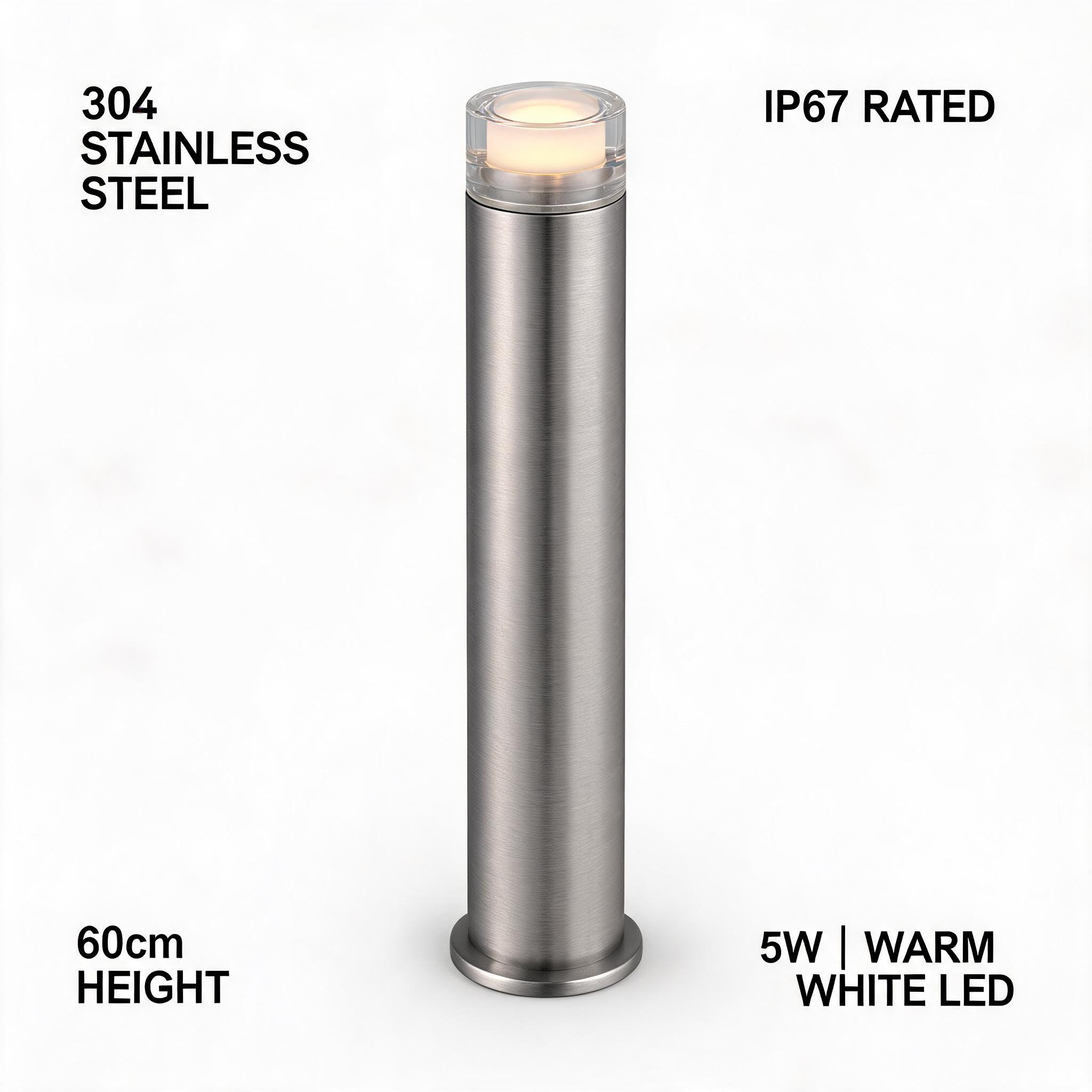
OKELI's bollard range addresses these variables across two height and wattage points. The 60 cm bollard path light at 5W / 500 lm covers standard pathway marking with a 120° beam at 3000K warm white. For low borders, compact courtyards, and accessible pathways where a 60 cm post would protrude above hedging, the 40 cm variant at 3W / 300 lm offers the same 304 stainless construction in a proportionate format. Both share the same tempered glass diffuser and 120° beam, so mixing heights on a single project creates layered path lighting without visual inconsistency.
There is also the 6W LED Garden Path Light, which adds IP65-rated stainless construction with a ground spike and surface mount option — useful for projects that need both soft-surface and hard-paving installation from the same SKU.
IP Rating: What IP67 Actually Buys You
IP ratings are not marketing labels — they describe specific test conditions. Here is what the numbers mean for outdoor bollard lighting:
| Rating | Solids | Water | Practical Meaning for Pathway Lighting |
|---|---|---|---|
| IP54 | Dust-protected | Splash from any direction | Sheltered positions only — covered entrances, under canopies |
| IP65 | Dust-tight | Water jets from any direction | Handles rain and irrigation spray — suitable for most garden paths |
| IP67 | Dust-tight | Submersion to 1 m for 30 min | Survives surface flooding, monsoon pooling, direct irrigation overspray |
The jump from IP65 to IP67 is not incremental. IP67 means the fixture survives temporary submersion — standing water on a pathway after a tropical downpour, irrigation overspray hitting the fixture directly, or surface flooding from a blocked drain. None of that reaches the LED chamber or the photosensor. For projects in monsoon climates, flood-prone sites, or areas with heavy irrigation systems, the difference between specifying IP65 and IP67 is the difference between a maintenance-free fixture and a warranty claim within the first year.
For a deeper comparison of what these ratings mean across landscape lighting categories, see our IP67 vs IP65 landscape lighting guide.
Dusk-to-Dawn Operation: Why Automatic Control Matters
On paper, a light sensor that switches a fixture on at dusk and off at dawn sounds like a minor convenience. In practice, for a resort with 80 pathway bollards, it eliminates two real costs:
First, the labour cost of staff walking the grounds to manually switch fixtures — or worse, not switching them and leaving them burning through daylight hours. Second, the energy waste of fixtures running 14+ hours per day instead of the 10-12 hours of actual darkness. Across a large installation, that energy waste compounds quickly.
All three bollard fixtures in OKELI's range include an integrated photosensor as standard. There is no timer to program, no app to configure, no smart hub to install. The sensor reads ambient light and handles every on/off cycle automatically, across seasonal changes in day length, without any adjustment.
Matching Bollard Height to Project Environment
Bollard height is not just an aesthetic preference — it determines where the light falls and how the fixture reads in the landscape. Here is how to think about it:
- 30 cm — Ground-level marker lighting. Best for solar pathway applications where no wiring is available. See the 304 stainless solar pathway light for a self-contained option.
- 40 cm — Low-profile pathway edge marking. Sits below most hedging and planting borders. The right choice for compact courtyards, children's play paths, accessible pathways, and Japanese-style garden design where proportion matters. See the 40 cm bollard path light.
- 60 cm — Standard pathway and driveway marking. Visible above low planting, provides clear path definition for pedestrians and vehicles. The most common specification for hotel pathways, estate driveways, and commercial walkways. See the 60 cm bollard path light.
On mixed-use projects, combining 40 cm and 60 cm heights creates layered pathway lighting — taller units at intersections and entry points for visibility, lower units along garden borders for subtle edge definition. Because both heights share the same 304 stainless platform, 3000K output, and IP67 rating, the visual language stays consistent across the installation.
LED Lifespan and Maintenance Planning
A 50,000-hour LED lifespan is a number that gets thrown around freely in spec sheets. Here is what it actually means for project planning: at 12 hours of nightly operation, 50,000 hours is approximately 11 years of daily service before the first lamp change. For commercial installations where lamp replacement requires groundwork, lift equipment, or coordination with a property management schedule, that eliminates a re-lamping cycle for the duration of most service contracts.
This matters most on large installations. A 100-unit bollard run across a resort property is not something you want to revisit for lamp replacement in year three. The combination of 304 stainless housing (no coating failure) and 50,000-hour LED (no lamp replacement) is what makes a bollard installation genuinely low-maintenance rather than just marketed as such.
Specifying for Different Project Types
Hotel and Resort Pathways
Coastal resort properties face the harshest combination: salt-air corrosion, irrigation systems, high guest expectations for ambience, and large fixture counts that make manual maintenance impractical. 304 stainless housing eliminates the corrosion failure mode. IP67 sealing handles irrigation and tropical rain. 3000K warm white delivers the hospitality-standard ambience. Automatic dusk-to-dawn operation removes the need for staff intervention.
Residential Estate Driveways
Upscale residential developments need pathway lighting that looks premium and stays premium. Painted steel degrades visibly within a year; 304 stainless maintains its finish indefinitely. The 60 cm height provides clear driveway boundary marking without the institutional look of a taller post light.
Commercial Plazas and Parks
High-footfall commercial environments need fixtures that survive impact, weather, and neglect. The tempered glass diffuser on OKELI's bollard range is impact-rated as well as weather-sealed. The 120° beam provides even coverage across wider walkway widths without the glare that narrower-beam fixtures create for approaching pedestrians.
Common Specification Mistakes to Avoid
1. Specifying IP65 for flood-prone sites. IP65 handles rain and spray, but not standing water. If your site experiences surface pooling after heavy rain, only IP67 will keep the LED chamber dry.
2. Mixing colour temperatures on the same project. 3000K and 4000K bollards on the same pathway create a visible colour clash that looks unprofessional. Specify one colour temperature across the entire installation.
3. Choosing bollard height based on appearance alone. A 60 cm bollard in a low garden border overshoots the planting and looks out of proportion. A 40 cm bollard on a wide commercial walkway may not provide adequate path definition. Match height to the landscape context, not to a catalog photo.
4. Ignoring the photosensor. Fixtures without automatic control will either waste energy running during daylight or require manual switching labour. On a 50-unit installation, that labour cost exceeds the fixture cost within months.
What to Ask a Supplier Before Ordering
When evaluating bollard light suppliers for a project, these questions separate manufacturers from resellers:
- What is the actual housing material — solid stainless, or coated steel marketed as "stainless finish"?
- What is the tested IP rating, and can the supplier provide certification documentation?
- Is the photosensor integrated, or does it require a separate control system?
- What is the LED lifespan rating, and what is the warranty structure (piece-for-piece replacement vs. repair)?
- Are custom heights, finishes, and private-label packaging available above MOQ?
- What certifications apply to the destination market (CE, ETL, RoHS)?
OKELI manufactures under ISO 9001 quality management from a 35,000 m² facility. CE, ETL, and RoHS certifications are available — specify your destination market when enquiring. MOQ is 100 pcs for standard configurations, with custom heights from 30 cm to 100 cm, alternative finishes, and private-label packaging available above MOQ. Sample orders ship in 7-10 business days; bulk production runs at 40-45 business days from order confirmation.
Complementary Lighting for a Complete Pathway Scheme
Bollard lights define the path edge, but most pathway lighting projects need complementary fixture types. For a complete outdoor lighting scheme, consider combining bollard path lights with:
- Landscape spotlights for tree uplighting and feature accents — see our 10W landscape spotlight or the 20W variant for mid-range subjects.
- Solar pathway lights for remote sections where trenching is impractical — the 304 stainless solar pathway light offers zero-wire installation with the same material quality.
- Step and deck lights for level changes along the pathway — the 3W recessed step light installs flush with stair risers.
Browse the full OKELI LIGHTING catalog or explore our product range for additional outdoor lighting options. For more sourcing guides and technical articles, visit our news section.
Next Steps
If you are planning a pathway lighting project, the most efficient next step is to request samples for pre-production approval. Share your project type, fixture count, destination market, and any custom specification requirements — our technical team responds within one business day with pricing, MOQ confirmation, and lead time.
For more context on material selection beyond 304 stainless, see our bollard light material comparison guide. For commercial pathway specification specifically, the commercial pathway bollard selection guide covers project-level decisions in more detail.
To explore the complete OKELI product range or request a project quote, contact our team today.