A wholesale buyer's guide to commercial outdoor string lights: construction differences, channel-specific specifications, supplier evaluation questions, MOQ and logistics, and common buying mistakes.
Why Commercial String Lights Are a Different Product
Walk down any restaurant street in Austin, Barcelona or Sydney and you are looking at the fastest-growing category in outdoor lighting: commercial string lights. But the sets hanging over those patios are not the string lights sold in gift shops. Commercial-grade product differs in four ways that matter enormously once the lights are up for a season: cable construction, socket sealing, LED quality and electrical certification. This guide is for distributors, installers and venue operators who need to buy the real thing — and evaluate who to buy it from.
What Separates Commercial Grade from Consumer Grade
Four construction details do the separating:
- Cable: Commercial sets use UV-stabilized PVC or rubber-jacketed cable that survives years of sun without chalking or cracking. Consumer cable goes brittle in one or two summers — the number-one failure mode in returned product.
- Sockets: Sealed, weatherproof sockets with gasketed fits. Open sockets collect water, corrode contacts and create intermittent faults that are miserable to diagnose on a 30-meter run.
- LEDs: Commercial sets specify LEDs rated 25,000–50,000 hours with consistent color temperature across the run. Cheap sets mix bins, so one string visibly shifts color along its length.
- Rating: IP65 minimum for permanent outdoor installation. Anything less is a fair-weather product.
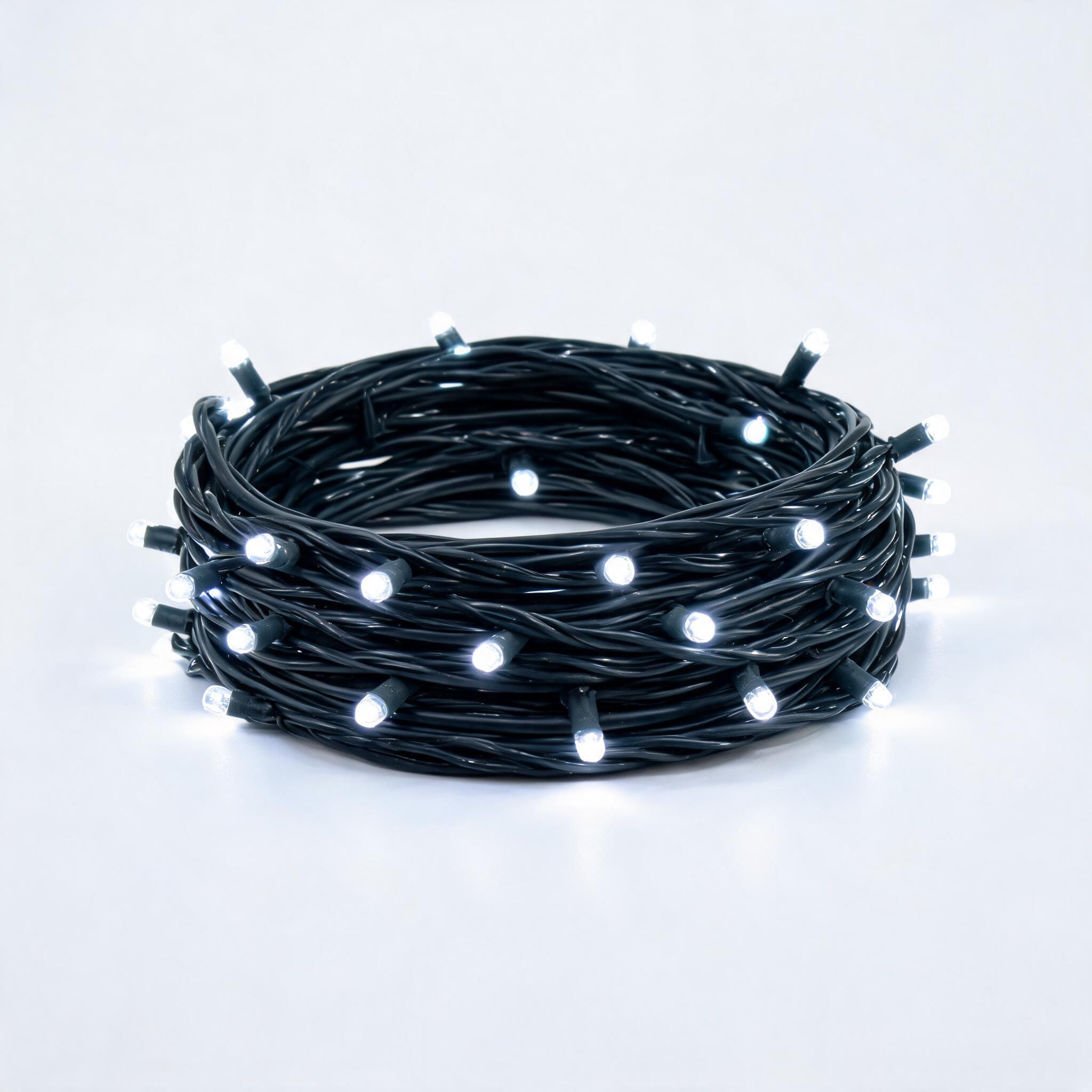
Our 100-LED warm white commercial string light and cool white commercial version — 10 meters, IP65, UV-resistant PVC — are representative of the specification tier this guide covers.
The Market Opportunity, in Numbers
For distributors weighing the category: commercial string lights combine high seasonal demand peaks (November–December and northern-hemisphere summer) with near-zero running cost for the end user — a 10W set costs about $4 a year to operate, as we break down in our running cost analysis. That combination — dramatic visual impact, trivial operating cost, and replacement-driven repeat sales — is why the category keeps expanding in hospitality, municipal and residential-prosumer channels.
Specifying for Your Channel
Different channels need different specifications:
- Hospitality (restaurants, hotels, venues): IP65, UV-stabilized cable, warm white 2700–3000K, dimmable drivers where ambiance control matters, and replaceable-socket designs for long service life.
- Municipal and events: Heavy-duty cable, high tensile strength for long spans, and consistent color across large installations. Cool white 6500K for modern streetscapes; warm white for plazas and markets.
- Residential prosumer / retail: The commercial spec at consumer-friendly lengths (10m is the volume sweet spot), with packaging that communicates the durability difference — that story is the margin.
Evaluating a String Light Supplier
The string light category is crowded with traders repackaging whatever is cheapest. Separate manufacturers from resellers with these questions:
- Cable specification: What is the jacket material and UV stabilization? Is there a UV aging test report?
- Socket construction: Sealed with what gasket design? What is the IP rating and its test evidence?
- LED sourcing and binning: Single color bin across a production run? What is the rated lifespan?
- Electrical certification: CE/UKCA/ETL as relevant to your market — ask for certificate numbers, not logos.
- Customization: Lengths, LED spacing, color temperature, plug types for target markets, private-label packaging.
- Sample policy: Will they send production-line samples, not showroom specials?
A manufacturer like OKELI LIGHTING publishes full specifications on every product page and supports OEM/ODM customization — plug types, lengths, color temperatures and packaging — because distributors need product that matches their market's sockets, voltages and aesthetics, not a one-size export SKU.
Logistics and Ordering Considerations
String lights are volumetric rather than heavy, which makes freight efficiency a real cost lever. Ask suppliers about co-packed cartons, and whether LED spacing and reel lengths can be tuned to reduce wasted packaging volume. Typical MOQs from established factories run 100–500 sets depending on customization level; lead times of 25–40 days are standard for production runs, longer for fully custom tooling. Order samples from the actual production line before committing, and age-test them outdoors for two weeks minimum — a balcony test catches UV and sealing failures that a desk inspection never will.
Common Buying Mistakes
Three mistakes cost distributors real money in this category. First, buying on price per meter without checking cable UV stabilization — the sets fail in the field and poison the channel's repeat business. Second, ignoring plug and voltage compatibility for the destination market — 220V European plugs do not sell in North American channels, and vice versa. Third, skipping the sample stage because "it's just string lights" — the difference between a good and bad set is invisible in a product photo and obvious in week three outdoors.
Frequently Asked Questions
What makes string lights "commercial grade"? UV-stabilized cable, sealed weatherproof sockets, single-bin LEDs rated 25,000+ hours, and IP65+ rating. Any set missing one of these is consumer product at a commercial price.
What MOQ should I expect when importing string lights? 100–500 sets from established manufacturers depending on customization; lower for stock configurations, higher for private-label tooling.
Can I get custom lengths and plug types? Yes, from manufacturers with OEM/ODM capability. Confirm plug certification for your destination market early — it affects lead time.
Warm white or cool white for commercial installations? Warm white (2700–3000K) for hospitality and plazas; cool white (6500K) for modern streetscapes and security-adjacent applications. Consistency across the installation matters more than the choice itself.
How long do commercial LED string lights last? The LEDs are rated 25,000–50,000 hours; the practical lifespan is decided by cable and socket durability, which is exactly why those components deserve the most scrutiny when comparing suppliers.
Request a Wholesale Quote
If you are building a string light program for distribution, hospitality or municipal channels, send your target specification — length, LED count, color temperature, plug type, packaging — and request production samples. Compare the warm white and cool white commercial sets for reference specifications, browse the full OKELI product range, and read more procurement guides in the news section.