A B2B procurement guide to UV-resistant LED string lights for permanent outdoor installation, covering UV-stabilised PVC cable, IP65 connectors, surge protection, colour temperature selection, and bulk procurement considerations.
Commercial Outdoor String Lighting - B2B Procurement Guide
UV-Resistant LED String Lights for Commercial Outdoor Use: What B2B Buyers Need to Know
Outdoor string lights are the highest-volume lighting product in hospitality and retail fit-out. A single hotel chain may specify thousands of strings across multiple properties. When those strings fail after one season - and many do - the replacement cost, labour cost, and guest experience damage add up fast. The two causes of premature failure are consistent across every project: UV degradation of the cable and moisture ingress at the connectors. Both are preventable at the specification stage, but only if the buyer knows what to ask for.
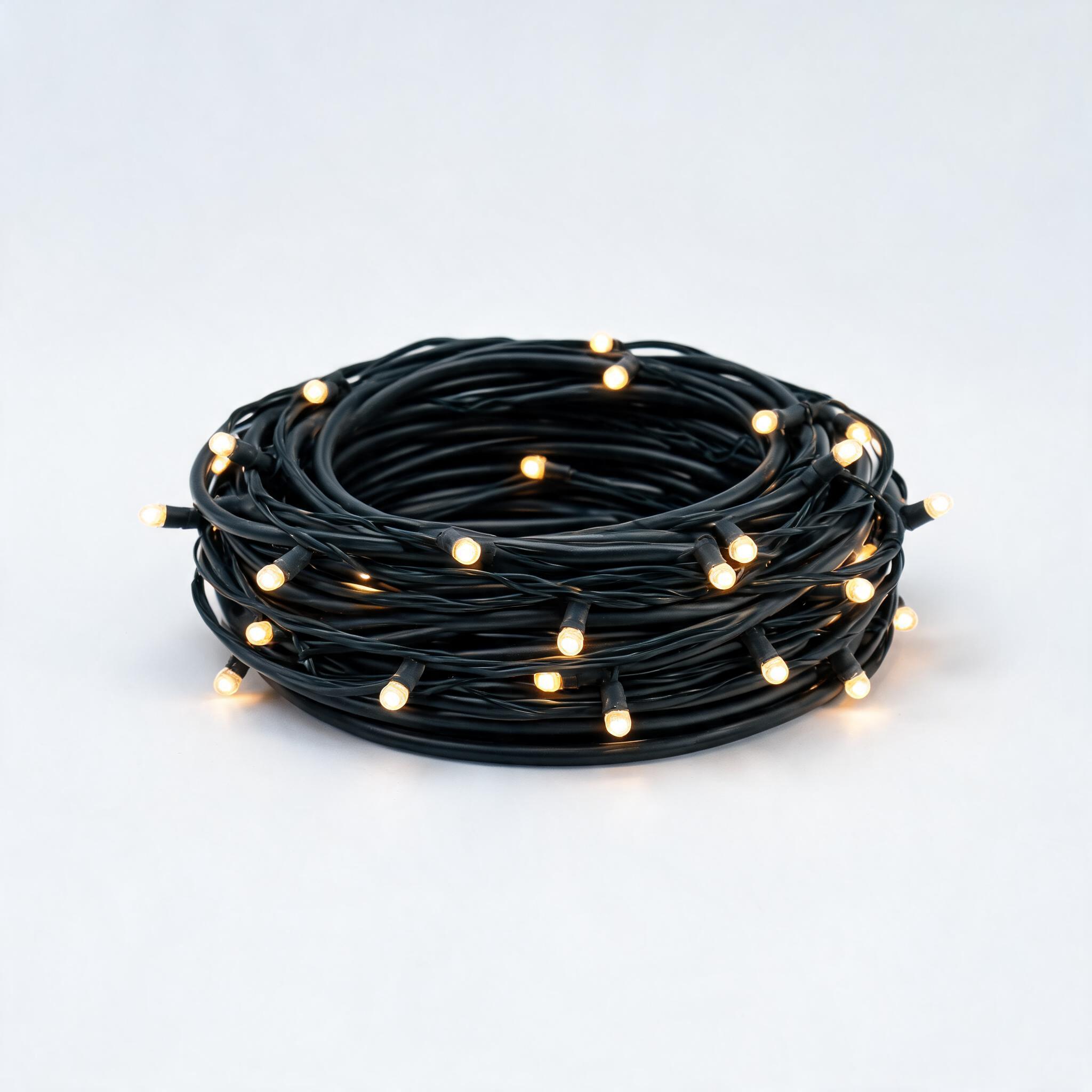
This guide covers what B2B buyers need to specify when sourcing LED string lights for permanent outdoor installation: UV-resistant cable material, IP65 connector sealing, surge protection, colour temperature selection, and bulk procurement considerations. We will reference OKELI's 9;s 3000K warm white and 6500K cool white string lights throughout - both share UV-resistant PVC cable, IP65 connectors, and built-in surge protection.
Key takeaway: Three specifications determine whether outdoor string lights survive permanent installation: UV-stabilised PVC cable (not standard PVC), IP65-rated connectors (not unsealed slip-on sockets), and built-in surge protection (not an optional add-on). If a supplier cannot confirm all three in writing, the product is not rated for permanent outdoor use.
The UV Degradation Problem - Why Cable Material Matters
Standard PVC cable contains plasticisers that evaporate under UV exposure. The process is invisible at first - the cable looks fine for the first few months. Then it starts to yellow. Then it becomes stiff. Then it cracks. Once the cable cracks, water enters along the conductor path and the string fails section by section from the crack point outward.
This failure mode is the number one reason outdoor string lights get replaced after one or two seasons. It is also entirely preventable.
UV-stabilised PVC includes UV inhibitors that absorb or reflect UV radiation before it reaches the polymer chains. The cable retains flexibility, insulation integrity, and mechanical strength after years of direct sun exposure. The cost difference between standard PVC and UV-stabilised PVC at the manufacturing level is small - but the difference in service life is measured in years, not months.
For B2B buyers specifying string lights for permanent installation, the question is straightforward: ask the supplier to confirm UV-stabilised PVC cable in writing. If they cannot, or if the specification says only "PVC" without the UV stabiliser qualifier, the product is manufactured for seasonal use, not permanent installation.llation.
OKELI's 9;s warm white and cool white string lights both use UV-stabilised PVC cable rated for permanent outdoor exposure.
IP65 Connectors - Sealing the Weakest Point
Connectors are the weakest point in any outdoor string light system. The cable itself is continuous and sealed. The LED sockets are moulded. But the connectors - where strings link together or connect to the power supply - are joints. Joints are where water enters.
Unsealed connectors rely on a friction fit between mating halves. Rain, condensation, and irrigation overspray can penetrate the gap between connector halves and reach the electrical contacts. Once corrosion starts on the contacts, resistance increases, the connection heats up, and the string fails at that point.
IP65-rated connectors solve this. The "6" means complete dust exclusion - no particulate matter can enter the connector body. The "5" means protection against water jets from any direction - rain, splashing, and pressure washing cannot reach the contacts. The connector uses a sealed threaded or bayonet coupling with an O-ring gasket that compresses when connected. when connected.
For commercial projects, the practical difference is this: unsealed connectors fail within the first wet season. IP65 connectors last the life of the string. The cost of upgrading from unsealed to IP65 at the specification stage is negligible compared to the cost of replacing a failed string installation.
Surge Protection - The Silent Killer in Developing Markets
Voltage spikes are the second most common cause of string light failure, and they are invisible. A spike lasts milliseconds - too fast to see and too fast for a circuit breaker to trip. But the spike passes through the LED driver, overheats a junction, and the driver fails. The string goes dark. There is no visible damage. The failure looks random.
Sources of voltage spikes in outdoor installations:
- Grid switching: Utility load switching creates transient overvoltages that travel through the supply line to connected fixtures.
- Lightning proximity: A lightning strike within 1 km can induce a voltage spike in outdoor cabling, even without a direct hit. The electromagnetic pulse couples into the string light wiring.
- Load switching on site: Air conditioning compressors, pumps, and other inductive loads on the same circuit generate spikes when they switch on and off.
- Unstable grid supply: In markets with variable grid quality - common in Southeast Asia, South Asia, Africa, and parts of Latin America - voltage fluctuations are frequent and severe.
Built-in surge protection absorbs these transients before they reach the LED drivers. The protection device clips the spike to a safe voltage level, dissipating the excess energy as heat. OKELI includes surge protection as standard in both the warm white and cool white string light variants - not as an optional upgrade.
Colour Temperature - Warm White vs Cool White for Commercial Applications
The choice between 3000K warm white and 6500K cool white is not aesthetic preference - it determines what the string light is suited for. OKELI offers both variants on the same platform:
| Specification | 3000K Warm White | 6500K Cool White |
|---|---|---|
| Visual Tone | Soft amber, incandescent-like | Crisp daylight, bright white |
| Primary Use Case | Hospitality dining, ambience, atmosphere | Retail display, visibility, functional |
| Food Rendering | Makes food look appetising | Accurate but clinical |
| Typical Buyer | Hotel, restaurant, wedding venue | Market stall, retail pop-up, commercial perimeter |
| Perceived Brightness | Lower (warm tones read as softer) | Higher (cool tones read as brighter) |
For most hospitality applications - hotel terraces, restaurant pergolas, resort walkways, wedding venues - 3000K warm white is the correct specification. It creates the ambience that guests expect and renders food and natural materials in flattering tones.
For functional applications - market stalls, outdoor retail displays, commercial perimeter lighting - 6500K cool white provides higher perceived brightness and more accurate colour rendering for product display. It is also the preferred choice for modern minimalist architectural environments where warm white would look out of place.
On mixed-use projects, both variants can be specified together. They share the same connector type, cable specification, and linkable design. A common configuration: warm white in dining and lounge zones, cool white in service and display zones.
Technical Specifications That Affect Bulk Procurement
When sourcing string lights in commercial quantities, several specifications affect not just performance but procurement logistics:
- LED count and spacing: 100 LEDs at 10cm spacing on 10m of cable is the commercial standard. Closer spacing (5cm) produces a denser light effect but uses more LEDs per metre, increasing cost. Wider spacing (15cm) is cheaper but creates visible dark gaps between LEDs.
- Total power draw: 50W per 10m string is typical. This matters for circuit design - a 220V circuit rated at 10A can theoretically support 44 strings (4,400W), but practical limits including surge margin and voltage drop over long runs reduce this. Consult an electrician for runs exceeding 50m.
- Linkable design: Strings that link end-to-end simplify installation for runs longer than 10m. Each string has a male connector at one end and a female at the other. Maximum linked run depends on cable cross-section and supply voltage.
- Operating voltage: 220V AC direct operation is standard for most global markets. For 110V markets (North America, parts of Latin America), confirm voltage compatibility before ordering.
- LED lifespan: 30,000+ hours rated life means the LEDs themselves are not the failure point. The cable, connectors, and driver are. This is why UV resistance and IP65 sealing matter more than LED quality for outdoor longevity.
Common Procurement Mistakes
1. Specifying seasonal-grade lights for permanent installation
Many string lights on the market are manufactured for seasonal use - Christmas decorations, temporary event lighting, party supplies. These products use standard PVC (not UV-stabilised), unsealed connectors, and no surge protection. They are not rated for permanent outdoor exposure. Using them in a hotel or restaurant installation guarantees failure within one season.
2. Ignoring connector ratings
Buyers often focus on LED count, colour temperature, and cable length but overlook the connector specification. The connector is the single most common failure point. Always specify IP65-rated connectors for outdoor installations.
3. Not accounting for voltage drop on long runs
When linking multiple strings end-to-end, voltage drops along the cable. The LEDs at the far end of the run receive less voltage and appear dimmer. For runs exceeding 30m, consider a parallel wiring configuration instead of a single daisy-chained run. Consult an electrician for installation design on long runs.
4. Ordering without surge protection in developing markets
In markets with unstable grid supply, surge protection is not optional. Without it, expect driver failures within the first wet season. The cost of surge-protected strings is marginally higher; the cost of replacing failed strings across a multi-site installation is not marginal.
OKELI String Light Specifications
Both colour temperature variants share these specifications:
- LED count: 100 LEDs per string
- String length: 10 m
- LED spacing: 10 cm
- Total power: 50W
- Cable material: UV-Resistant PVC
- Connector rating: IP65
- Operating voltage: 220V AC (110V available on request)
- Surge protection: Built-in (standard, not optional)
- LED lifespan: 30,000+ hours
- Linkable: Yes
- Custom options: Length, LED count, spacing, colour temperature, RGB, private-label packaging
OKELI LIGHTING has manufactured outdoor lighting since 2009 from a 35,000 m² ISO 9001-certified facility. Products carry CE, ETL, and RoHS certifications. The company supports OEM/ODM programmes with custom string lengths, LED counts, spacing, colour temperatures (2700K, 4000K, RGB), and private-label packaging above MOQ. Samples are available - lead time 7–10 business days; bulk production 40–45 business days.
Frequently Asked Questions
Can strings be linked for runs longer than 10 metres?
Yes. Strings are linkable end-to-end. Maximum recommended linked run depends on cable cross-section and local supply voltage. Contact us with your project run length and we will advise on configuration and any additional power feed points needed.
What is the difference between UV-resistant PVC and standard PVC?
UV-stabilised PVC contains inhibitors that prevent UV radiation from breaking down the polymer chains. Standard PVC yellows, hardens, and cracks within 1–2 seasons of direct sun exposure. UV-stabilised PVC retains flexibility and insulation integrity for years. The cost difference is small; the service life difference is significant.
Are cool white and multicolour options available?
Yes. 6500K cool white, 4000K neutral white, and RGB multicolour variants are available on request. The warm white (3000K) and cool white (6500K) variants are stocked as standard.
What is the minimum order quantity?
MOQ is 100 pcs for standard configurations. Custom lengths, LED counts, or packaging may carry a higher MOQ. Contact our sales team with your project volume for a specific quote.
Do these lights work in 110V markets?
110V variants are available on request. Specify your destination market when enquiring. The 220V version is standard production.
Can I get samples for specification approval?
Yes. Samples are available for pre-production approval. Lead time is 7–10 business days. Contact us for sample pricing and courier options.
Sourcing LED string lights for a commercial project? Share your installation type, quantity, colour temperature preference, and destination market. OKELI's technical team will confirm specifications, pricing, and lead time within one business day. ay. Contact us here.