
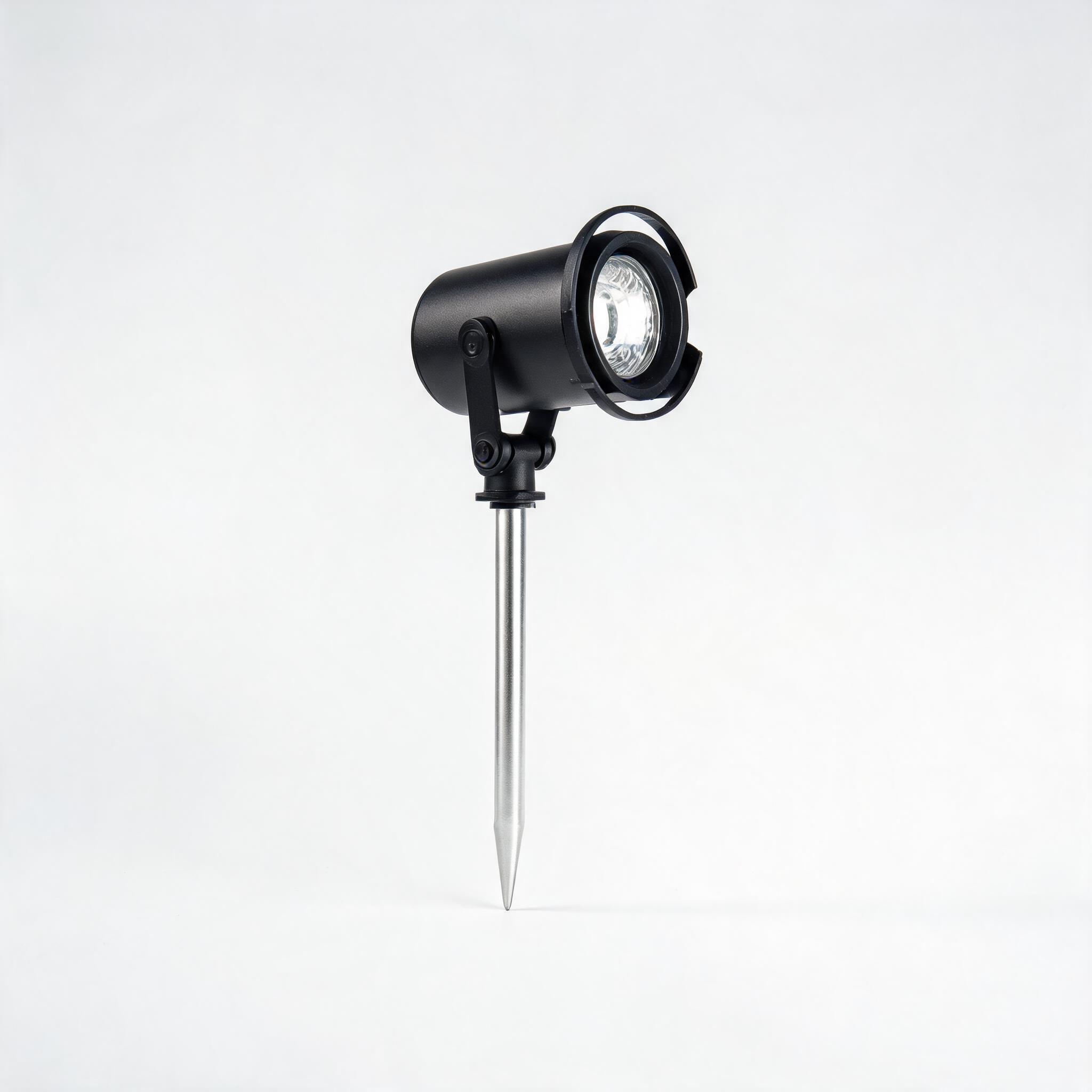
A practical wattage selection guide for LED landscape spotlights - comparing 10W (800lm), 20W (1,600lm), and 50W (4,000lm) fixtures by application zone, subject height, and project type. Includes a mixed-wattage project specification example and common sourcing mistakes.
Landscape Spotlight Wattage Guide
Specifying landscape spotlights is not about picking the brightest fixture. It is about matching wattage to the subject - the tree, the wall, the column, the sculpture in front of you. Too much wattage on a small residential garden shrub washes out the scene and creates glare complaints from neighbours. Too little wattage on a 10-metre mature oak leaves the canopy dark and the lighting design looking unfinished. The gap between an 800-lumen fixture and a 4,000-lumen fixture is not subtle. It is the difference between a fixture that accents and one that dominates.
This guide breaks down the three core wattages in the OKELI landscape spotlight range - 10W (800 lm), 20W (1,600 lm), and 50W (4,000 lm) - and maps each to the project zones where it performs best. If you source landscape lighting for hotels, residential estates, municipal projects, or mixed-use developments, this is the framework your spec sheet should follow.
In this guide:
Why Wattage Selection Is the First Sourcing Decision
Before beam angle. Before colour temperature. Before IP rating. Wattage comes first because it determines whether the fixture can physically reach the subject with enough light. A perfectly specified IP67, 3000K, adjustable-beam spotlight is useless if it cannot throw enough lumens to illuminate the tree it was bought for.
The mistake we see most often from buyers new to landscape lighting is purchasing one wattage across an entire project. A resort orders 200 units of 20W spotlights because 20W seemed like a safe middle ground. The result: the entrance feature tree - a 12-metre royal palm - looks under-lit because 1,600 lm cannot reach the canopy from ground level. Meanwhile, the garden border shrubs are overlit, creating hot spots that ruin the ambience the landscape architect designed. Two zones, two different needs, one SKU - and a project that does not look right.
The correct approach is to divide the site into zones by subject height and area, then assign wattage per zone. This guide gives you the framework to do that.
Quick Comparison: 10W vs 20W vs 50W
All three wattages share the same die-cast aluminum housing platform, IP67 sealing, continuously adjustable 15°–60° beam, and integrated 220V transformer. The difference is output and the zone each one serves.
| Specification | 10W | 20W | 50W |
|---|---|---|---|
| Luminous Flux | 800 lm | 1,600 lm | 4,000 lm |
| Efficacy | ~80 lm/W | ~80 lm/W | ~80 lm/W |
| Effective Reach | 2–4 m | 4–7 m | 8–12 m |
| Best Subject Height | Up to 3 m | 3–6 m | 6–10 m+ |
| Typical Application | Garden accents, small signage, patio borders | Mid-height trees, entrance columns, courtyard features | Mature trees, wide facades, commercial plazas |
| Project Type | Residential, boutique hotel | Hotel, resort, residential estate | Commercial, civic, large resort |
| Beam Angle | 15°–60° continuously adjustable (all three) | ||
| Ingress Protection | IP67 (all three) | ||
| Housing | Die-cast aluminum, powder-coat (all three) | ||
| LED Lifespan | 50,000 hours (all three) | ||
| Warranty | 3 years (all three) | ||
The key takeaway: efficacy is identical across the range (~80 lm/W). You are not paying for efficiency differences. You are paying for raw output matched to the subject scale.
10W - The Residential and Boutique Commercial Zone
The 10W spotlight produces 800 lm. That is enough light for subjects up to 3 metres - garden specimen plants, low walls, small signage panels, terrace borders, and architectural features in compact courtyards. It is not enough for a 5-metre tree, and it will not graze a building facade with any meaningful coverage.
Where the 10W excels is precision. On a boutique hotel courtyard with a single sculptural plant, 800 lm creates a controlled pool of warm white light that draws the eye without flooding the space. The same fixture on a 50W setting would overpower the scene, turning an intimate courtyard into a car park.
Typical 10W applications:
- Residential garden features - specimen plants, stone ornaments, water features under 2m
- Boutique hotel courtyards - intimate spaces where atmosphere matters more than illumination level
- Small retail signage and entrance features - brand lighting that flatters without overpowering
- Terrace and patio borders - low-level accent integrated into hardscape
- Golf course putting greens - subtle feature lighting on course architecture
The 10W is also the right choice when you need to light multiple small subjects close together. Three 10W fixtures on three garden features give you three distinct light pools. One 50W fixture in the same position gives you one blown-out hot spot.
20W - The Mid-Range Sweet Spot
The 20W spotlight at 1,600 lm is the most versatile unit in the range. It covers the zone that most projects actually need: medium-height trees (4–7m canopy), single-storey building features, entrance columns, courtyard focal points, and water feature surrounds. If you could only stock one wattage for an entire mixed-use development, the 20W would be it.
The 20W bridges the gap between residential subtlety and commercial power. It has enough reach to uplight a 6-metre palm tree from ground level. It is not so powerful that it overwhelms a hotel courtyard. For landscape contractors who handle both residential and light commercial projects, the 20W is the SKU that works across the most job types.
Typical 20W applications:
- Hotel courtyards and resort entrances - mid-height palm trees, entrance columns, water feature surround lighting
- Residential estate driveways - tree uplighting along drive borders, gate pillars, boundary feature walls
- Retail and F&B outdoor areas - entrance canopy lighting, outdoor dining perimeter, signage uplightingting
- Municipal parks and public gardens - feature tree uplighting, path border accents, sculpture lighting
- Golf clubhouses and sports facilities - entrance feature lighting, car park perimeter landscape lighting
Specifying tip: For a hotel entrance with a 5-metre feature tree flanked by two 3-metre columns, use one 20W on the tree (narrowed to 25° beam) and two 10W units on the columns. This gives balanced illumination where each subject is lit proportionally. Using three 20W units would flatten the scene - the columns would be as bright as the tree, destroying visual hierarchy.
50W - The Commercial and Civic Zone
The 50W spotlight at 4,000 lm exists for subjects that the 20W physically cannot reach. Mature trees above 8 metres. Wide building facades. Large commercial entrance features. Monument uplighting. Civic plaza sculptures. These are applications where under-lighting is not a design choice - it is a project failure.
One 50W fixture replaces two or three 20W units on large subjects. That means fewer ground stakes, fewer cable runs, fewer maintenance access points, and a cleaner installation footprint. On a commercial plaza with a 10-metre specimen oak, clustering three 20W fixtures around the base is more expensive and more visually cluttered than a single 50W unit set back at the correct throw distance.
Typical 50W applications:
- Commercial plazas and mixed-use developments - mature tree uplighting, water feature accents, entrance feature lighting
- Government and civic buildings - facade illumination, monument and sculpture uplighting
- Large hotel and resort grounds - high-canopy tree lighting, building facade grazing, resort entrance features
- Sports parks and recreational facilities - perimeter feature lighting, spectator area accents
- Retail high streets and shopping centres - exterior brand lighting, large-scale facade wash
Specifying Mixed-Wattage Projects
Real projects rarely need a single wattage. A resort property might have a 10-metre entrance palm (50W), a row of 5-metre courtyard olives (20W), and low garden border accent points (10W). Because all three wattages share the same die-cast aluminum housing, the same IP67 sealing, and the same adjustable beam mechanism, they look visually consistent on site. A guest walking through the property sees one fixture family, not three different products.
This platform consistency is a procurement advantage. One supplier, one warranty framework, one spare parts inventory, one installation training protocol. For contractors bidding on multi-zone projects, it simplifies the bid and reduces post-installation support complexity.
Here is a sample wattage specification for a hypothetical 4-star resort project:
| Zone | Subject | Wattage | Qty | Beam Setting |
|---|---|---|---|---|
| Entrance | 12m royal palm | 50W | 2 | 25° narrow |
| Entrance | Building facade columns | 20W | 4 | 40° medium |
| Courtyard | 5m olive trees | 20W | 6 | 30° narrow-medium |
| Garden border | Specimen shrubs | 10W | 12 | 45° medium-wide |
| Pool deck | Water feature | 20W | 2 | 60° wide wash |
| Pathway accent | Stone ornaments | 10W | 4 | 25° narrow |
Total: 30 fixtures across three wattages. One visual platform. One procurement line. One warranty framework.
Common Wattage Mistakes and Their Cost
Over five years of supplying landscape spotlights to commercial projects, the same specification errors appear repeatedly. Each one has a cost - either in re-purchasing, re-installation, or client dissatisfaction.
Mistake 1: Over-wattage on small subjects. A 50W fixture on a 2-metre garden shrub creates a hot spot visible from 50 metres away. The fix is replacing with 10W units - which means re-purchasing, re-installing, and potentially re-wiring if the circuit was sized for fewer fixtures.
Mistake 2: Under-wattage on tall subjects. A 20W fixture on a 10-metre tree produces a dim glow on the lower trunk and nothing on the canopy. The tree looks like it has a flashlight pointed at its base. The fix is either adding more 20W units (clustering) or replacing with 50W. Both involve additional procurement and installation labour.
Mistake 3: Single-wattage specification across mixed zones. Ordering 200 units of one wattage because it simplifies procurement. The installation looks flat - every subject lit to the same intensity regardless of size or distance. The landscape architect's layered lighting design is lost.ost.
Mistake 4: Ignoring beam angle interaction with wattage. A 50W fixture at 60° (wide flood) produces a different result than the same fixture at 15° (narrow spot). High wattage + wide beam = area wash. High wattage + narrow beam = intense accent. Specifying wattage without also specifying beam angle leads to fixtures that are technically "correct" in output but wrong in distribution.ibution.
FAQ
Can I dim the 50W spotlight to achieve 20W output?
No. LED spotlights in this category are not dimmable by default. Dimming would require a compatible driver and control system, which adds cost and complexity. The correct approach is to specify the right wattage for the zone rather than trying to dim a higher-wattage fixture.
How many 10W fixtures equal one 50W fixture in light output?
By raw lumen count, five 10W fixtures (5 × 800 lm = 4,000 lm) match one 50W fixture (4,000 lm). But lumens are not the whole story. Five fixtures create five light sources with five shadows and five installation points. One 50W fixture creates a single, clean light source. For uplighting a tall tree, one 50W is almost always preferable to five 10W units clustered at the base.
Are all three wattages available in 3000K warm white?
Yes. 3000K warm white is the standard colour temperature across the entire range. 2700K and 4000K are available on request for all three wattages. Colour temperature consistency across wattages is important for mixed-zone projects - you do not want a 3000K 20W fixture next to a 4000K 10W fixture on the same site.
What is the maximum installation distance from the fixture to the subject?
As a rule of thumb: 10W reaches 2–4m, 20W reaches 4–7m, 50W reaches 8–12m. These are practical ranges for meaningful illumination, not absolute maximums. At the far end of each range, the beam will be visibly weaker. For subjects at the boundary between two wattages (e.g., a 4m tree), either wattage can work - choose based on whether you want a brighter or softer effect.
Can I mix 10W, 20W, and 50W on the same electrical circuit?
Yes. All three wattages operate on 220V AC with integrated transformers. They can share the same circuit. Total load is the sum of individual wattages - 30 fixtures across mixed wattages (as in the resort example above) draw approximately 500W total, well within a standard landscape lighting circuit.
Need Help Specifying Your Project?
Share your site plan, subject heights, and zone layout. Our technical team will build a wattage specification across the 10W/20W/50W range - including beam angle settings and fixture counts - within one business day.
Request a Specification