
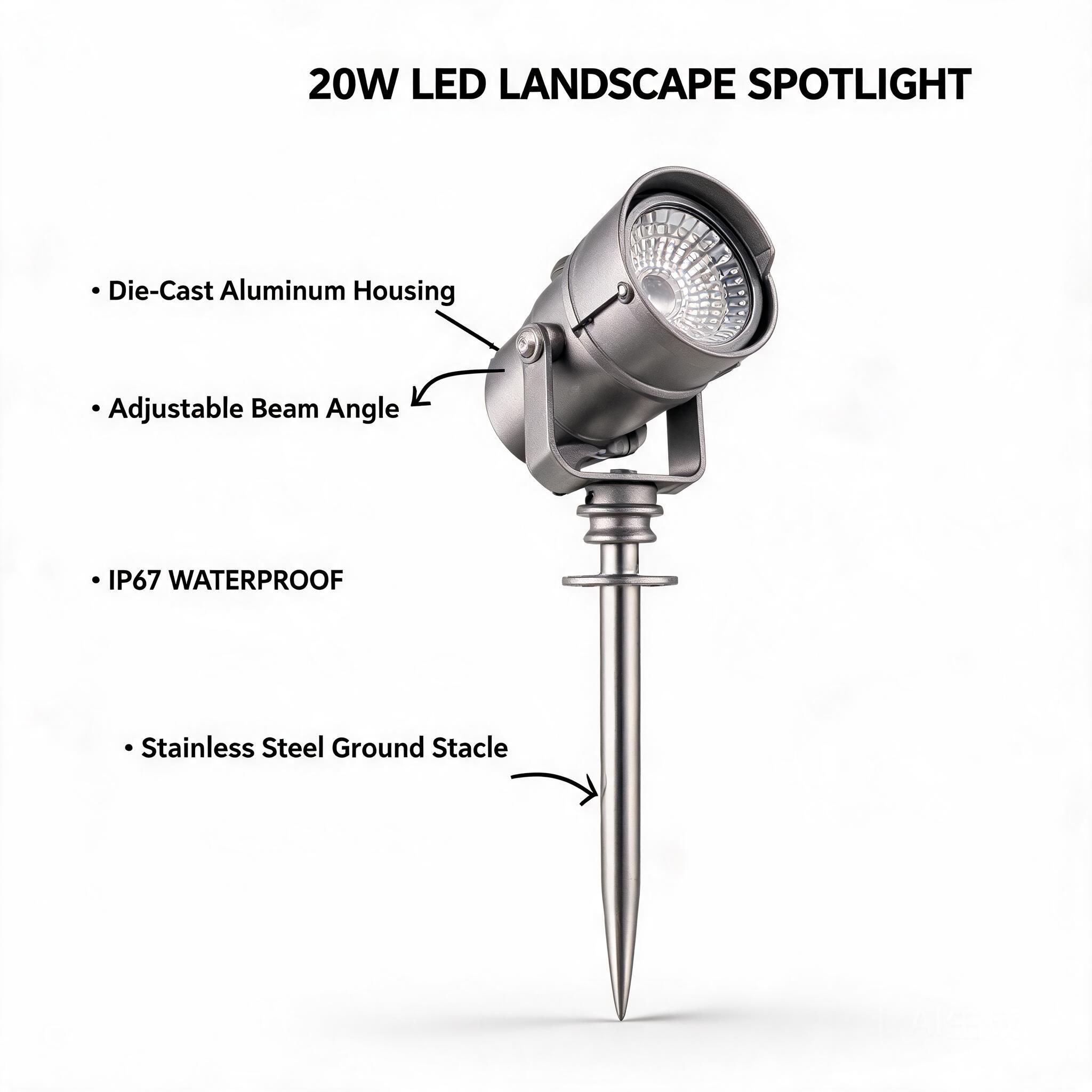
A practical guide to IP ratings for landscape lighting: what IP65 and IP67 actually handle, real-world water ingress failure modes, how to match IP rating to installation environment, and why OKELI specifies IP67 as standard for ground-mounted fixtures.
Waterproof Rating Guide for Landscape Lighting
IP67 vs IP65 Landscape Lighting: What Buyers Need to Know
The IP rating on a landscape spotlight datasheet looks like a minor technical detail. It is not. For ground-mounted fixtures exposed to irrigation, storm drainage, and surface flooding, the difference between IP65 and IP67 determines whether the fixture survives its first rainy season or becomes a warranty claim within six months of installation.
This guide explains what IP ratings actually mean for landscape lighting, how to match the rating to the installation environment, and why the cost difference between IP65 and IP67 at the manufacturing stage is marginal but the field performance difference is significant.
What This Guide Covers
- 1. How IP ratings work: Breaking down the two digits
- 2. IP65: What it handles and what it does not
- 3. IP67: The submersion threshold that matters for ground-mounted fixtures
- 4. Real-world failure modes: What happens when water gets in
- 5. Matching IP rating to installation environment
- 6. Why OKELI specifies IP67 as standard across landscape spotlights
- 7. IP rating and warranty: What the fine print means
1. How IP Ratings Work: Breaking Down the Two Digits
IP stands for Ingress Protection. The rating consists of two digits: the first describes protection against solid objects (dust, debris, tools), and the second describes protection against liquids (water, in various forms). For landscape lighting, both digits matter, but the second digit is where the specification decision usually lands.
| First Digit (Solids) | Protection Level | Relevance to Landscape Lighting |
|---|---|---|
| 5 | Dust-protected (some ingress allowed, no harmful deposits) | Acceptable but not ideal; fine dust can accumulate on optical surfaces |
| 6 | Dust-tight (no ingress of any dust) | The correct specification for outdoor fixtures; prevents dust build-up on LED modules and drivers |
| Second Digit (Liquids) | Test Condition | What It Means in the Field |
|---|---|---|
| 4 | Splashing water from any direction | Survives rain splashes but not direct water jets; suitable only for sheltered positions |
| 5 | Water jets (6.3mm nozzle) from any direction | Handles direct rain and garden hose spray; not rated for pressure washing |
| 6 | Powerful water jets (12.5mm nozzle) | Handles pressure washing; good for high-traffic commercial sites |
| 7 | Submersion to 1 metre for 30 minutes | Survives surface flooding and water pooling; critical for ground-mounted fixtures |
| 8 | Continuous submersion beyond 1 metre (manufacturer-specified depth) | For underwater fixtures like pond and pool lights; unnecessary for above-ground landscape lighting |
When a fixture is rated IP65, both digits are high: dust-tight (6) plus water-jet resistant (5). When a fixture is rated IP67, the upgrade is in the second digit: from water-jet resistant (5) to submersible (7). For landscape spotlights mounted on ground stakes, that upgrade matters more than it might seem.
2. IP65: What It Handles and What It Does Not
IP65 is the standard outdoor rating for many landscape lighting products. It handles direct rainfall from any angle, garden hose spray, and irrigation overspray from pop-up sprinklers and drip lines. These are the conditions that most people think of when they hear outdoor lighting.
What IP65 does not handle is surface water pooling. When heavy rain or drainage overflow causes water to pool around the fixture base, IP65 sealing does not prevent water from entering through the cable gland or stake mounting point. This is the most common failure mode for ground-mounted landscape fixtures rated IP65. Similarly, if a storm drainage system backs up and the fixture is submerged for even a few minutes, IP65 sealing is not rated to prevent water ingress. And the high-pressure jet from commercial cleaning equipment exceeds the IP65 test condition and can force water past the seals.
For wall-mounted or ceiling-mounted fixtures positioned above ground level, IP65 is often sufficient. The fixture is above the water line during normal weather events. For ground-mounted landscape spotlights, IP65 leaves a gap that shows up as field failures within the first one to two seasons.
3. IP67: The Submersion Threshold That Matters for Ground-Mounted Fixtures
IP67 adds submersion protection to 1 metre for 30 minutes. For a landscape spotlight mounted on a ground stake, this rating addresses the exact failure mode that IP65 misses: water pooling around the fixture base during heavy rain, drainage overflow, or irrigation system malfunction.
Consider a typical landscape spotlight installation: the fixture is mounted on a ground stake, with the LED head 30 to 60 cm above ground level and the cable gland and driver compartment at or below ground level. During a tropical downpour producing 50 mm of rain in an hour, surface water can easily pool 5 to 10 cm deep around the stake base. If the drainage is imperfect, which it often is in planted areas where soil compaction varies, that pooling can persist for 30 minutes or more.
An IP65 fixture in this scenario may allow water to enter through the cable gland, the stake mounting joint, or the bezel seal under hydrostatic pressure. Once water reaches the LED module or driver, the fixture fails. The failure may not be immediate; sometimes water enters slowly, corrodes contacts over weeks, and the fixture dims or flickers before failing completely. An IP67 fixture in the same scenario maintains its seal under the same conditions, survives the storm, dries out, and continues operating.
4. Real-World Failure Modes: What Happens When Water Gets In
Water ingress in a landscape spotlight does not produce a single, predictable failure. It produces a cascade of issues that compound over time:
Water Ingress Failure Cascade
- Phase 1: Condensation – A small amount of moisture enters the optical chamber. Temperature cycling causes condensation on the inside of the lens. The fixture still works, but a visible water droplet or fog pattern appears on the glass.
- Phase 2: Corrosion – Moisture reaches metal contacts, solder joints, or LED chip terminals. Corrosion begins at the contact points, increasing electrical resistance. The fixture may flicker or dim intermittently.
- Phase 3: Driver failure – Water reaches the LED driver circuit board. The driver fails, either gradually (dimming, colour shift) or suddenly (complete failure). At this point, the fixture is dead.
- Phase 4: Housing damage – In cold climates, water inside the housing causes freeze-thaw damage. Water expands as it freezes, cracking the lens or housing. The fixture is not just failed; it is destroyed.
The cost of this cascade is not just the replacement fixture. For a commercial installation with 100+ landscape spotlights, each field failure requires a site visit, diagnosis, removal, replacement, and disposal. At contractor rates, the labour cost of replacing a failed fixture often exceeds the cost of the fixture itself.
5. Matching IP Rating to Installation Environment
Not every installation environment requires IP67. The correct specification depends on the mounting position, drainage conditions, and weather exposure of the site:
| Installation Environment | Minimum IP Rating | Why |
|---|---|---|
| Wall-mounted, above 2m height, sheltered | IP54 | Splash protection only; fixture is above water line and protected by eave or canopy |
| Wall-mounted, exposed to rain | IP65 | Direct rain exposure; fixture is above ground-level pooling risk |
| Ground stake, well-drained soil | IP65 minimum, IP67 preferred | Rain and irrigation spray; pooling risk is low but not zero |
| Ground stake, planted area with irrigation | IP67 | Irrigation overspray plus drainage uncertainty; pooling is likely during operation |
| Ground stake, tropical or monsoon climate | IP67 | Heavy rainfall produces reliable surface pooling; IP65 will fail |
| Ground stake, coastal or flood-prone site | IP67 | Storm surge, high water table, and salt spray all increase water exposure |
| Underwater (pond, pool, fountain) | IP68 | Continuous submersion; IP67 is rated for temporary submersion only |
The pattern is clear: any fixture mounted at or near ground level in an environment with irrigation, heavy rainfall, or uncertain drainage should be specified at IP67. The cost difference between IP65 and IP67 at the manufacturing stage is a matter of gasket material, cable gland design, and housing tolerance, all of which are marginal cost items. The field performance difference is significant.
6. Why OKELI Specifies IP67 as Standard Across Landscape Spotlights
OKELI landscape spotlight range, including the 10W, 20W, and 50W variants, specifies IP67 as standard across the entire line. This is a deliberate engineering decision:
- Gasket design – The optical chamber uses a continuous silicone gasket that maintains its compression set across the full operating temperature range. Silicone retains elasticity from -40 to +200 degrees Celsius, which means the seal does not harden or shrink in extreme climates.
- Cable gland sealing – The point where the power cable enters the housing is the most common water ingress path in landscape fixtures. OKELI uses a compression-style cable gland with an internal rubber seal that tightens under hydrostatic pressure, meaning the seal actually improves when water pushes against it.
- Tempered glass lens – The lens is tempered glass, not acrylic. Glass does not degrade under UV exposure, does not yellow, and maintains its structural integrity across thermal cycling. The gasket seats against a ground glass surface, which provides a more consistent sealing surface than moulded acrylic.
- Housing integrity – The die-cast aluminum housing is a single-piece construction with no separate back plate or access panel. Every joint is a potential leak path; eliminating joints eliminates leak paths.
The cost of this specification approach is slightly higher per unit than a comparable IP65 fixture using acrylic lens and a screw-down back plate. For a commercial project ordering 100+ fixtures, that cost difference is recovered within the first replacement cycle, when IP65 fixtures start failing and IP67 fixtures do not.
7. IP Rating and Warranty: What the Fine Print Means
A warranty claim for water ingress is where the IP rating specification meets the commercial reality. Check whether the warranty covers water ingress: some warranties exclude damage caused by flooding, submersion, or abnormal water exposure. If your IP65 fixture fails after a storm, the supplier may argue that the flooding was abnormal and outside the warranty scope. An IP67 fixture with a warranty that covers water ingress up to the rated condition gives you a clear claim path.
OKELI provides piece-for-piece compensation on confirmed manufacturing defects, including seal failures within the rated IP condition. Replacement drivers and LED modules are shipped with the next order at no cost. Some suppliers only offer repair, which means the fixture must be returned, diagnosed, and re-shipped, a process that can take months. OKELI technical team responds to warranty enquiries within one business day.
Common IP Rating Mistakes
- Equating IP65 with waterproof – IP65 is water-jet resistant, not waterproof. It does not handle submersion, pooling, or pressure washing. For ground-mounted fixtures, specify IP67.
- Specifying IP68 for above-ground fixtures – IP68 is for continuous submersion (pond and pool lights). For landscape spotlights, IP67 covers the worst-case above-ground water exposure. IP68 adds cost without adding practical benefit.
- Ignoring the cable gland – The IP rating applies to the fixture housing, but water often enters through the cable entry point. Check that the cable gland is sealed to the same IP standard as the housing.
- Assuming higher IP rating means better fixture – IP rating is one specification among many. A fixture with IP67 but poor thermal management, low-quality LEDs, or weak housing material will still fail. Evaluate the full specification, not just the IP rating.
- Skipping the drainage assessment – Even with IP67 fixtures, poor site drainage creates standing water that accelerates gasket degradation over years of service. Assess drainage at the specification stage, not after installation.
FAQ
Q: Can I use IP65 spotlights if my site has good drainage?
A: You can, but the risk is that drainage conditions change over time. Soil compacts, planting matures and blocks drainage paths, and irrigation systems malfunction. IP67 costs marginally more at the specification stage but eliminates the drainage variable from your long-term maintenance risk.
Q: Does IP67 mean the fixture can stay underwater permanently?
A: No. IP67 is rated for temporary submersion to 1 metre for 30 minutes. It covers storm flooding, drainage backup, and irrigation pooling. For permanent underwater installation, such as pond or pool lighting, specify IP68.
Q: How do I verify that a fixture actually meets its IP rating?
A: Ask the supplier for IP test reports from an independent testing laboratory. The test report should specify the exact test conditions and the pass criteria. OKELI provides IP test documentation on request, along with CE and RoHS certification documents.
Q: Does the IP rating degrade over time?
A: Yes, but slowly. Gasket materials age, UV exposure degrades some seal compounds, and thermal cycling stresses the seal over thousands of cycles. Silicone gaskets, as used in OKELI fixtures, have the best long-term aging characteristics. Annual inspection of seals in harsh environments is good practice.
Next Steps
If you are specifying landscape lighting for a site with irrigation, heavy rainfall, or uncertain drainage, request IP67-rated samples and test them in the actual installation environment before placing a bulk order. Install two or three units in the lowest-draining area of the site, run the irrigation system, and inspect the fixtures after a heavy rain. OKELI provides IP67 landscape spotlights across 10W, 20W, and 50W variants, all with documented IP test reports and a 3-year warranty covering water ingress within rated conditions.
Request IP67 Spotlight Samples or Technical Documentation
Send your installation environment details, drainage conditions, and project quantity. We will provide IP test reports, sample fixtures, and a specification recommendation within one business day.
Contact OKELI Lighting