
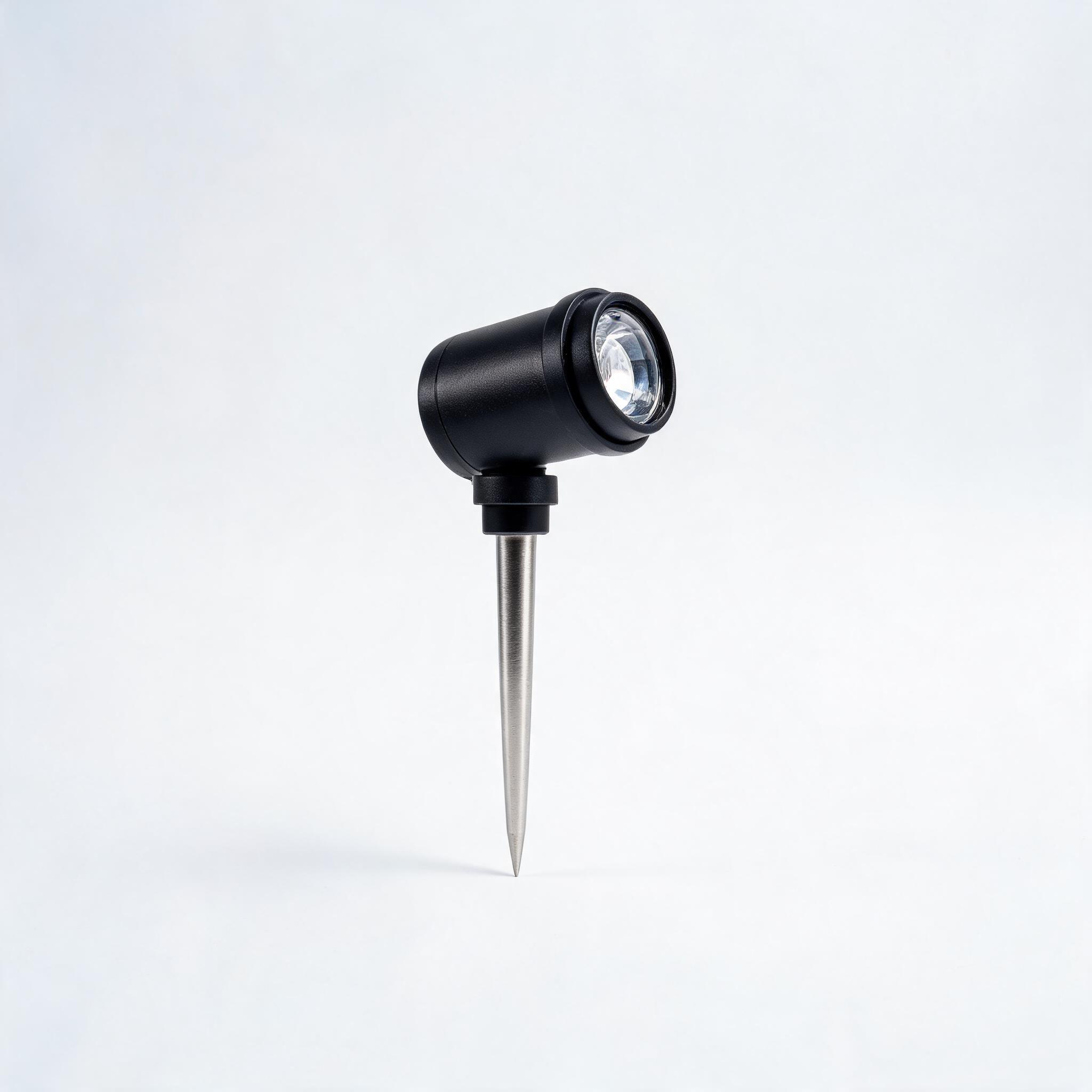
A practical guide to choosing 15°, 30°, or 60° beam angles for LED landscape spotlights, with real installation scenarios, wattage matching, and common mistakes. Covers OKELI's 10W/20W/50W adjustable-beam spotlight range.
Landscape Lighting Design Guide
How to Choose the Right Beam Angle for LED Landscape Spotlights
Beam angle is the single most misunderstood specification in landscape lighting. Get it wrong and a mature oak tree looks like a telephone pole under a searchlight, or a wide facade goes half-lit with a dark band running across the middle. Get it right and the same fixture does three different jobs across a project without changing hardware.
This guide breaks down what beam angle actually does on-site, how 15°, 30°, and 60° compare in real installation scenarios, and how to specify the right fixture for each zone of a landscape project. We will reference OKELI's 9;s 10W, 20W, and 50W landscape spotlight range throughout - all three share a continuously adjustable 15°–60° beam, so the principles apply across the full wattage spectrum.
Key takeaway: Beam angle controls how light spreads from the fixture - not how bright it is. A 50W spotlight at 15° throws a tight, intense beam that reaches 10+ metres. The same 50W at 60° spreads light across a wide area but only reaches 3–4 metres effectively. Wattage determines total output; beam angle determines what shape that output takes.
What Beam Angle Actually Means
Beam angle is the angle at which light intensity drops to 50% of the maximum (centre beam) value. A fixture with a 15° beam angle produces a narrow, concentrated cone of light. A 60° beam angle produces a wide, diffused cone. The difference is not subtle - it changes everything about how and where you install the fixture.
Here is why this matters for landscape lighting specifically:
- Subject height and distance: A 6-metre tree trunk needs a narrow beam to reach the canopy without spilling light into the neighbour's window. A 2-metre garden wall needs a wide beam to wash the surface evenly.nly.
- Subject width: A column or statue 0.5m wide needs a narrow beam to avoid lighting the surrounding paving. A facade 8m wide needs a wide beam - or multiple narrow beams placed at intervals.
- Glare control: Wide beams create less direct glare for viewers because the light is spread over a larger surface area. Narrow beams concentrate intensity, which can cause discomfort when viewed head-on.
- Fixture count: Choosing the right beam angle can reduce the number of fixtures needed. One 60° beam at the right wattage may cover what two 30° fixtures would be required to achieve.
15° Narrow Beam - When and Why
A 15° beam produces a tight cone of light roughly 1 metre in diameter at a 4-metre throw distance. It is the landscape lighting equivalent of a spotlight in a theatre - intense, focused, and dramatic.
Best applications for 15°:
- Tree trunk uplighting: A 15° beam aimed upward at a mature tree trunk creates a dramatic column of light that follows the trunk line without spilling into the canopy. This is the classic palm-tree uplight effect used in resort and hotel entrance lighting.
- Tall column accent: Architectural columns on hotel entrances, portico pillars, and monument bases. The narrow beam lights the full height of the column without washing the surrounding wall.
- Distant focal points: Sculptures, water features, or signage located 6–10 metres from the nearest fixture position. A 15° beam at 50W (4,000 lm) can reach subjects at this distance where wider beams would lose intensity.
- Flagpole lighting: Narrow beams are standard for flagpole uplighting, where the light must travel vertically without spill.
When NOT to use 15°:
Avoid 15° for low subjects (under 2 metres), wide surfaces, or any application where the viewer will see the fixture head-on at close range. The concentrated intensity creates harsh glare and hot spots on surfaces closer than 2 metres.
30° Medium Beam - The All-Rounder
A 30° beam is the default landscape lighting beam angle. It produces a cone roughly 2 metres in diameter at a 4-metre throw - wide enough for most garden features, narrow enough to maintain direction and drama. If you are specifying a single beam angle for an entire residential project and cannot go wrong, 30° is the choice.
Best applications for 30°:
- Medium tree uplighting (4–7m height): A 30° beam covers the trunk and lower canopy of a medium-sized tree without the searchlight effect of 15°. The 20W spotlight at 1,600 lm with a 30° setting is the workhorse combination for hotel courtyard and residential estate tree lighting.
- Shrub and planting bed accents: 30° covers a 1.5–2m planting area from a ground stake, providing enough spread to light a group of shrubs rather than a single plant.
- Building facade grazing (narrow sections): For wall sections 2–3m wide, a 30° beam aimed upward creates a defined grazing effect that highlights texture in stone, render, or cladding.
- Path and step edge definition: When aimed downward from a low position, 30° marks path edges without the flat, over-lit look of a 60° flood.
60° Wide Beam - Flood and Wash
A 60° beam produces a cone roughly 4.5 metres in diameter at a 4-metre throw. It is the broadest setting on an adjustable spotlight and behaves more like a small flood light than a spot. The light spreads quickly and loses intensity over distance, so 60° works best for close-range, wide-area coverage.
Best applications for 60°:
- Facade wash (wide sections): A 60° beam placed 1.5–2m from a wall surface creates an even wash across 3–4m of wall height. For wider facades, space multiple 60° fixtures at 3-metre intervals.
- Garden bed flood lighting: When the goal is ambient garden illumination rather than dramatic accent, 60° spreads light across a wide planting area from a single fixture.
- Hedge and wall perimeter lighting: A 60° beam along a hedge line or boundary wall provides soft, even coverage that defines the landscape edge without creating hot spots.
- Substitution for a flood light: In mixed-use projects where a separate flood fixture is not justified, a 50W spotlight at 60° delivers enough spread to function as a small area flood.
When NOT to use 60°:
Do not use 60° for tree uplighting above 4 metres. The beam spreads too wide and loses intensity before reaching the canopy, leaving the upper tree dark. Also avoid 60° for any application where you need to control light spill - the wide spread will light everything within range, including areas you did not intend to illuminate.
Beam Angle Comparison at a Glance
| Beam Angle | Cone Diameter at 4m | Best Subject Height | Typical Application | Recommended Wattage |
|---|---|---|---|---|
| 15° | ~1.0 m | 6–10 m | Tree trunk, column, distant focal point | 20W–50W |
| 30° | ~2.1 m | 3–7 m | Medium tree, shrub beds, facade grazing | 10W–50W |
| 60° | ~4.6 m | 1–4 m | Facade wash, garden flood, hedge perimeter | 10W–50W |
Matching Beam Angle to Wattage
Beam angle and wattage work together. A 10W spotlight at 15° produces a narrow beam that reaches about 3–4 metres - useful for small tree trunks and garden features. A 50W spotlight at 15° reaches 10+ metres, making it suitable for mature trees and tall building features. The same beam angle behaves very differently depending on how much light is behind it.
Here is how the three wattages in OKELI's spotlight range pair with beam angles:les:
- 10W / 800 lm - Best at 30°–60° for close-range accent work. At 15°, the beam is narrow but lacks the throw for subjects above 4 metres. Ideal for residential garden beds, small specimen plants, and patio perimeter lighting.
- 20W / 1,600 lm - The most versatile. Performs well across the full 15°–60° range. At 15°, reaches medium trees (4–7m). At 60°, covers facade sections up to 3m wide. This is the fixture most landscape contractors specify as a default.
- 50W / 4,000 lm - Built for reach. At 15°, lights mature trees and multi-storey facades. At 60°, functions as a flood light for large commercial entrances. Use where 20W output is insufficient at the required throw distance.
The Advantage of Adjustable Beam Angle
Fixed-beam spotlights force you to stock multiple SKUs - one narrow, one medium, one wide - and hope you guessed the beam angle correctly before installation. An adjustable beam fixture eliminates that problem.
OKELI's landscape spotlight range uses a continuously adjustable beam collar. Turn the bezel to select any angle between 15° and 60°, then lock it in position. No lens swap, no tools, no additional parts. This means:ans:
- One SKU covers all zones: A mixed-use project with tree uplighting (15°), shrub accents (30°), and facade wash (60°) uses the same fixture model throughout. Procurement is simpler. Spare parts management is simpler.
- On-site adjustment: If the tree has grown since the design phase, or the planting plan changed, the beam angle can be re-set on site without changing the fixture. This flexibility is particularly valuable for landscape contractors who handle post-installation adjustments.
- Visual consistency: The 10W, 20W, and 50W variants share the same die-cast aluminum housing. A project using all three wattages maintains a consistent fixture appearance across zones.
Common Beam Angle Mistakes
1. Using a narrow beam for close-range subjects
A 15° beam placed 1 metre from a garden wall creates a bright hot spot roughly 25cm in diameter - the rest of the wall stays dark. If the fixture is within 2 metres of the subject, use 30° or 60° instead.
2. Using a wide beam for tall subjects
A 60° beam aimed at a 8-metre tree loses most of its intensity before reaching the canopy. The trunk gets lit, the canopy stays dark. For subjects above 4 metres, use 15° or 30°.
3. Mixing beam angles without a plan
Randomly varying beam angles across a project creates visual inconsistency. Plan beam angles by zone: narrow for vertical features, medium for mid-range accents, wide for surface wash. Use the same angle for similar subjects across the site.
4. Forgetting about light spill
Wide beams spill light beyond the intended subject. In residential areas, this can mean light entering neighbouring properties. In commercial areas, it can create unwanted glare for pedestrians and drivers. Check the beam spread against site boundaries before finalising fixture positions.
Specifying OKELI Landscape Spotlights
All three wattages in the OKELI landscape spotlight range share these specifications:
- Housing: Die-cast aluminum with powder-coat finish
- Sealing: IP67 (submersion-rated, not just splash-resistant)
- Beam: 15°–60° continuously adjustable, tool-free
- Mounting: Stainless steel ground stake included
- Driver: Integrated 220V transformer (110V available on request)
- LED lifespan: 50,000 hours
- Warranty: 3 years with piece-for-piece compensation
- Certifications: Manufactured under ISO 9001; CE, ETL, RoHS available
OKELI LIGHTING has manufactured outdoor lighting since 2009 from a 35,000 m² ISO 9001-certified facility. The company supports OEM/ODM programmes with custom wattage, colour temperature (2700K, 3000K, 4000K), RAL finish colours, and private-label packaging above MOQ. Samples are available for pre-production approval - lead time 7–10 business days; bulk production 40–45 business days.
Frequently Asked Questions
Can I change the beam angle after installation?
Yes. The adjustable beam collar is designed for on-site changes. Turn the bezel to the new angle and lock it. No tools or lens changes required. This is useful when landscape planting matures and grows into the light path.
Which wattage should I start with for a residential project?
The 20W at 1,600 lm is the most versatile choice. It covers the majority of residential landscape applications - tree uplighting, facade grazing, and garden accent work. Add 10W units for intimate spaces and 50W units for tall trees or wide facades.
Are the 10W, 20W, and 50W fixtures visually identical?
Yes. All three share the same die-cast aluminum housing profile and finish. On a mixed-wattage project, the fixtures look consistent from ground level. The difference is internal LED output, not external appearance.
What happens if water gets into the fixture?
IP67 sealing means the optical chamber is rated for submersion to 1 metre for 30 minutes. Irrigation overspray, heavy rain, and surface flooding cannot reach the LED module or driver. No gasket maintenance is required between service intervals.
Can I get samples for a specification project?
Yes. Samples are available for pre-production approval and specification sign-off. Lead time is 7–10 business days. Contact OKELI with your project requirements for sample pricing.
Need help specifying the right beam angle and wattage for your project? Share your site plan, subject heights, and fixture positions. OKELI's technical team will recommend the spotlight wattage and beam angle for each zone, along with pricing and lead time. me. Contact us here.