
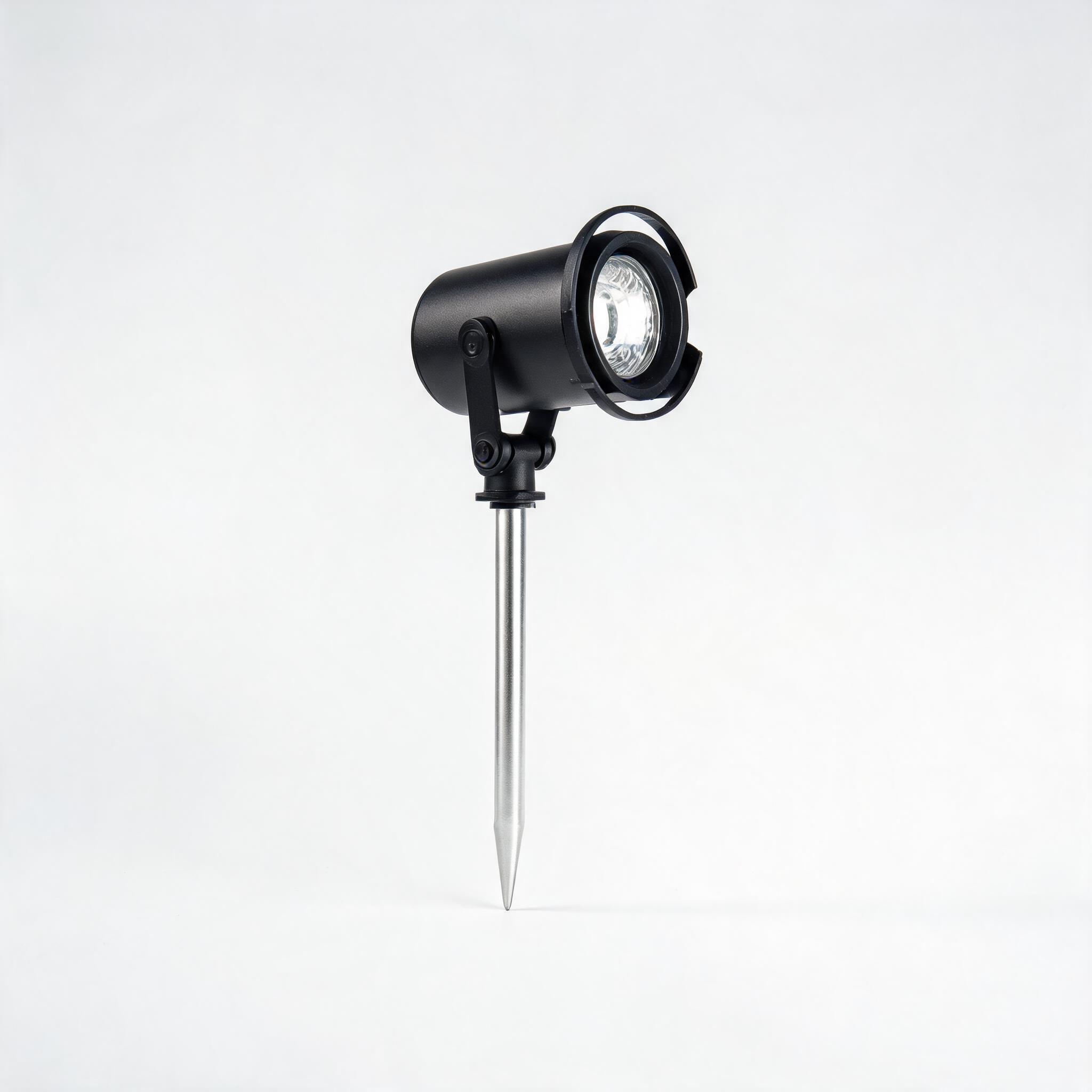
A practical guide to landscape spotlight beam angles: what 15° vs 60° means on site, when to use narrow vs wide beams, why adjustable-beam fixtures simplify procurement, and how to match beam angle to subject type across a mixed-use project.
Landscape Spotlight Specification Guide
How to Choose the Right Beam Angle for Landscape Spotlights
Beam angle is the specification that most often separates a landscape lighting design that works from one that falls flat. Get it right and a single fixture type handles everything from narrow tree-trunk accents to broad facade washes. Get it wrong and you end up over-ordering fixtures, compensating for hot spots, or re-specifying mid-project because the lighting effect does not match the design intent.
This guide breaks down how beam angle works in practice, what 15° versus 60° actually looks like on site, and why an adjustable-beam fixture has become the preferred specification for contractors and distributors who want to simplify their SKU count without sacrificing design flexibility.
What This Guide Covers
- 1. What beam angle means in landscape lighting
- 2. Narrow beam (15°–25°): When and where to use it
- 3. Wide beam (45°–60°): When and where to use it
- 4. The problem with fixed-beam fixtures
- 5. Adjustable beam: One SKU, full range
- 6. Matching beam angle to subject type
- 7. Specifying beam angle across a mixed-use project
1. What Beam Angle Means in Landscape Lighting
Beam angle describes how widely light spreads from the fixture. A narrow angle concentrates light into a tight cone, producing a bright, focused spot at the subject. A wide angle spreads light across a broader area, producing a softer, more diffuse wash. The angle is measured at the point where light intensity drops to 50% of the maximum at the centre of the beam.
In practical terms, a 15° beam from a fixture mounted 3 metres from a tree trunk produces a light circle roughly 80 cm in diameter at the subject. A 60° beam from the same distance produces a light circle closer to 3.5 metres. That is the difference between highlighting a single columnar trunk and washing an entire wall section.
| Beam Angle | Light Circle at 3m Distance | Light Circle at 5m Distance | Typical Application |
|---|---|---|---|
| 15° (narrow) | ~0.8 m diameter | ~1.3 m diameter | Columnar tree trunks, narrow architectural features, sign accents |
| 25° (spot) | ~1.3 m diameter | ~2.2 m diameter | Medium tree trunks, statue lighting, column uplighting |
| 45° (flood) | ~2.5 m diameter | ~4.2 m diameter | Tree canopy underlighting, entrance washes, hedge lighting |
| 60° (wide flood) | ~3.5 m diameter | ~5.8 m diameter | Facade wash, broad wall grazing, area accent |
The key insight for procurement: beam angle determines how many fixtures you need to light a given subject. A wider beam covers more area per fixture, but at lower intensity per square metre. A narrower beam delivers higher intensity but covers less area. The specification decision is about matching the beam to the subject.
2. Narrow Beam (15°–25°): When and Where to Use It
Narrow beam angles serve a specific set of landscape lighting applications where precision matters more than coverage:
- Columnar tree uplighting – Cypress, Italian poplar, and other narrow-growth trees need a tight beam that concentrates light on the trunk without spilling into the surrounding planting. A 15° beam at 3 metres distance lights the trunk without washing the foliage behind it.
- Architectural column lighting – Entrance columns, portico pillars, and structural features where the design intent is to highlight the vertical form, not the wall behind it. A narrow beam creates a defined shaft of light up the column face.
- Sign and feature accents – Illuminating a specific sign panel, a sculpture detail, or a water feature jet. The narrow beam puts light exactly where it is needed and nowhere else.
- Grazing textured surfaces – When mounted close to a stone or brick wall, a narrow beam grazes the surface at a low angle, revealing texture and depth through shadow. This technique is common in hotel entrance courts and boutique retail facades.
The risk with narrow beams is over-concentration. If the beam is too tight for the subject, you get a hot spot, a bright circle of light that looks harsh and draws the eye for the wrong reason. This is the most common complaint from landscape architects reviewing mock-up installations.
3. Wide Beam (45°–60°): When and Where to Use It
Wide beam angles cover applications where the goal is to wash a surface with even light rather than create a focused accent:
- Facade washing – Lighting a building facade from ground level requires a wide beam that covers the full width of the wall section from a single fixture position. A 60° beam at 5 metres from the wall covers nearly 6 metres of facade width.
- Tree canopy underlighting – Mature trees with broad canopies need wide-beam fixtures placed at the drip line to light the underside of the canopy. A narrow beam would create a bright spot on one branch; a wide beam fills the canopy with even light.
- Hedge and planting bed lighting – Continuous hedge runs and broad planting beds need wide-beam fixtures to create an even wash of light across the full planting area. Narrow beams create a polka-dot effect that breaks the design intent.
- Entrance and feature washes – Hotel and resort entrance features, water features, and sculptural elements that need to be lit as a whole rather than in sections.
The risk with wide beams is under-intensity. Spread the light too far and the subject looks dim. This is where wattage selection intersects with beam angle: a 50W fixture at 60° delivers enough photons to cover a wide area effectively, while a 10W fixture at 60° may not have the output to make the wash visible at distance.
4. The Problem with Fixed-Beam Fixtures
Most landscape spotlight product lines offer fixed beam angles: a 30° version, a 45° version, maybe a 60° version. The procurement logic seems straightforward: buy the beam angle that matches the application. In practice, this creates three problems:
Three Problems with Fixed-Beam Fixtures
- SKU proliferation – A mixed-use project with tree uplighting, facade washing, and entrance accents needs three different beam angles. That means three separate product codes, three inventory lines, and three sets of spare fixtures. For a distributor, each additional SKU adds warehousing and ordering complexity.
- Design changes on site – Landscape projects evolve during installation. A tree specified for 30° uplighting gets pruned differently than expected, or the planting plan changes and a hedge replaces a specimen tree. With fixed-beam fixtures, a design change means swapping the fixture. With an adjustable fixture, it means turning the bezel.
- Inconsistent visual effect across zones – When different zones use different fixed beam angles, the lighting effect varies noticeably as the eye moves across the site. An adjustable fixture set to the same angle across all zones produces a consistent visual language.
5. Adjustable Beam: One SKU, Full Range
An adjustable-beam spotlight addresses all three problems. A single fixture with a continuously variable beam from 15° to 60° replaces two or three fixed-beam SKUs. The adjustment is tool-free: turn the bezel to narrow or widen the beam, then lock it in position. No lens kit, no adaptor ring, no on-site tool kit.
For distributors and contractors, the benefit is straightforward inventory management. Stock one fixture, not three. For landscape designers, the benefit is design flexibility: the same fixture can be set to 15° for a narrow tree accent on one side of the site and 60° for a broad facade wash on the other, with identical housing appearance and light quality across the installation.
OKELI's landscape spotlight range uses this adjustable-beam approach across all three wattage variants:nts:
- 10W / 800 lm – Residential and boutique commercial accent lighting. View the 10W landscape spotlight.
- 20W / 1,600 lm – Mid-range output for hotel courtyards, residential estates, and light commercial projects. View the 20W landscape spotlight.
- 50W / 4,000 lm – High-output for large commercial plazas, mature tree uplighting, and wide facade grazing. View the 50W commercial landscape spotlight.
All three share the same die-cast aluminum housing, IP67 sealing, and integrated 220V driver, so a project using multiple wattages maintains a consistent fixture appearance across all zones.
6. Matching Beam Angle to Subject Type
The following reference table matches common landscape lighting subjects to the recommended beam angle setting. These are starting points for specification; always validate with a mock-up on site before committing to bulk production.
| Subject Type | Subject Size | Recommended Beam | Why |
|---|---|---|---|
| Columnar tree (cypress, poplar) | 0.5–1m width | 15°–25° | Concentrate light on trunk, avoid spill into planting behind |
| Medium ornamental tree | 2–4m canopy | 25°–45° | Cover trunk and lower branching without hot spots |
| Mature shade tree | 6–10m canopy | 45°–60° | Wash full canopy underside from drip-line position |
| Architectural column | 0.4–0.8m diameter | 15°–25° | Define vertical form, graze surface texture |
| Building facade section | 3–6m width | 45°–60° | Even wash across full wall section |
| Water feature / fountain | 1–3m feature | 25°–45° | Highlight feature without overpowering water movement |
| Sculpture / statue | 0.5–2m height | 25°–45° | Reveal form and texture, avoid flat over-lighting |
| Hedge run | Continuous | 60° | Even wash along full planting run |
7. Specifying Beam Angle Across a Mixed-Use Project
A typical commercial landscape project, a hotel resort for example, includes multiple lighting zones: entrance features, pathway borders, specimen tree uplighting, building facade accents, and water feature lighting. Each zone has a different beam angle requirement, but the procurement team wants to minimise the number of distinct products ordered.
With an adjustable-beam fixture, the specification strategy is:
- Order one fixture model in the wattage that matches the project scale. For a hotel resort, the 20W variant at 1,600 lm is typically the workhorse. For larger commercial sites, the 50W variant at 4,000 lm covers the primary feature zones.
- Set the beam angle per zone during installation. 15° at the entrance columns, 45° at the medium ornamental trees, 60° at the facade sections. The installer adjusts the bezel on site, locks it, and moves to the next fixture.
- Keep a small quantity of the adjacent wattage for special cases. A 10W unit for intimate courtyard details, a 50W unit for the main entrance tree. All three share the same housing, so the visual language stays consistent.
This approach reduces the SKU count from five or six fixed-beam fixtures down to two or three adjustable-beam fixtures. For a project ordering 80 to 200 landscape spotlights, the procurement and inventory simplification is significant.
Common Beam Angle Mistakes
- Using a narrow beam for broad subjects – A 15° beam on a 6-metre facade section produces a bright circle in the centre and darkness at the edges. The fix is to widen the beam, not add more fixtures.
- Using a wide beam for tall, narrow subjects – A 60° beam on a columnar tree spills light past the trunk into the planting behind it, wasting output and creating light pollution. Narrow the beam to 15°–25°.
- Assuming one beam angle fits all zones – Even with an adjustable fixture, some installers set every unit to the same angle for consistency. This produces the wrong effect for subjects that need a different beam. Adjust per zone, not per site.
- Ignoring beam angle when comparing wattage – A 20W fixture at 15° produces a much brighter effect at the subject than the same 20W fixture at 60°, because the light is concentrated. When comparing output across fixtures, always account for beam angle, not just lumen count.
- Skipping the mock-up – Beam angle specifications on paper do not always translate as expected in the field. Always install two or three fixtures at the correct angle and distance, view them at night, and adjust before ordering the full quantity.
FAQ
Q: Can I change the beam angle after installation?
A: Yes. With OKELI's adjustable-beam spotlights, the beam collar turns by hand and locks in position. If the landscape design changes, a tree grows, or the lighting effect needs adjustment, the beam angle can be reset on site without tools or fixture replacement.ent.
Q: Does adjusting the beam angle change the total light output?
A: No. The total lumen output of the fixture stays the same. Narrowing the beam concentrates the same amount of light into a smaller area, which increases intensity at the subject. Widening the beam spreads the same light over a larger area, which reduces intensity per square metre but increases coverage.
Q: Should I use the same wattage with different beam angles, or different wattages?
A: For most mixed-use projects, the same wattage with different beam angle settings is the most efficient approach. It simplifies procurement, inventory, and maintenance. Use a higher wattage only when the subject size or mounting distance requires more raw output, not when a beam angle adjustment would achieve the same effect.
Q: What beam angle should I specify for a hotel entrance feature?
A: It depends on the feature. For a column flanking the entrance, use 15°–25°. For a sculptural element or water feature, use 25°–45°. For washing the entrance facade, use 45°–60°. A hotel entrance typically uses all three settings across different fixtures in the same zone.
Next Steps
If you are specifying landscape spotlights for a commercial project, request samples of the adjustable-beam spotlight in the wattage that matches your project scale. Install two or three units at different beam angle settings, view them at night, and confirm the effect before placing the full order. OKELI's technical team can help you map beam angles to your project zones and confirm wattage selection based on subject height and mounting distance.nce.
Request Spotlight Samples or a Project Quote
Tell us your project zones, subject types, and mounting distances. We will recommend beam angle settings, wattage selection, and fixture quantities within one business day.
Contact OKELI Lighting