
Las luces LED de cadena cuestan entre $3 y $4 al año de funcionamiento con un uso típico, una novena parte que las incandescentes. El verdadero factor de coste es la durabilidad. Aritmética completa para compradores y distribuidores.
La pregunta detrás de la pregunta
Cuando un comprador pregunta cuánto cuesta hacer funcionar las luces LED de cadena, normalmente está preguntando una de dos cosas: «¿Se notará en mi factura de electricidad?» (un propietario o un operador de un local) o «¿Puedo venderlas a clientes que se preocupan por los costes de funcionamiento?» (un distribuidor o instalador). Ambas se responden con la misma aritmética, así que hagámoslo correctamente, con cifras reales que pueda reutilizar en sus propias cotizaciones y páginas de producto.
Las matemáticas básicas
Coste de funcionamiento = vatios × horas × tarifa eléctrica. Esa es toda la fórmula. Todo lo demás es completar con cifras honestas.
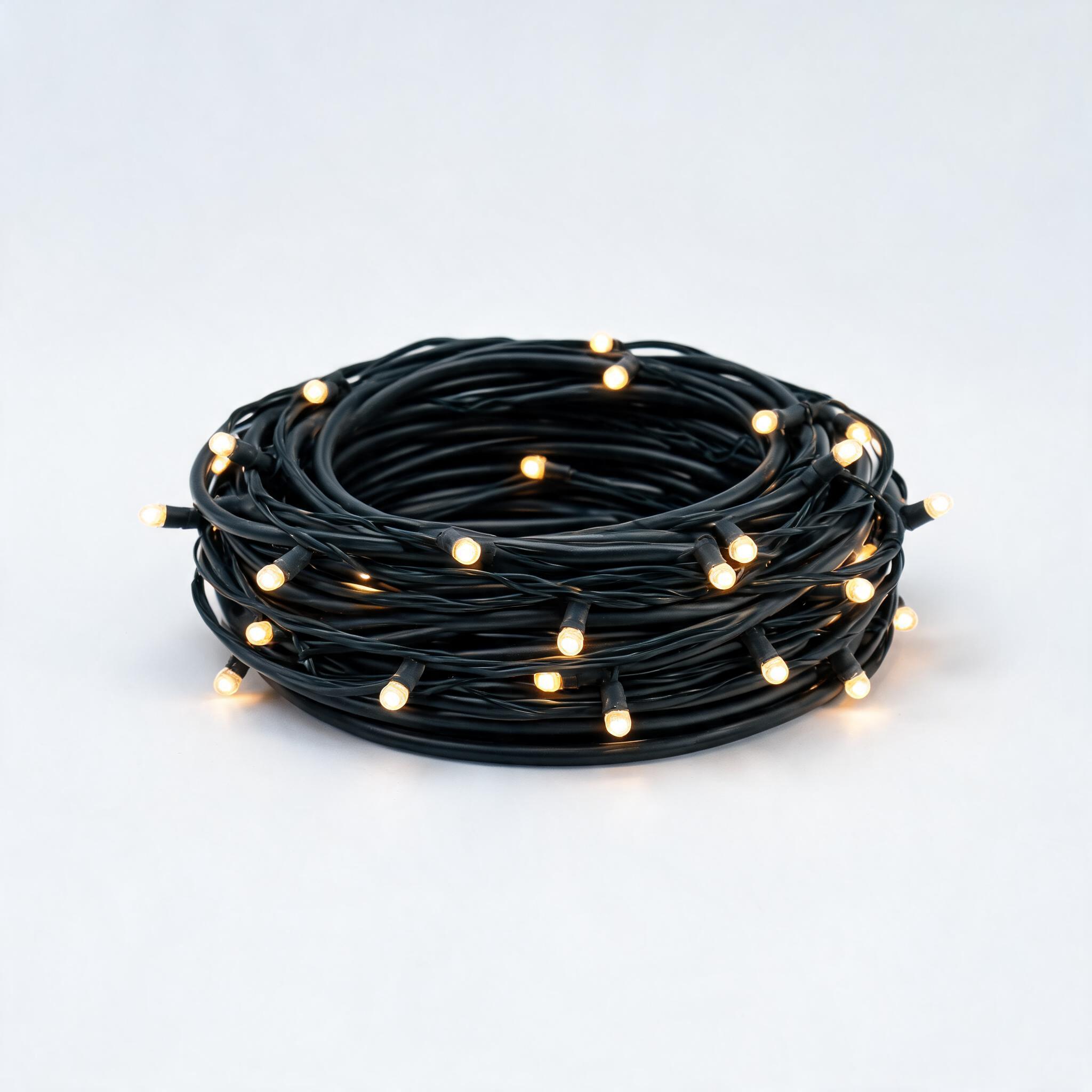
Tomemos un juego típico de luces LED de cadena para exteriores: 100 LED a aproximadamente 0,1 W cada uno consumen unos 10 W en total. Nuestro juego de luces de cadena de luz cálida de 100 LED y 10 m es un ejemplo representativo. Si se enciende 6 horas por noche:
- 10 W × 6 h = 60 vatios-hora por noche = 0,06 kWh
- A la tarifa residencial media de EE. UU. de aproximadamente $0,17/kWh: aproximadamente $0,01 por noche
- En un año de 365 noches: aproximadamente $3,70 al año
Eso no es un error de redondeo en el presupuesto de nadie: es iluminación prácticamente gratuita. Compare con un juego de luces de cadena incandescentes de la misma longitud: 100 bombillas incandescentes a ~0,9 W cada una consumen 90 W, lo que cuesta unos $33 al año con el mismo uso. El juego LED cuesta una novena parte en funcionamiento, por lo que la prima LED se amortiza en la primera temporada de uso intensivo.
Cifras a escala comercial
Para una terraza de restaurante o un local de eventos que utilice 20 juegos de luces LED de 10 W, 8 horas por noche, 300 noches al año:
- 20 × 10 W × 8 h × 300 = 480 kWh al año
- A $0,17/kWh: aproximadamente $82 al año para la iluminación ambiental de todo el local
El mismo local con juegos incandescentes consumiría aproximadamente 1.800 W y pagaría unos $730 al año. Para un operador de hostelería, la decisión LED vale más de $600 anuales por terraza, sin contar el ahorro de mano de obra al no tener que reemplazar bombillas incandescentes fundidas, que los juegos LED simplemente no tienen.
Qué es lo que realmente impulsa el coste de funcionamiento
Tres variables mueven el número:
- Vataje total: Número de LED × consumo por bombilla. Consulte la ficha técnica para conocer el consumo total del juego, no solo el número de LED: un juego de «100 LED» con un controlador deficiente puede consumir más que un juego de 100 LED bien diseñado.
- Horas por noche: El control mediante temporizador o fotocélula importa más de lo que la mayoría de los compradores esperan. Reducir el tiempo de funcionamiento de 8 a 5 horas reduce el coste un 37%. Nuestras luces de cadena de calidad comercial se combinan bien con temporizadores de fotocélula simples.
- Tarifa eléctrica local: Las tarifas varían desde menos de $0,10/kWh en algunos mercados hasta más de $0,30/kWh en partes de Europa. A $0,30, el ejemplo del local anterior cuesta $144/año, sigue siendo trivialmente barato, pero vale la pena cotizarlo con precisión para los clientes europeos.
Dónde está el coste real: la durabilidad
Esta es la idea que importa para los compradores B2B: el coste de funcionamiento es un error de redondeo, pero el coste de reemplazo no lo es. Un juego de luces de cadena que sobrevive dos temporadas al aire libre a $15 cuesta $7,50 al año; un juego que muere en una temporada a $8 cuesta $8 al año más la mano de obra de volver a colgarlo. La durabilidad (cable de PVC estabilizado contra rayos UV, enchufes sellados, clasificación IP65) es donde está el dinero realmente.
Por eso los compradores comerciales especifican juegos con clasificación IP65 y resistencia a los rayos UV, como nuestras luces de cadena comerciales de luz cálida y luz fría : la electricidad es casi gratuita, por lo que el producto que gana es el que permanece instalado y funcionando.
Responder a las preguntas de sus clientes
Si distribuye o instala luces de cadena, estos son los números que sus clientes le pedirán; téngalos listos:
- «¿Cuánto cuesta dejar las luces de cadena encendidas toda la noche?» Un juego de 10 W durante 12 horas: aproximadamente $0,02/noche, $7/año.
- «¿Las luces LED de cadena consumen mucha electricidad?» No: un juego típico consume menos que un cargador de teléfono.
- «¿Las luces de cadena solares son más baratas de funcionar?» Utilizan cero electricidad de la red, pero cuestan más por adelantado y ofrecen una salida menor y dependiente del clima. Para instalaciones comerciales permanentes, los juegos LED con cable ganan en fiabilidad.
- «¿Y el voltaje?» Nuestros juegos funcionan con red de 220 V; las variantes de bajo voltaje de 24 V son adecuadas para mercados y aplicaciones donde el acceso a la red es limitado o las normas de seguridad lo requieren.
Preguntas frecuentes
¿Cuánta electricidad consumen las luces LED de cadena? Un juego típico de 100 LED y 10 m consume unos 10 W, aproximadamente una décima parte de un juego incandescente equivalente. Diez horas de funcionamiento cuestan alrededor de un centavo a las tarifas medias de EE. UU.
¿Cuánto cuesta al mes hacer funcionar las luces de cadena para exteriores? Un solo juego de 10 W encendido 6 horas por noche cuesta unos $0,30 al mes. Una terraza comercial con 20 juegos cuesta unos $7 al mes.
¿Las luces de cadena aumentan notablemente la factura de la luz? No con LED. Incluso una instalación residencial grande de 10 juegos cuesta menos de $5 al mes con un uso típico.
¿Es más barato dejar las luces LED de cadena encendidas o apagarlas? El ahorro de apagar un juego de 10 W es de unos céntimos: use un temporizador por conveniencia, no por ahorro. La durabilidad y la exposición a la intemperie importan mucho más para el coste total.
¿Qué deberían comparar los compradores comerciales además del coste de funcionamiento? Clasificación IP, cable estabilizado contra rayos UV, sellado de los enchufes, vida útil del LED (25.000 a 50.000 horas) y condiciones de garantía. El coste de funcionamiento es un problema resuelto; la durabilidad no.
Especificaciones para su mercado
Para los distribuidores, la historia del coste de funcionamiento es un punto de venta que vale la pena imprimir en la caja: «cuesta menos de $4 al año de funcionamiento». Para los instaladores, justifica especificar LED a cada cliente sin dudarlo. Y para cualquiera que compare proveedores, recuerde que el vataje en la ficha técnica es una promesa: pida el consumo medido del juego completo, incluido el controlador. Explore la gama OKELI LIGHTING para ver las especificaciones completas y consulte más guías de compra en la sección de noticias.