
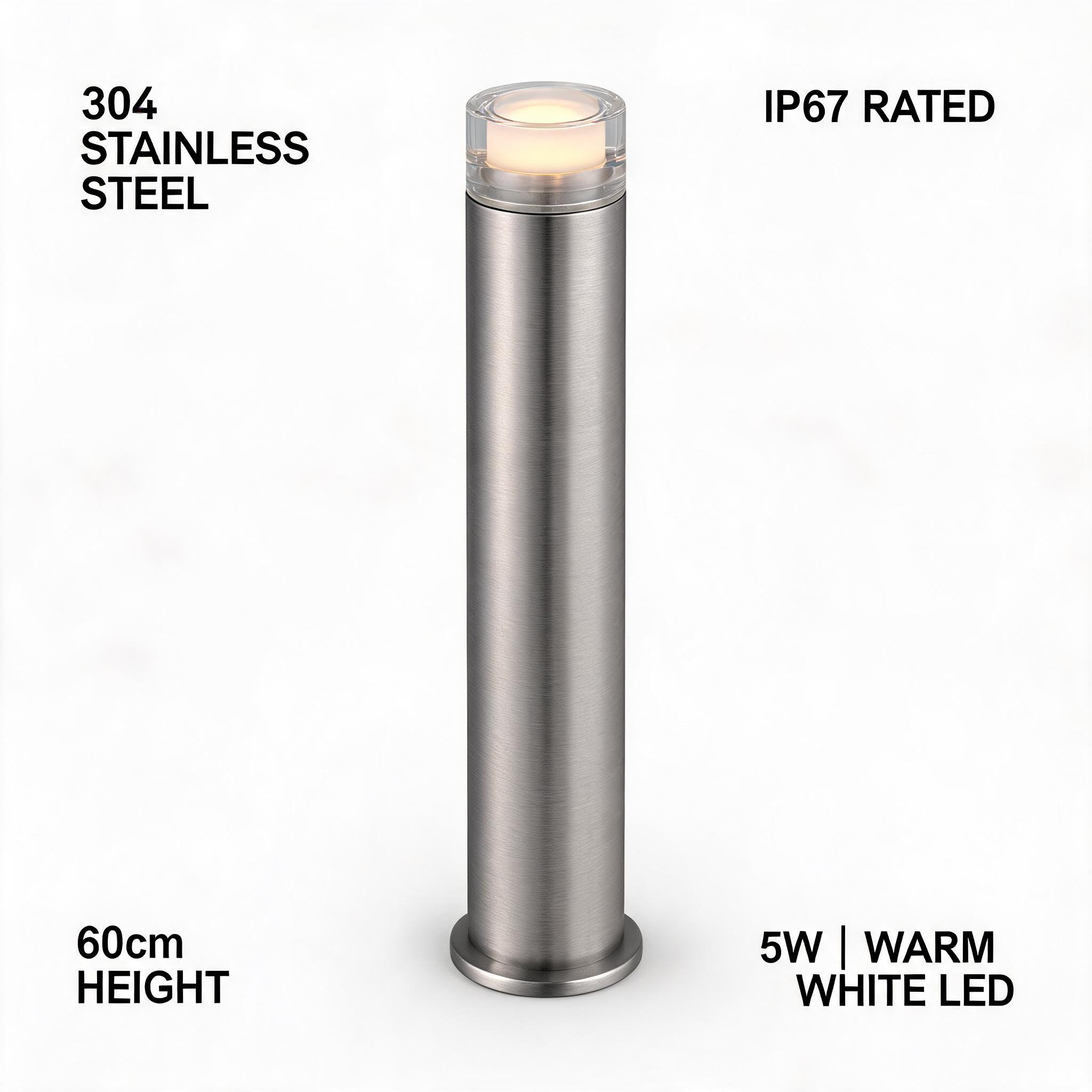
A material selection guide for outdoor LED bollard lights - comparing 304 stainless steel, 316 stainless steel, and die-cast aluminum by corrosion resistance, cost, and application fit. Includes environmental matching framework and 10-year lifecycle cost analysis.
Bollard Light Material Selection Guide
The housing material of an outdoor bollard light is not a cosmetic choice. It determines whether the fixture survives two seasons or twelve. It determines whether rust streaks stain your client's stone paving in year three. It determines whether a coastal resort project passes its one-year warranty inspection or triggers a full replacement order. For B2B buyers specifying pathway lighting across hospitality, residential, or municipal projects, material selection is the first line of defence against premature failure.ure.
This guide compares the three materials most commonly used in LED bollard light housings - 304 stainless steel, 316 stainless steel, and die-cast aluminum - across corrosion resistance, structural durability, thermal performance, cost, and application fit. The goal is to help you specify the right material for each project environment rather than defaulting to a single option across every job.
In this guide:
- Why Housing Material Matters More Than Wattage
- Material Comparison at a Glance
- 304 Stainless Steel - The Hospitality Standard
- 316 Stainless Steel - The Marine-Grade Option
- Die-Cast Aluminum - The Commercial Workhorse
- Matching Material to Project Environment
- Cost Analysis: Initial Price vs Lifecycle Value
- FAQ
Why Housing Material Matters More Than Wattage
Wattage determines how much light a fixture produces. IP rating determines how well it keeps water out. But neither of those specifications addresses the most common failure mode in outdoor pathway lighting: housing degradation. A 5W, IP67 bollard with perfect internal sealing is still useless if the housing corrodes, cracks, or detaches from its base after two winters.
The failure pattern is predictable. Painted steel or zinc-alloy bollards develop surface rust within 6–12 months in coastal or high-humidity environments. That rust penetrates the housing, compromises structural integrity, and eventually reaches the LED chamber through cracks and gasket degradation. The IP67 rating that looked good on the spec sheet becomes meaningless because the housing itself has failed.
This is why material selection should be settled before any other specification. The right material ensures the housing survives long enough for the IP rating, LED lifespan, and warranty to actually matter.
Material Comparison at a Glance
| Property | 304 Stainless Steel | 316 Stainless Steel | Die-Cast Aluminum |
|---|---|---|---|
| Corrosion Resistance | Excellent (general outdoor) | Superior (marine/coastal) | Good (with powder-coat) |
| Salt-Spray Resistance | 500+ hours | 1,000+ hours | Depends on coating quality |
| Structural Strength | High (resists impact) | High (resists impact) | Medium (can crack under impact) |
| Thermal Conductivity | Moderate | Moderate | Excellent (acts as heatsink) |
| Surface Finish | Brushed/mirror (no coating needed) | Brushed/mirror (no coating needed) | Powder-coat (can chip/scratch) |
| UV Resistance | Inherent (metal does not degrade) | Inherent (metal does not degrade) | Coating-dependent |
| Relative Cost | Medium | High | Low-Medium |
| Best Application | Hotels, resorts, residential estates, general commercial | Beachfront, marine, chlorinated pool surrounds | Budget projects, high-wattage fixtures, non-coastal |
304 Stainless Steel - The Hospitality Standard
Grade 304 stainless steel is the most widely specified material for premium outdoor bollard lighting, and for good reason. It contains 18% chromium and 8% nickel, which gives it inherent corrosion resistance without any surface coating. The metal itself is the finish - there is no paint to chip, no powder-coat to scratch off, no plating to wear through. What you see on day one is what you get in year ten.
OKELI's 304 stainless steel bollard path lightight (60cm, 5W, IP67) is built on this principle. The housing passes 500-hour salt-spray testing, which covers the vast majority of outdoor environments including coastal areas with moderate salt exposure. The brushed stainless finish is low-maintenance - surface contamination can be cleaned with standard stainless steel cleaner, and the material self-passivates when exposed to oxygen, meaning minor scratches do not lead to spreading corrosion.
Where 304 stainless is the right choice:
- Hotel and resort pathway lighting - the polished aesthetic matches premium landscape design
- Residential estate driveways and garden paths - homeowners expect a metal finish, not painted steel
- Commercial plazas and office campuses - high footfall areas where impact resistance matters
- Golf courses and country clubs - long service life in managed landscape environments
- General outdoor environments up to 5km from coastline
Where 304 is not enough: Direct beachfront installations, areas with heavy industrial salt exposure, or chlorinated pool surrounds where chlorine concentrations create a more aggressive corrosive environment than salt air alone. In these cases, upgrade to 316.
316 Stainless Steel - The Marine-Grade Option
Grade 316 stainless steel adds 2% molybdenum to the 304 composition. That single addition dramatically increases resistance to chloride corrosion - the specific failure mode caused by salt water, chlorine, and de-icing chemicals. 316 passes 1,000+ hours of salt-spray testing, double the 304 benchmark.
The visual difference between 304 and 316 is negligible - both have the same brushed or mirror finish options. The difference is entirely in longevity under aggressive corrosive conditions. A 316 bollard on a beachfront resort pathway will maintain its structural integrity and surface finish for years longer than a 304 unit in the same position.
Where 316 is worth the premium:
- Beachfront and seafront properties - direct salt spray exposure within 500m of the shoreline
- Pool surround lighting - chlorinated water creates a more aggressive environment than salt air
- Marina and waterfront walkways - constant salt moisture and splash
- Areas using de-icing salt in winter - road salt runoff creates chloride exposure similar to marine environments
- Industrial zones with chemical airborne pollutants
Cost-benefit note: 316 stainless typically costs 20–30% more than 304. For a 100-unit bollard project, that premium may represent a significant line item. However, the cost of replacing 304 units that fail prematurely in marine environments - including labour, disposal, and re-purchasing - almost always exceeds the 316 premium. Specify 316 once, or specify 304 and replace it in three years. The math favours 316 for genuine marine environments.
Die-Cast Aluminum - The Commercial Workhorse
Die-cast aluminum is the most common housing material for budget-to-mid-range outdoor lighting. It is lighter than stainless steel, cheaper to manufacture, and has excellent thermal conductivity - the housing itself acts as a heatsink, pulling heat away from the LED module. For high-wattage fixtures (30W+), this thermal advantage matters because it extends LED lifespan by keeping junction temperatures low.
The weakness of aluminum is corrosion protection. Bare aluminum oxidises rapidly outdoors. To prevent this, aluminum housings are treated with a powder-coat finish that provides a barrier between the metal and the environment. The problem: powder-coat is a surface treatment, not an inherent material property. If the coating chips from impact, scratches during installation, or degrades from UV exposure over time, the underlying aluminum is exposed and corrosion begins.
Where die-cast aluminum is the right choice:
- Budget-conscious projects where initial cost is the primary driver
- High-wattage fixtures (30W+) where thermal management is critical and stainless steel's lower thermal conductivity is a disadvantagetage
- Inland commercial projects with low salt exposure and moderate humidity
- Flood lights and area lights where the fixture is mounted out of reach (less impact risk)
Where aluminum is a risk: Coastal environments, areas with frequent pressure washing, high-impact zones near vehicle traffic, and any project where the client expects a 10+ year maintenance-free lifecycle. Powder-coat finishes on aluminum bollards in coastal environments typically show degradation within 3–5 years, compared to stainless steel which maintains its finish indefinitely.
Matching Material to Project Environment
The correct material specification depends primarily on the installation environment. Here is a practical framework for matching material to project type:
| Project Environment | Recommended Material | Rationale |
|---|---|---|
| Inland hotel or resort (5km+ from coast) | 304 Stainless | Excellent corrosion resistance, premium finish, cost-effective for the protection level needed |
| Coastal hotel or resort (within 5km of coast) | 316 Stainless | Salt spray exposure requires molybdenum-enhanced alloy; 304 will show pitting within 2-3 years |
| Beachfront property (within 500m of shoreline) | 316 Stainless | Direct salt spray and splash; 316 is the minimum acceptable specification |
| Pool surround / spa area | 316 Stainless | Chlorine is more aggressive than salt; 316 resists chloride pitting |
| Residential estate (inland) | 304 Stainless | Good balance of aesthetics and durability; homeowners expect metal finish |
| Commercial plaza (inland, high footfall) | 304 Stainless or Aluminum | 304 for premium projects; aluminum acceptable for budget projects with replacement cycle budget |
| Municipal park (inland) | Aluminum or 304 Stainless | Aluminum acceptable for budget projects; 304 for longer lifecycle |
| Marina or waterfront | 316 Stainless | Constant salt moisture exposure; no other material is acceptable |
| Cold climate with de-icing salt | 316 Stainless | Road salt runoff creates chloride exposure equivalent to marine environment |
Cost Analysis: Initial Price vs Lifecycle Value
The cheapest fixture on the purchase order is rarely the cheapest fixture over the project lifecycle. Here is a simplified comparison for a 100-unit bollard installation over a 10-year period:
| Cost Factor | Aluminum (Powder-Coat) | 304 Stainless | 316 Stainless |
|---|---|---|---|
| Initial Unit Cost (relative) | 1.0x | 1.4x | 1.8x |
| Expected Housing Lifespan (coastal) | 3-5 years | 5-8 years | 10+ years |
| Expected Housing Lifespan (inland) | 7-10 years | 10+ years | 15+ years |
| Re-coating / Refinishing Needed | Yes (year 4-6 typical) | No | No |
| Replacement Risk in 10 Years (coastal) | High (1-2 full replacements) | Medium (possible 1 replacement) | Low (no replacement expected) |
| Maintenance Labour | Highest (coating inspection, touch-up) | Low (cleaning only) | Low (cleaning only) |
For a coastal project, aluminum's lower initial cost is wiped out by the first replacement cycle. The labour cost alone of removing 100 bollards, disposing of corroded units, and installing replacements - including rewiring and ground stake reset - often exceeds the material cost difference between aluminum and 316 stainless. This is before factoring in the client relationship damage from a visible failure on their property.rty.
The counter-argument for aluminum is valid in specific scenarios: inland projects with mild climates, budget-constrained municipal contracts with defined replacement cycles, or large-scale installations where the sheer quantity makes the per-unit cost difference significant. In these cases, specify aluminum with a high-quality powder-coat (not the cheapest option) and plan for a 7-10 year replacement cycle.
FAQ
Can I use 304 stainless steel bollards in a coastal project?
It depends on proximity to the shoreline. For projects 2–5km from the coast with moderate salt exposure, 304 stainless is generally adequate and will provide 5–8 years of reliable service. For projects within 1km of the shoreline, or directly beachfront, upgrade to 316 stainless. If you are unsure, specify 316 - the cost premium is modest compared to replacement costs.
How do I maintain the finish on stainless steel bollards?
Stainless steel requires minimal maintenance. For 304 and 316, periodic cleaning with mild soap and water removes surface contamination. For areas with salt deposition, a fresh-water rinse every 3–6 months prevents chloride buildup. Avoid abrasive cleaners or steel wool, which can scratch the surface. Unlike painted or powder-coated finishes, stainless does not require re-coating or refinishing.
Is powder-coated aluminum ever better than stainless steel?
Yes, in two scenarios. First, for high-wattage fixtures (30W+) where thermal management is critical - aluminum's superior thermal conductivity keeps LED junction temperatures lower, extending lifespan. Second, for budget-constrained projects in mild inland climates where the replacement cycle is planned and budgeted. In both cases, specify a high-quality multi-layer powder-coat, not the cheapest option.ion.
What is the difference between brushed and mirror stainless steel finish?
Brushed finish has a satin, non-reflective texture that hides fingerprints and minor scratches. It is the standard choice for commercial and hospitality installations. Mirror finish is highly polished and reflective - visually striking but requires more maintenance to keep clean. Both use the same underlying 304 or 316 alloy, so corrosion resistance is identical.
Does OKELI offer both 304 and 316 stainless steel bollards?
OKELI's standard bollard path lights are manufactured in 304 stainless steel, which covers the majority of outdoor applications. 316 stainless steel is available as a custom specification for marine-grade projects - contact our technical team with your environment details and we will confirm material options and lead time.ime.
Need Help Specifying the Right Material?
Tell us your project location, distance from coastline, and environmental conditions. We will recommend the correct housing material and provide samples for your evaluation within one business day.
Request a Material Consultation