A buying guide to UV-resistant LED string lights for permanent installation: PVC cable, IP65 connectors, surge protection, color temperature selection, and wholesale purchasing.
Commercial outdoor string lighting — a B2B buyer's guide
UV-resistant LED string lights for commercial outdoor use: what B2B buyers need to know
Outdoor string lights are the highest-volume lighting product in hospitality and retail: a single hotel chain may order thousands of string lights across multiple properties. When they fail after one season — and many do — replacement cost, labor, and damage to the guest experience escalate quickly. Two causes of premature failure recur in every project: UV degradation of the cable and moisture ingress at the connectors. Both are preventable at the specification stage — but only if the buyer knows what to require.
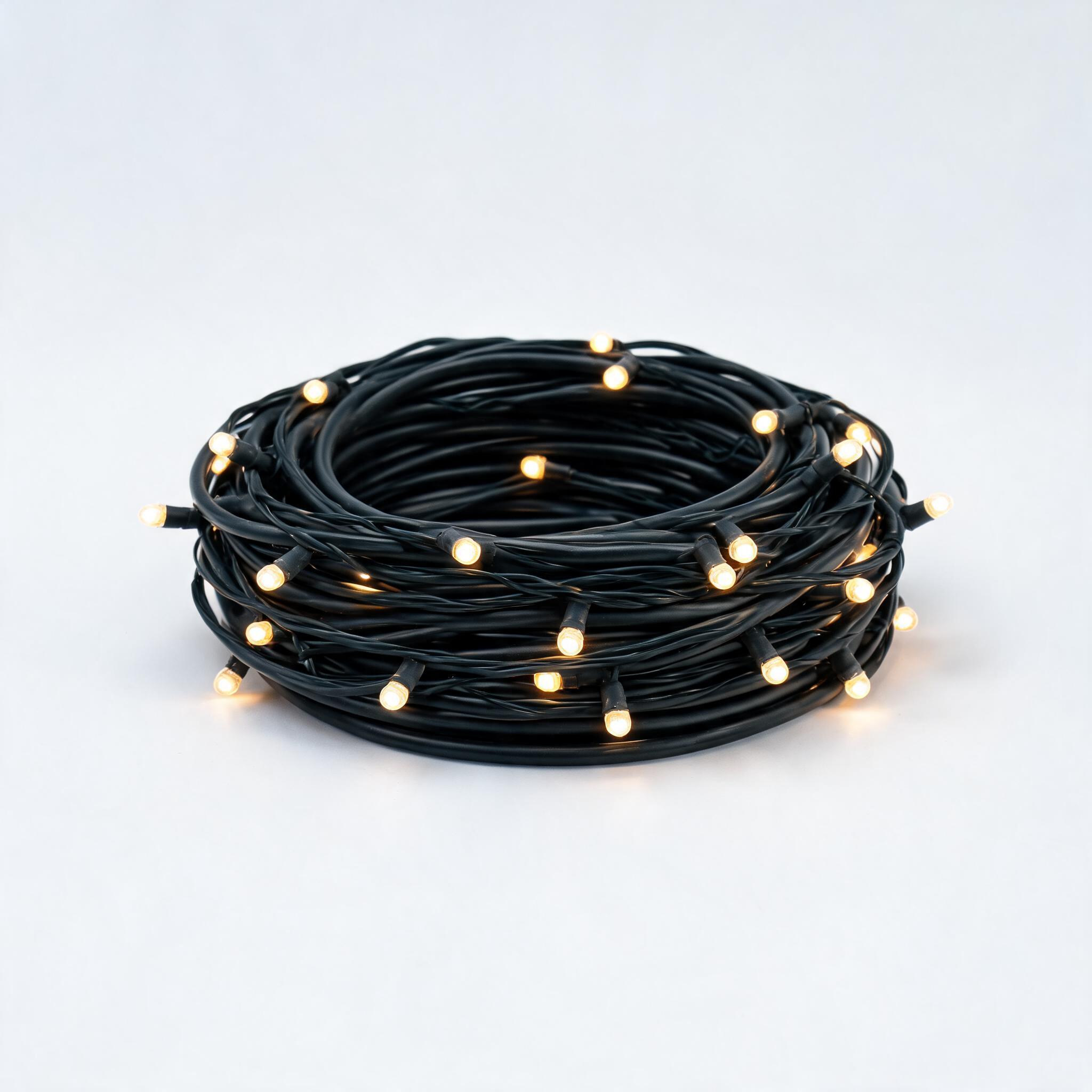
This guide covers specifications for permanent outdoor installation: UV-resistant cable material, IP65 connector sealing, surge protection, color temperature selection, and wholesale purchasing considerations. Examples include 3000K warm white string lights and 6500K cool white OKELI: both with UV-resistant PVC cable, IP65 connectors, and built-in surge protection.
Key points: three characteristics determine whether outdoor string lights will survive permanent installation: UV-stabilized PVC cable (not standard PVC), IP65 connectors (not unprotected connections), and built-in surge protection (not an optional upgrade). If a supplier does not confirm all three in writing, the product is not designed for permanent outdoor installation.
The UV degradation problem: why cable material matters
Standard PVC contains plasticizers that evaporate under UV exposure. At first the cable looks fine, then it yellows, hardens, and cracks. Once cracked, water penetrates along the conductors, and the string fails section by section from the crack point. This is the number one cause of outdoor string light replacement after one or two seasons — and it is entirely preventable.
UV-stabilized PVC contains inhibitors that absorb or reflect UV radiation before it reaches the polymer chains: the cable retains flexibility, insulation integrity, and mechanical strength for years under direct sun. The production cost difference between standard and UV-stabilized PVC is small — but the difference in service life is measured in years, not months.
For a B2B buyer specifying string lights for permanent installation, the question is direct: request written confirmation of UV-stabilized PVC cable from the supplier. If the specification says only “PVC” without the UV qualifier, the product is made for seasonal use, not permanent installation. OKELI string lights warm white and cool white use UV-stabilized PVC cable rated for permanent outdoor exposure.
IP65 connectors — sealing the weakest point
Connectors are the weakest point of any outdoor string light. The cable itself is continuous and sealed, the LED sockets are molded, but the connections between strings and to the power supply are joints, and water enters through joints. Unprotected connectors rely on friction-fit halves: rain, condensation, and irrigation spray reach the electrical contacts, corrosion increases resistance, the connection heats up — and the string fails at that point.
IP65 connectors solve the problem: the “6” means complete dust tightness, the “5” means protection against water jets from any direction — rain, spray, and washing do not reach the contacts. The connection is made with a sealed threaded or bayonet joint with an O-ring gasket that compresses on connection. The practical difference for a commercial project: unprotected connectors fail in the first wet season; IP65 connectors last as long as the string itself. The cost of upgrading to IP65 at the specification stage is negligible compared with replacing a failed installation.
Surge protection — the “silent killer” in developing markets
Voltage spikes are the second most common cause of string light failure, and they are invisible: a surge lasts milliseconds — too fast to see, and too fast for a circuit breaker. But the surge passes through the LED driver, overheats the junction — and the driver fails. The string goes dark. There is no visible damage — the failure looks random.
Sources of surges in outdoor installations:
- Grid load switching: utility load switching creates transient overvoltages that travel along the line to connected luminaires.
- Lightning proximity: a strike within 1 km induces a surge in outdoor wiring even without a direct hit — the electromagnetic pulse is induced in the string wiring.
- On-site load switching: air conditioning compressors, pumps, and other inductive loads on the same circuit produce spikes when switched on and off.
- Unstable grid: in markets with variable power quality — Southeast Asia, South Asia, Africa, parts of Latin America — voltage fluctuations are frequent and severe.
Built-in surge protection clips transient spikes to a safe level, dissipating the excess as heat, before they reach the LED drivers. OKELI includes surge protection as standard in both versions — warm white and cool white — not as an optional upgrade.
Color temperature: warm versus cool white for commercial applications
Choosing between 3000K and 6500K is not an aesthetic whim but a determination of the string light's suitability for the task:
- 3000K warm white — a soft amber tone close to incandescent; hotel terraces, restaurant pergolas, resort walkways, wedding venues; flatters food and natural materials; creates the atmosphere guests expect.
- 6500K cool white — a crisp daylight tone; market stalls, outdoor shop windows, commercial perimeter; higher perceived brightness and accurate merchandise rendering; also the choice for modern minimalist architectural settings.
On mixed projects, both versions are ordered together: same connector type, cable, and linkable construction. Typical configuration: warm white in dining and lounge areas, cool white in service and display areas.
Technical specifications affecting wholesale purchasing
- LED count and pitch: 100 LEDs at 10 cm pitch on 10 m of cable — the commercial standard. A 5 cm pitch gives a denser light effect but requires more LEDs per meter and costs more; 15 cm is cheaper but creates visible dark gaps.
- Total power: 50 W per 10 m string. For circuit design: theoretically a 220 V / 10 A circuit supports 44 strings (4,400 W), but practical limits — surge margin and voltage drop on long runs — reduce this value; for runs over 50 m, consult an electrician.
- Linkability: strings connect end to end, simplifying installation of runs longer than 10 m; the maximum run depends on cable cross-section and supply voltage.
- Voltage: 220 V AC — standard for most markets; for 110 V (North America, parts of Latin America), confirm voltage compatibility when ordering.
- LED lifespan: 30,000+ hours — the LEDs themselves are not the failure point. Cable, connectors, and driver are why UV resistance and IP65 sealing matter more than “LED quality” for outdoor durability.
Common purchasing mistakes
1. Seasonal grade for permanent installation. Many string lights on the market are made for seasonal use — Christmas decor, temporary event lighting. Such products use standard PVC (not UV-stabilized), unprotected connectors, and have no surge protection. In a hotel or restaurant, they are guaranteed to fail within one season.
2. Ignoring the connector rating. Buyers often look at LED count, temperature, and length but overlook the connector specification — the most common failure point. For outdoor installations, always IP65.
3. Voltage drop on long runs. When several strings are linked, voltage drops along the cable — distant LEDs receive less power and look dimmer. For runs over 30 m, consider a parallel layout instead of a single series chain; have the installation design for long runs reviewed by an electrician.
4. Ordering without surge protection in developing markets. On grids with unstable power, protection is not optional: without it, expect driver failures in the first wet season. Protected string lights cost slightly more; replacing failed string lights on a multi-site installation costs far more.
OKELI string light specification
Both color temperature versions share common specifications:
- LED count: 100 per string
- Length: 10 m; LED pitch: 10 cm
- Total power: 50 W
- Cable: UV-resistant PVC
- Connector rating: IP65
- Voltage: 220 V AC (110 V on request)
- Surge protection: built-in (standard, not optional)
- LED lifespan: 30,000+ hours
- Linkability: yes
- Custom options: length, LED count and pitch, color temperature, RGB, private label packaging
OKELI LIGHTING has manufactured outdoor lighting since 2009 at a 35,000 m² factory certified to ISO 9001. Products are certified CE, ETL, and RoHS. The company supports OEM/ODM: custom lengths, LED count and pitch, temperatures (2700K, 4000K, RGB), and private label packaging from MOQ. Samples are available — 7–10 working days; mass production — 40–45 working days.
Frequently asked questions
Can string lights be linked on a run longer than 10 meters? Yes, end to end. The maximum recommended run depends on cable cross-section and local voltage. Send us your project run length — we will advise on the configuration and any additional power points required.
What is the difference between UV-resistant PVC and standard PVC? UV-stabilized PVC contains inhibitors that prevent UV from degrading the polymer chains. Standard PVC yellows, hardens, and cracks within 1–2 seasons of direct sun. UV-stabilized PVC retains flexibility and insulation integrity for years. The price difference is small; the difference in service life is significant.
Are cool white and multicolor versions available? Yes: 6500K cool white, 4000K neutral white, and RGB on request. Standard stock: 3000K warm white and 6500K cool white.
What is the minimum order quantity? The MOQ is 100 units for standard configurations. Custom lengths, LED counts, or packaging may require a higher MOQ.
Do the string lights work on 110 V power? 110 V versions are available on request; specify the destination market in your inquiry. Standard production is 220 V.
Can I get samples to approve the specification? Yes, samples are available for approval prior to mass production. Lead time is 7–10 working days; contact us for sample pricing and shipping options.
Sourcing LED string lights for a commercial project? Send us the installation type, quantity, preferred color temperature, and destination market. The OKELI technical team will confirm specifications, pricing, and lead times within one working day. Contact us.