
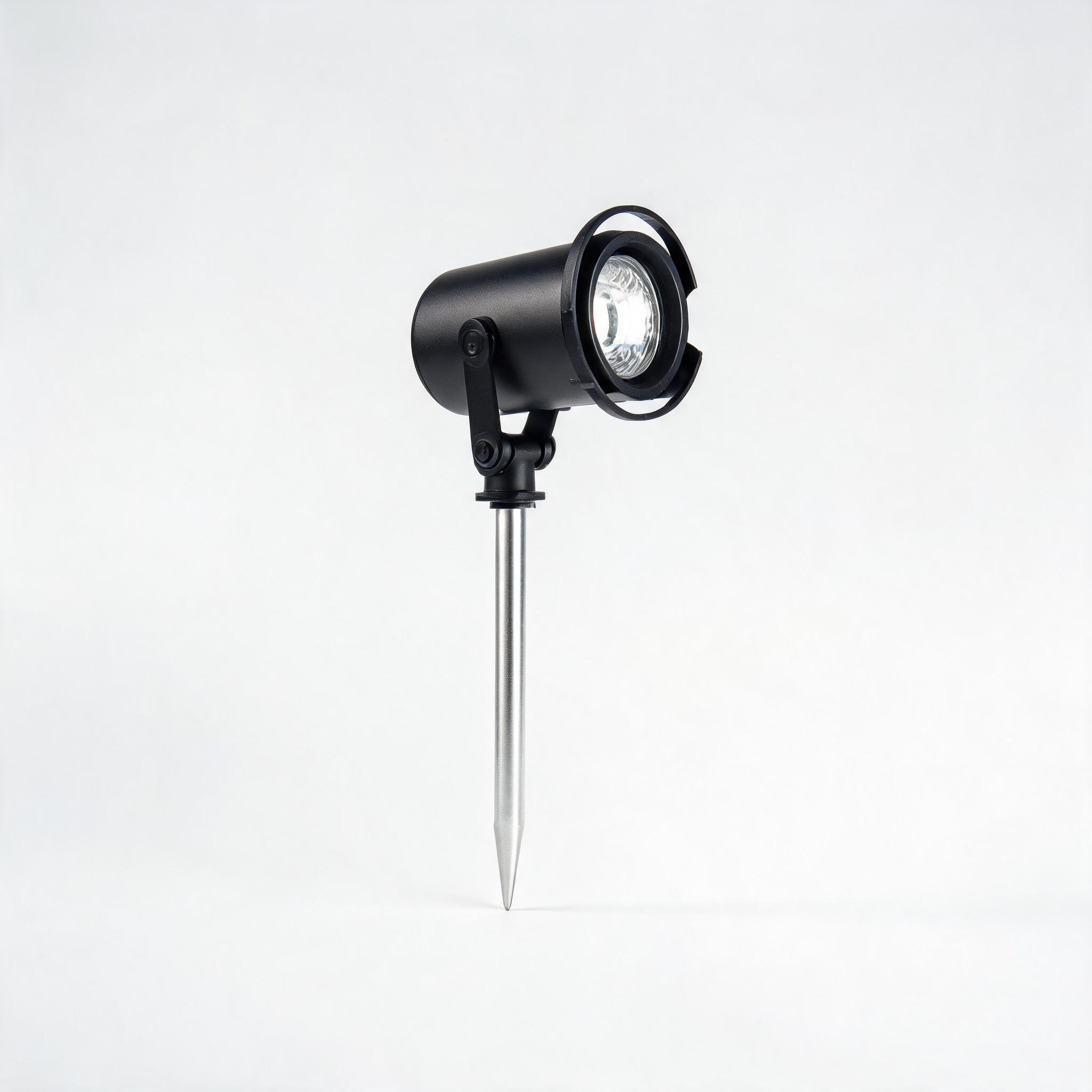
A wattage selection guide: a comparison of 10 W (800 lm), 20 W (1,600 lm), and 50 W (4,000 lm) by application area, object height, and project type. Includes a mixed-use project example and common procurement mistakes.
Landscape Spotlight Power Guide
Landscape spotlight specification is not about choosing the brightest fixture. It is about matching power to the object: the tree, wall, column, or sculpture in front of you. Too much power on a small shrub washes out the scene and creates neighbor complaints about glare. Too little on a 10-meter mature oak leaves the canopy dark and the design incomplete. The difference between an 800 lm and a 4,000 lm fixture is not subtle: it is the difference between an accent fixture and a dominant fixture.
This guide breaks down three key power ratings in the OKELI landscape spotlight lineup — 10 W (800 lm), 20 W (1,600 lm) and 50 W (4,000 lm) — and matches each to the project zones where it performs best. If you are procuring landscape lighting for hotels, estates, municipal projects, or mixed-use developments, this is the framework your specification should be built on.
Contents:
Why power selection is the first procurement decision
Before beam angle. Before color temperature. Before IP rating. Power comes first because it determines whether the fixture can physically reach the object with enough light. An impeccable specification of IP67, 3000K, adjustable beam is useless if the fixture does not emit enough lumens to illuminate the tree it was bought for.
The most common beginner mistake in landscape lighting is buying one power rating for the entire project. A resort orders 200 spotlights at 20 W because 20 W seemed like a safe middle ground. The result: the entrance tree — a 12-meter royal palm — looks underlit because 1,600 lm cannot reach the canopy from ground level. And the border shrubs are overlit, with hot spots that destroy the atmosphere the landscape architect intended. Two zones, two different needs, one SKU — and a project that does not look right.
The right approach: divide the site into zones by object height and area, then assign power by zone. This guide provides the framework for that.
Quick comparison: 10 W vs 20 W vs 50 W
All three power ratings share one die-cast aluminum housing platform, IP67 sealing, continuously adjustable 15°–60° beam, and a built-in 220 V transformer. The difference is in output and in each one's application zone.
| Specification | 10 W | 20 W | 50 W |
|---|---|---|---|
| Luminous flux | 800 lm | 1,600 lm | 4,000 lm |
| Efficacy | ~80 lm/W | ~80 lm/W | ~80 lm/W |
| Effective range | 2–4 m | 4–7 m | 8–12 m |
| Best object height | up to 3 m | 3–6 m | 6–10 m+ |
| Typical application | Garden accents, small signage, patio borders | Medium trees, entrance columns, courtyard features | Mature trees, wide facades, commercial plazas |
| Project type | Residential, boutique hotel | Hotel, resort, estate | Commercial, public, large resort |
| Beam angle | 15°–60° continuous adjustment (all three) | ||
| Protection rating | IP67 (all three) | ||
| Housing | Die-cast aluminum, powder-coated (all three) | ||
| LED lifespan | 50,000 hours (all three) | ||
| Warranty | 3 years (all three) | ||
Key takeaway: efficacy is identical across the lineup (~80 lm/W). You are not paying for a difference in efficiency, but for raw output matched to the scale of the object.
10 W — residential and intimate commercial range
The 10 W spotlight delivers 800 lm. That is enough for objects up to 3 meters: garden specimen plants, low walls, small signage, terrace borders, and architectural details in intimate courtyards. It is not enough for a 5-meter tree, and it will not meaningfully reveal a building facade.
The strength of 10 W is precision. In a boutique hotel courtyard with a single sculptural planting, 800 lm creates a controlled circle of warm light that draws the eye without flooding the space. The same fixture in a 50 W setting would overwhelm the scene, turning an intimate courtyard into a parking lot.
Typical 10 W applications:
- Residential garden features — specimen plants, stone decorations, water features up to 2 m
- Boutique hotel courtyards — intimate spaces where atmosphere matters more than light level
- Small retail signage and entrance groups — brand light that highlights without overpowering
- Terrace and patio borders — low accent integrated into paving
- Golf courses — delicate lighting of course architecture
10 W is also right when you need to light several small objects nearby. Three 10 W fixtures on three objects give three separate light circles; one 50 W in the same position would give one burned-out center.
20 W — the sweet spot
The 20 W spotlight at 1,600 lm is the most versatile fixture in the lineup. It covers the zone most projects need: medium-height trees (4–7 m canopy), single-story building elements, entrance columns, courtyard focal points, and water feature surroundings. If you had to hold one power rating across an entire mixed-use project, it would be 20 W.
20 W bridges residential subtlety and commercial power: enough range to uplight a 6-meter palm, yet not so much that it overwhelms a hotel courtyard. For contractors handling both residential and light commercial projects, 20 W is the SKU that works on the largest number of tasks.
Typical 20 W applications:
- Hotel courtyards and resort entrances — medium-height palms, entrance columns, lighting around water features
- Estate driveways — tree lighting along borders, gate pillars, border decorative walls
- Retail and F&B outdoor areas — lighting of entrance canopies, summer terrace perimeters, signage from below
- Parks and public gardens — specimen plant lighting, path-edge accents, sculptures
- Clubhouses and sports facilities — entrance accents, parking perimeter
Specification tip: for a hotel entrance group with a 5-meter tree and two 3-meter columns, use one 20 W on the tree (beam narrowed to 25°) and two 10 W on the columns. This gives a balanced picture where each object is lit proportionally. Three 20 W fixtures would flatten the scene — the columns would become as bright as the tree, destroying the visual hierarchy.
50 W — commercial and public range
The 50 W spotlight at 4,000 lm exists for objects that 20 W physically cannot reach. Mature trees above 8 meters. Wide facades. Large entrance groups. Monument lighting. Public plaza sculptures. These are applications where underlighting is not a design choice but a project failure.
One 50 W fixture replaces two or three 20 W units on large objects: fewer ground stakes, fewer cable runs, fewer access points for maintenance, a cleaner installation footprint. On a commercial plaza with a 10-meter specimen oak, three 20 W fixtures at the base are more expensive and visually cluttered than one 50 W at the correct throw distance.
Typical 50 W applications:
- Commercial plazas and mixed-use developments — lighting of mature trees, water features, entrance groups
- Government and public buildings — facade, monument, and sculpture lighting
- Large hotel and resort grounds — tall-canopy trees, facade attachment, entrance groups
- Sports parks and recreational facilities — perimeter accents, spectator areas
- High streets and shopping centers — exterior brand lighting, large-scale facade wash
Mixed-power projects
Real projects rarely require a single power rating. A resort site may have a 10-meter entrance palm (50 W), a row of 5-meter courtyard olives (20 W), and low border accents (10 W). Because all three power ratings share the die-cast aluminum housing, IP67 sealing, and adjustable beam mechanism, they look uniform on site: the guest sees one fixture family, not three different products.
This platform consistency is a procurement advantage: one supplier, one warranty framework, one spare parts stock, one installation training protocol. For contractors bidding on multi-zone projects, it simplifies the proposal and reduces post-installation support complexity.
Example power specification for a hypothetical 4-star resort:
| Zone | Object | Power | Qty | Beam setting |
|---|---|---|---|---|
| Entry | 12 m palm | 50 W | 2 | 25° narrow |
| Entry | Facade columns | 20 W | 4 | 40° medium |
| Courtyard | 5 m olives | 20 W | 6 | 30° medium-narrow |
| Garden border | Specimen shrubs | 10 W | 12 | 45° medium-wide |
| Pool deck | Water feature | 20 W | 2 | 60° wide flood |
| Path accents | Stone features | 10 W | 4 | 25° narrow |
Total: 30 luminaires across three wattages. One visual platform, one purchasing line, one warranty framework.
Common wattage mistakes and their cost
Over years of supplying landscape floodlights to commercial projects, the same specification mistakes recur. Each has a cost — in overbuying, reinstallation, or client dissatisfaction.
Mistake 1: over-lighting small objects. A 50 W luminaire on a 2 m shrub creates a hot spot visible from 50 m. The fix is replacing it with 10 W: overbuying, reinstallation, and possibly rewiring if the circuit was sized for fewer fixtures.
Mistake 2: under-lighting tall objects. A 20 W luminaire on a 10 m tree gives a dim glow on the lower trunk and nothing on the canopy. The tree looks as if a handheld flashlight is aimed at its base. The fix is either a cluster of additional 20 W units or a replacement with 50 W: in both cases additional purchasing and installation.
Mistake 3: one wattage for mixed zones. Ordering 200 fixtures of one wattage for purchasing simplicity. The installation looks flat — all objects are lit identically, regardless of size and distance. The landscape architect’s layered concept is lost.
Mistake 4: ignoring the interaction of wattage and angle. 50 W at 60° (wide flood) gives a different result than the same 50 W at 15° (narrow spot). High wattage + wide beam = area flood. High wattage + narrow beam = intense accent. Specifying wattage without angle leads to luminaires that are “right” in output but wrong in distribution.
FAQ
Can a 50 W floodlight be dimmed to the level of 20 W?
No. LED floodlights in this category are not dimmable by default. Dimming would require a compatible driver and control system — a cost and complexity. The right approach is to specify the correct wattage for the zone rather than trying to dim a higher-wattage fixture.
How many 10 W luminaires are equivalent to one 50 W?
In raw lumens, five 10 W fixtures (5 × 800 lm = 4,000 lm) equal one 50 W. But lumens are not the whole story: five luminaires mean five light sources, five shadows, five mounting points. One 50 W is a single clean source. For up-lighting a tall tree from below, one 50 W is almost always preferable to a cluster of five 10 W units at the base.
Are all three wattages available in 3000K warm white?
Yes. 3000K is the standard colour temperature across the range. 2700K and 4000K are available on request for all three wattages. Consistency of colour temperature across wattages matters for mixed projects: do not place a 20 W 3000K next to a 10 W 4000K on the same object.
What is the maximum distance from the luminaire to the object?
As a rule of thumb: 10 W reaches 2–4 m, 20 W reaches 4–7 m, 50 W reaches 8–12 m. These are practical ranges for meaningful illumination, not absolute maximums: at the edge of each range the beam is noticeably weaker. For objects at the boundary between two wattages (for example, a 4 m tree), either will work — choose based on whether you want a brighter or softer effect.
Can 10, 20, and 50 W be mixed on the same electrical circuit?
Yes. All three wattages operate from a 220 V mains supply with built-in transformers and can share a circuit. The total load is the sum of wattages: 30 mixed-wattage luminaires (as in the resort example above) draw about 500 W — comfortably within a standard landscape circuit.
Need help with project specification?
Send us the site plan, object heights, and zone layout. Our technical team will prepare a wattage specification across the 10/20/50 W range — including angle settings and luminaire quantities — within one business day.
Request a specification