
A practical guide to IP ratings for landscape lighting: real-world water failure modes, environment-based selection, and why OKELI makes IP67 standard for inground lights.
Guide to IP Ratings for Landscape Lighting
IP67 vs IP65 in landscape lighting: what buyers need to know
The IP rating in a landscape spotlight specification looks like a minor technical detail, but it is not. For in-ground fixtures exposed to irrigation, stormwater runoff, and surface flooding, the difference between IP65 and IP67 determines whether the fixture survives its first rainy season or becomes a warranty claim within six months of installation.
In this guide: what an IP rating actually means for landscape lighting, how to choose a rating for the installation environment, and why the cost difference between IP65 and IP67 at the production stage is marginal while the difference in field performance is significant.
1. How an IP rating is structured: two digits
IP (Ingress Protection) consists of two digits: the first describes protection against solid particles (dust, debris, tools), and the second describes protection against liquids in various forms. For landscape lighting, both matter, but the decision usually comes down to the second digit.
First digit: 5 — dust-protected (a small amount of dust is permitted, with no harmful deposits — acceptable, but not ideal: fine dust accumulates on the optics); 6 — dust-tight, the correct specification for outdoor fixtures: it prevents dust from accumulating on the LEDs and driver.
Second digit: 4 — splashing from any direction (survives rain, but not jets; protected positions only); 5 — water jets (6.3 mm nozzle) from any direction (rain and a garden hose, but no pressure washing); 6 — powerful jets (12.5 mm): withstands pressure washing; 7 — immersion up to 1 meter for 30 minutes (survives flooding; critical for in-ground fixtures); 8 — continuous immersion (for underwater fixtures, ponds, and pools).
IP65 means: dust-tight (6) plus resistance to water jets (5). IP67 is the same level of dust protection plus immersion (7). For spotlights on ground stakes, this upgrade of the second digit matters more than it seems.
2. IP65: what it covers and what it does not
IP65 is the standard outdoor rating for many products: direct rain from any angle, a garden hose jet, and irrigation spray from pop-up sprinklers and drip lines. What IP65 does not cover is standing surface water: when a downpour or drain overflow pools water at the base of the fixture, an IP65 seal does not stop water from entering through the cable entry or the stake mounting point. This is the most common failure scenario for IP65 in-ground fixtures. Likewise, even a few minutes of flooding and a jet from industrial washing equipment exceed the IP65 test conditions.
For wall and ceiling fixtures above ground level, IP65 is usually sufficient — the fixture sits above the water level during normal weather events. For in-ground landscape spotlights, IP65 leaves a loophole that shows up as failures in the first or second season.
3. IP67: the immersion threshold that matters for in-ground fixtures
IP67 adds protection against immersion to 1 meter for 30 minutes — exactly the scenario IP65 misses: water pooling at the base of the fixture during a downpour, a drain overflow, or an irrigation system failure.
Consider a typical landscape spotlight installation: the fixture on a ground stake, the LED head 30–60 cm above the ground, and the cable entry and driver compartment at or below ground level. In a tropical downpour of 50 mm/hour, surface water easily pools 5–10 cm deep at the base of the stake, and where drainage is imperfect — common in plantings with uneven soil compaction — it stays there for 30 minutes or longer. An IP65 fixture in this situation can let water in through the cable entry under hydrostatic pressure. Water ingress is not always immediate: sometimes water enters slowly, corrodes the contacts over weeks, and the fixture dims and flickers before it fails completely. An IP67 fixture under the same conditions stays sealed, rides out the storm, dries out, and keeps working.
4. The failure cascade when water enters
Failure cascade when water enters
- Phase 1 — condensation: a small amount of moisture enters the optical chamber; temperature cycles produce condensation on the inside of the lens. The fixture still works, but moisture is visible on the glass.
- Phase 2 — corrosion: moisture reaches the contacts, solder joints, and LED leads; resistance rises, and the fixture flickers or dims intermittently.
- Phase 3 — driver failure: water reaches the driver board; failure is gradual (fading, color shift) or instant. The fixture is dead.
- Phase 4 — housing damage: in cold climates, freezing water cracks the lens or housing — the fixture has not just failed, it is destroyed.
The cost of this cascade is not just the replacement fixture: in a commercial installation of 100+ spotlights, each failure requires a site visit, diagnosis, removal, replacement, and disposal. At contractor rates, the labor to replace a failed fixture often exceeds the price of the fixture itself.
5. Choosing an IP rating for the installation environment
- Wall-mounted, above 2 m, sheltered — IP54 minimum: the fixture is above water level and under cover.
- Wall-mounted, exposed to rain — IP65: direct rain; there is no risk of water pooling at ground level.
- Ground stake, well-drained soil — IP65 minimum, IP67 preferred: rain and irrigation spray; the flooding risk is low, but not zero.
- Ground stake in an irrigated zone — IP67: irrigation spray plus uncertain drainage; flooding is likely.
- Tropical or monsoon climate — IP67: heavy rains produce consistent flooding; IP65 will fail.
- Coastal or flood-prone site — IP67: storm surges, high groundwater, and salt spray.
- Underwater fixtures (pond, pool, fountain) — IP68: continuous immersion; IP67 covers temporary immersion only.
The pattern is clear: any fixture at ground level in an environment with irrigation, heavy rain, or uncertain drainage should be specified as IP67. The difference in production cost — seal material, cable entry design, housing tolerances — is marginal; the difference in field performance is significant.
6. Why OKELI specifies IP67 across the entire range
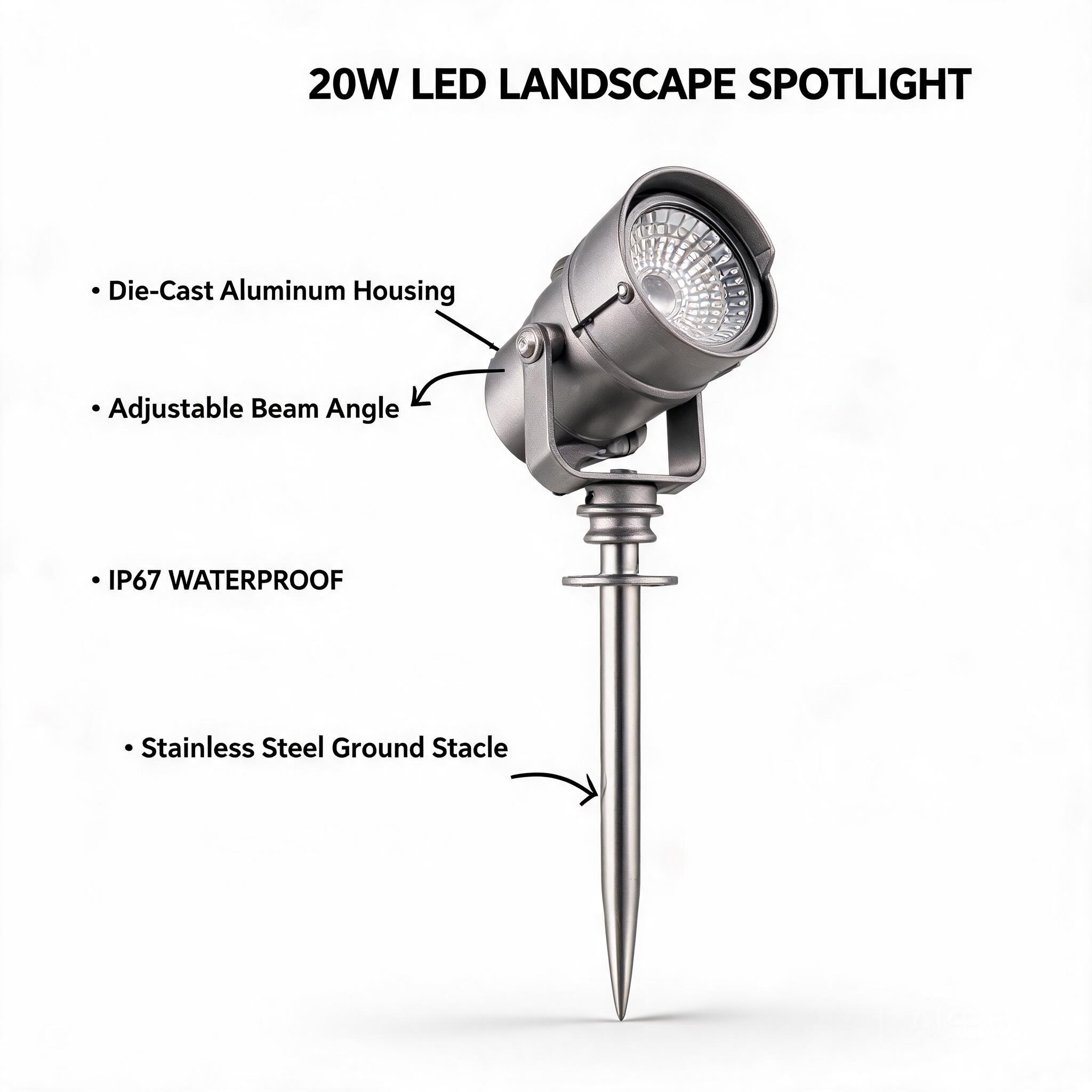
The OKELI landscape spotlight range — 10 W, 20 W and 50 W — is IP67 as standard. This is a deliberate engineering decision:
- Seal design — the optical chamber uses a continuous silicone gasket that maintains compression across the full operating temperature range: silicone stays elastic from −40 to +200 °C, so the seal does not harden or shrink in extreme climates.
- Cable entry sealing — the most common water entry point in landscape fixtures. OKELI uses a compression gland with an internal rubber sealing sleeve that tightens under hydrostatic pressure: the seal improves as water pushes against it.
- Tempered glass lens — glass does not degrade under UV, does not yellow, and holds its geometry through temperature cycles; the gasket seats against the treated glass surface, giving a more stable seal than against molded acrylic.
- Housing integrity — the die-cast aluminum housing is a single piece with no separate back panels or access hatches: every joint is a potential leak path, and eliminating joints eliminates leaks.
This approach costs slightly more per unit than a comparable IP65 fixture with an acrylic lens and a screw-on back panel. For a commercial project of 100+ fixtures, the difference pays for itself in the first replacement cycle — when the IP65 fixtures start to fail and the IP67 ones do not.
7. IP rating and warranty: what the fine print means
A water ingress warranty claim is where the IP rating meets commercial reality. Check whether the warranty covers water ingress: some warranties exclude damage from flooding, immersion, and “abnormal” water exposure. If your IP65 fixture fails after a storm, the supplier may argue that the flooding was abnormal and outside the warranty. An IP67 fixture with a warranty that covers water ingress within the stated rating gives you a clear claim path.
OKELI provides unit-by-unit compensation for confirmed manufacturing defects, including seal failure within the stated IP rating. Replacement drivers and LED modules ship free with your next order. Some suppliers offer repair only — the fixture must be returned, diagnosed, and sent back, which takes months. The OKELI technical team responds to warranty requests within one business day.
Common IP rating mistakes
- Treating IP65 as “waterproof” — IP65 resists jets, but not immersion, flooding, or pressure washing. For in-ground fixtures, use IP67.
- Specifying IP68 for above-ground fixtures — IP68 is for continuous immersion (pond, pool); for landscape spotlights, IP67 covers the worst above-ground scenario, while IP68 adds cost without practical benefit.
- Ignoring the cable entry — the IP rating applies to the housing, but water often enters at the cable entry point: check that the entry is sealed to the same standard as the housing.
- Assuming a higher IP rating means a better fixture — the IP rating is only one characteristic: an IP67 fixture with poor heat dissipation, cheap LEDs, or a weak housing will still fail. Evaluate the whole specification, not just the IP rating.
- Skipping the drainage assessment — even with IP67, standing water accelerates seal degradation over years of service. Assess drainage at the specification stage, not after installation.
FAQ
Can I use IP65 spotlights if the site has good drainage? You can, but drainage changes over time: soil compacts, plantings block drains, and irrigation systems fail. IP67 costs slightly more at the specification stage but removes the drainage variable from your long-term maintenance risk.
Does IP67 mean the fixture can stay underwater permanently? No. IP67 covers temporary immersion up to 1 meter for 30 minutes: storm flooding, drain overflow, and irrigation pooling. For permanent underwater installation, such as pond or pool lighting, specify IP68.
How can I verify that a fixture really meets its stated IP rating? Ask the supplier for IP test reports from an independent laboratory: the report should state the exact test conditions and pass criteria. OKELI provides IP documentation on request along with CE and RoHS certificates.
Does the IP rating degrade over time? Yes, but slowly: seal materials age, UV degrades some compounds, and temperature cycles stress the seal through thousands of cycles. Silicone gaskets, as used in OKELI fixtures, have better long-term aging performance; annual seal inspection in harsh environments is good practice.
Next steps
If you are specifying landscape lighting for a site with irrigation, heavy rain, or uncertain drainage, request IP67 samples and test them in the actual installation environment before placing a large order: install two or three fixtures in the lowest area of the site, turn on the irrigation system, and inspect the fixtures after heavy rain. OKELI supplies IP67 landscape floodlights in 10, 20, and 50 W versions — with documented IP test reports and a 3-year warranty covering water ingress within the stated rating.
Request IP67 samples and technical documentation
Send us your installation conditions, drainage status, and project quantity. We will provide IP test reports, samples, and a specification recommendation within one business day.
Contact OKELI Lighting