
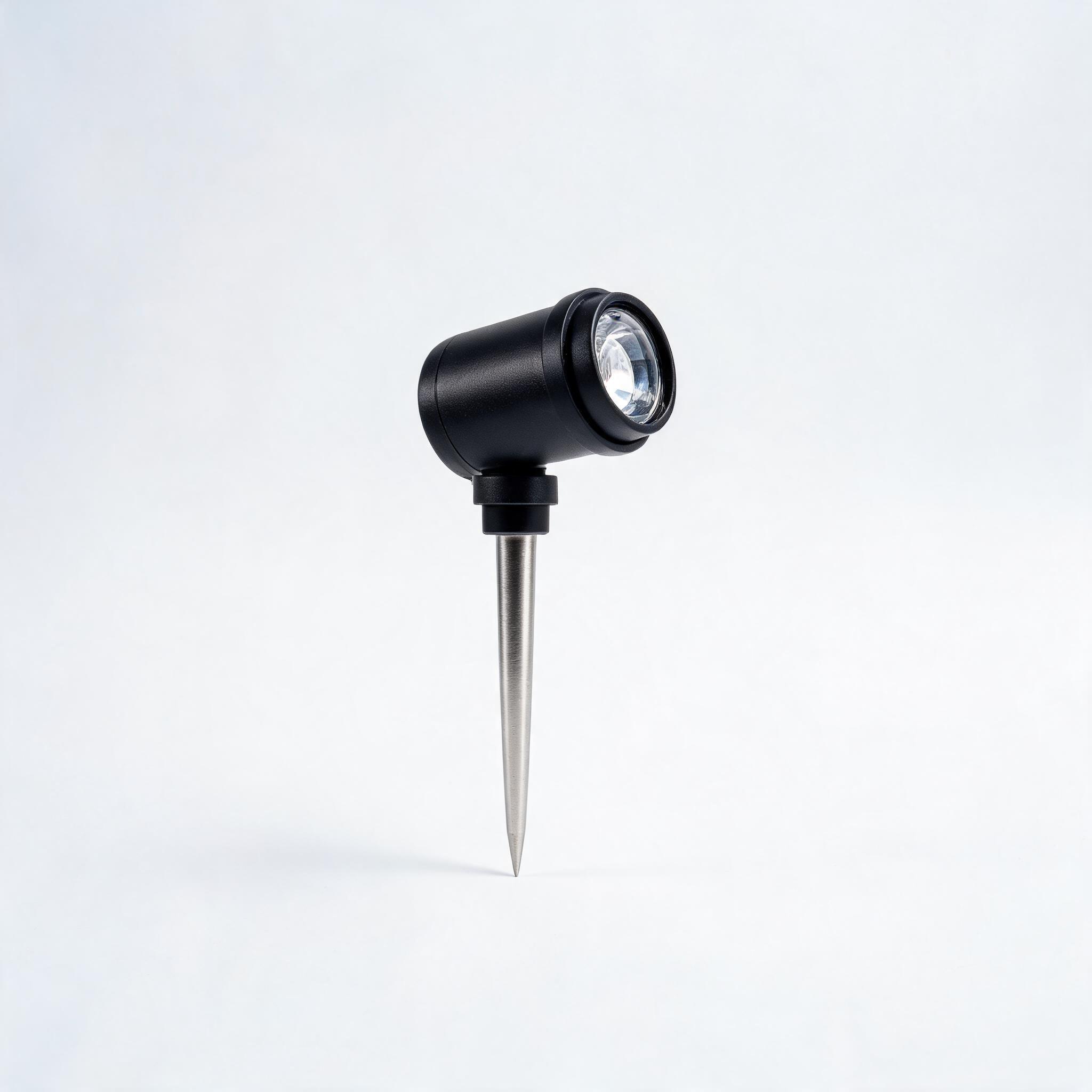
A guide to choosing a 15°, 30°, or 60° angle with real installation scenarios, wattage selection, and common mistakes. Covers the OKELI 10/20/50 W adjustable spotlight range.
Landscape lighting guide
How to choose the right beam angle for LED landscape floodlights
Beam angle is the most underestimated specification in landscape lighting. Get it wrong and a mature pine looks like a post under a floodlight, or a wide facade is half-lit with a dark band down the middle. Get it right and the same fixture performs three different tasks on a project without changing equipment.
This guide breaks down what beam angle does on site, how 15°, 30°, and 60° compare in real installation scenarios, and how to specify the right fixture for each landscape zone. Along the way we reference the OKELI floodlight range in 10W, 20W and 50W — all three offer continuously adjustable 15°–60° beams, so the principles apply across the full power range.
Key point: beam angle controls how light spreads from the fixture, not how bright it is. A 50W floodlight at 15° throws a tight, intense beam 10+ meters. The same 50W at 60° spreads across a wide area but effectively reaches only 3–4 meters. Power determines total output; beam angle determines the shape that output takes.
What beam angle actually means
Beam angle is the angle at which light intensity drops to 50% of maximum (the center beam). A 15° fixture produces a narrow, concentrated cone; 60° produces a wide, diffuse one. The difference is not subtle — it changes everything about how and where you mount the fixture.
Why this matters specifically for landscape lighting:
- Subject height and distance: a 6-meter tree trunk needs a narrow beam to reach the canopy without flooding the neighboring window. A 2-meter garden wall needs a wide beam for even wash.
- Subject width: a 0.5 m column or statue needs a narrow beam so surrounding paving is not lit. An 8 m facade needs a wide beam — or several narrow beams spaced apart.
- Glare control: wide beams cause less glare because light is distributed over a larger area. Narrow beams concentrate intensity and can be uncomfortable when viewed directly.
- Fixture count: the right angle can reduce the number of units: a single 60° beam of the right power covers what would otherwise require two 30° fixtures.
Narrow 15° beam — when and why
A 15° beam produces a tight cone of light about 1 meter in diameter at a 4-meter throw. It is the landscape equivalent of a theatrical spotlight — intense, focused, dramatic.
Best applications for 15°:
- Uplighting trunks: a 15° beam aimed upward at a mature trunk creates a dramatic column of light along the trunk line without washing the canopy — the classic palm-uplighting effect at resort and hotel entrances.
- Accenting tall columns: architectural entrance columns, portico supports, monument plinths. A narrow beam lights the column through its full height without washing the adjacent wall.
- Distant focal points: sculptures, water features, or signage 6–10 meters from the nearest fixture position. A 15° beam at 50W (4,000 lm) reaches subjects at this distance, where wide beams lose intensity.
- Flagpole lighting: narrow beams are the standard for vertical uplighting without spill.
When 15° is NOT suitable:
Avoid 15° for low subjects (under 2 meters), wide surfaces, and any application where the viewer sees the fixture up close from a frontal position. Concentrated intensity produces harsh glare and hot spots on surfaces closer than 2 meters.
Medium 30° beam — the all-rounder
The 30° beam is the default angle for landscape lighting. A cone about 2 meters in diameter at a 4-meter throw is wide enough for most garden subjects and narrow enough to retain direction and drama. If you need to specify one angle for an entire residential project and get it right, this is 30°.
Best applications for 30°:
- Uplighting medium trees (4–7 m): a 30° beam covers the trunk and lower canopy of a medium tree without the spotlight effect of 15°. A 20W floodlight at 1,600 lm with a 30° setting is a working combination for tree uplighting in hotel courtyards and residential estates.
- Shrub and flower bed accents: A 30° beam covers a 1.5–2 m planting area from a ground stake — lighting a group of shrubs rather than a single plant.
- “Sliding” light across narrow façade sections: for walls 2–3 m wide, an upward-directed 30° beam creates a pronounced effect that reveals the texture of stone, render, or cladding.
- Marking the edges of paths and steps: directed downward from a low position, a 30° beam marks the edges without the flat over-lighting of a 60° flood.
Wide 60° beam — flood and wash
A 60° beam produces a cone about 4.5 metres in diameter at a 4-metre throw. This is the widest setting on the adjustable floodlight, working more like a small floodlight than a spot. The light spreads quickly and loses intensity with distance, so 60° is best for short-range wide-area flooding.
Best applications for 60°:
- Façade flooding (wide sections): a 60° beam 1.5–2 m from the wall creates even flooding up to 3–4 m of wall height. For wider façades, space 60° fixtures 3 metres apart.
- Garden flower bed flooding: when the goal is atmospheric garden lighting rather than dramatic accent, 60° distributes light across a wide planting area from a single fixture.
- Hedge and wall perimeter: a 60° beam along a hedge line or boundary provides soft, even coverage that defines the landscape edge without hot spots.
- Floodlight replacement: in mixed-use projects where a separate floodlight is not justified, a 50 W floodlight at 60° provides sufficient spread for the small floodlight function.
When 60° does NOT suit:
Do not use 60° for uplighting trees taller than 4 metres: the beam spreads too wide and loses intensity before reaching the canopy — the top of the tree stays dark. Also avoid 60° where light spill must be controlled: a wide flood will light everything within range, including areas you did not plan to illuminate.
Beam angle comparison
| Beam angle | Cone diameter at 4 m | Best subject height | Typical application | Recommended wattage |
|---|---|---|---|---|
| 15° | ~1.0 m | 6–10 m | Tree trunk, column, distant focus | 20–50 W |
| 30° | ~2.1 m | 3–7 m | Medium tree, flower beds, façade attachment | 10–50 W |
| 60° | ~4.6 m | 1–4 m | Façade flooding, garden flooding, hedge perimeter | 10–50 W |
Beam angle and wattage interplay
Angle and wattage work together. A 10 W floodlight at 15° gives a narrow beam with a 3–4 metre range — useful for small trunks and garden features. 50 W at 15° reaches 10+ metres — suitable for mature trees and tall architectural elements. The same angle behaves completely differently depending on how much light is behind it.
How the three OKELI wattages pair with beam angles:
- 10 W / 800 lm — the best choice at 30°–60° for close-range accents. At 15° the beam is narrow but does not reach subjects above 4 metres. Ideal for residential flower beds, small specimen plants, and patio perimeters.
- 20 W / 1,600 lm — the most versatile. It performs well across the full 15°–60° range: at 15° it reaches medium trees (4–7 m), at 60° it covers façade sections up to 3 m wide. This is the fixture most contractors specify by default.
- 50 W / 4,000 lm — built for reach. At 15° it illuminates mature trees and multi-storey façades; at 60° it works as a floodlight for large commercial entrances. Use it where 20 W is not enough for the required throw distance.
The advantage of an adjustable angle
Fixed-beam floodlights force you to stock several SKUs — narrow, medium, wide — and hope you guessed the angle before installation. An adjustable beam eliminates that problem.
The OKELI floodlight range uses a continuously adjustable beam ring: turn the bezel to any angle between 15° and 60° and lock it. No lens changes, no tools, no extra parts. This means:
- One SKU covers every zone: a mixed-use project with tree uplighting (15°), shrub accents (30°), and façade flooding (60°) uses a single model across the whole site. Purchasing and spares are simpler.
- On-site adjustment: if a tree has grown since the design stage or the planting plan has changed, the angle can be re-set on site without replacing the fixture. This is especially valuable for contractors handling post-installation corrections.
- Visual consistency: the 10, 20, and 50 W versions share a single die-cast aluminium housing. A project using all three wattages keeps a uniform fixture appearance between zones.
Common beam angle mistakes
1. Narrow beam for close-range subjects
A 15° beam 1 metre from a garden wall produces a hot spot about 25 cm in diameter — the rest of the wall stays dark. If the fixture is closer than 2 metres to the subject, use 30° or 60°.
2. Wide beam for tall subjects
A 60° beam on an 8-metre tree loses most of its intensity before reaching the canopy: the trunk is lit, the canopy is dark. For subjects above 4 metres, use 15° or 30°.
3. Mixing angles without a plan
Randomly varying angles across a project creates visual inconsistency. Plan angles by zone: narrow for vertical elements, medium for mid-range accents, wide for surface flooding. Use the same angle for similar subjects across the whole site.
4. Overlooked light spill
Wide beams spill light beyond the intended subject. In residential areas this means light into neighbours’ windows; in commercial areas, glare for pedestrians and drivers. Check the beam spread against site boundaries before finalising fixture positions.
OKELI floodlight specification
All three wattages in the OKELI landscape floodlight range share these specifications:
- Housing: die-cast aluminium with powder coating
- Sealing: IP67 (submersion-rated, not just splash-proof)
- Beam: 15°–60°, continuous tool-free adjustment
- Mounting: stainless steel ground stake included
- Driver: built-in 220 V transformer (110 V on request)
- LED lifetime: 50,000 hours
- Warranty: 3 years with piece-for-piece replacement
- Certification: manufactured under ISO 9001; CE, ETL, and RoHS available
OKELI LIGHTING has manufactured outdoor lighting since 2009 at a 35,000 m² facility with ISO 9001 certification. The company offers OEM/ODM services: customized wattages, colour temperatures (2700K, 3000K, 4000K), RAL colours, and private label packaging from MOQ. Samples are available for pre-production approval — 7–10 working days; production lead time is 40–45 working days.
Frequently asked questions
Can the angle be changed after installation?
Yes. The adjustable beam ring is designed for on-site changes: turn the bezel to the new angle and lock it. No tools and no lens changes. This is useful when plantings grow into the light path.
Which wattage should I start with for a residential project?
20 W at 1,600 lm is the most versatile choice: it covers most residential tasks (tree uplighting, façade attachment, garden accents). Add 10 W for intimate areas and 50 W for tall trees and wide façades.
Do the 10, 20, and 50 W versions look identical?
Yes. All three use the same die-cast aluminium housing profile and finish. In a project with mixed wattages, the fixtures look uniform from ground level; the difference is in the internal LED output, not the appearance.
What happens if water gets inside?
IP67 sealing means the optical chamber is rated for immersion up to 1 metre for 30 minutes. Irrigation, heavy rain, and surface flooding will not reach the LED module or driver. No gasket servicing is required between service intervals.
Can I get samples for specification?
Yes. Samples are available for pre-production approval and specification sign-off. Lead time is 7–10 working days. Send your project requirements and we will quote sample prices.
Need help choosing the beam angle and wattage for your project? Send us your site plan, subject heights, and fixture positions. The OKELI technical team will recommend wattage and angle for each zone, along with pricing and lead times. Contact us.