
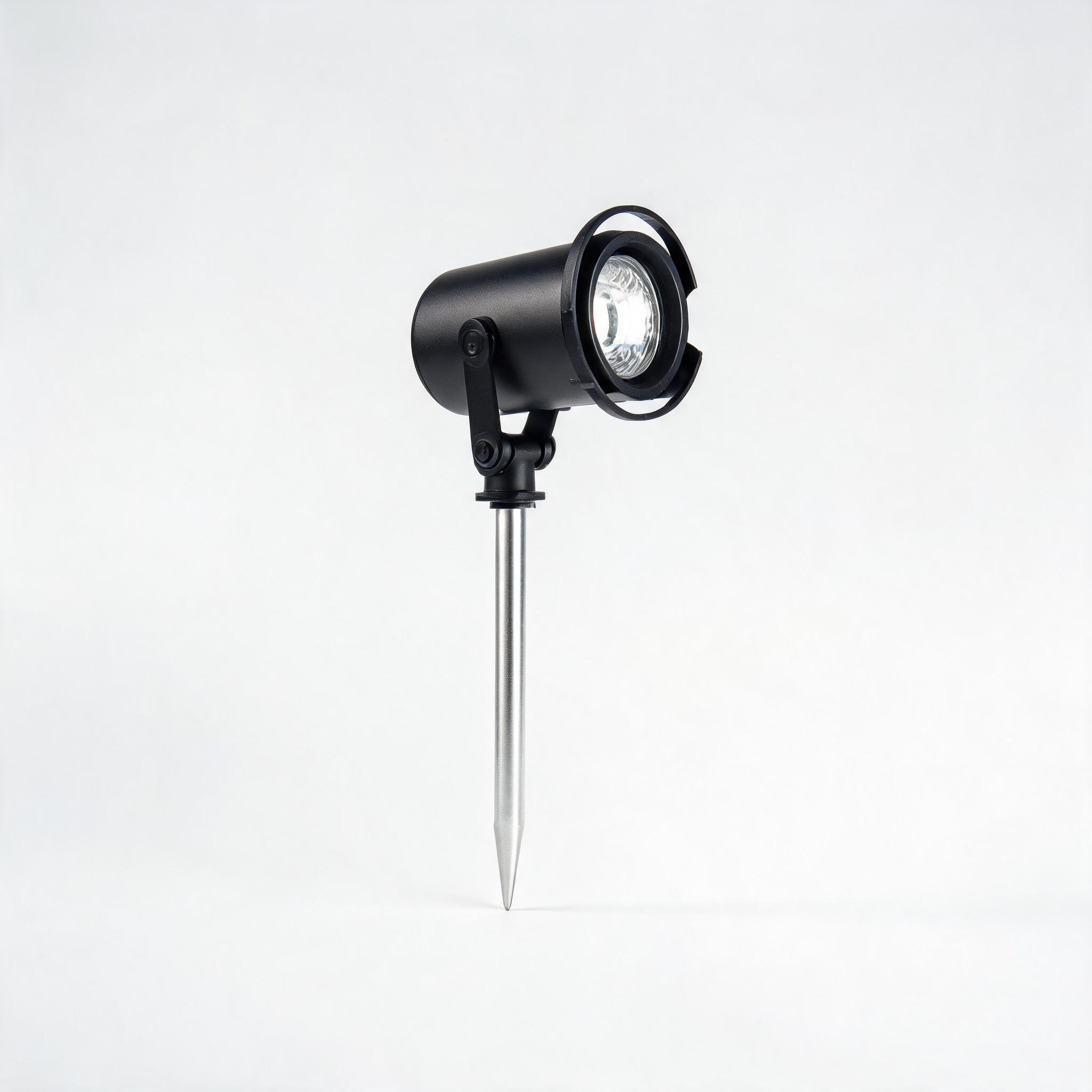
A practical beam angle guide: what 15° and 60° mean on site, when to use narrow or wide beams, why adjustable fixtures simplify procurement, and how to match the angle to the application type.
Landscape Floodlight Specification Guide
How to Choose the Right Beam Angle for Landscape Floodlights
Beam angle is the specification that most often separates a working landscape project from a failed one. The right choice: a single fixture type covers everything from narrow tree trunk accents to broad façade washes. The wrong choice: over-ordering fixtures, compensating for hot spots, or redesigning mid-project because the light effect did not match the intent.
This guide breaks down how beam angle works in practice, what separates 15° from 60° on site, and why an adjustable-beam fixture has become the preferred specification for contractors and distributors looking to reduce SKU count without losing design flexibility.
Contents
- 1. What beam angle means in landscape lighting
- 2. Narrow beam (15°–25°): when and where to use it
- 3. Wide beam (45°–60°): when and where to use it
- 4. The problem with fixed-beam fixtures
- 5. Adjustable beam: one SKU, the full range
- 6. Matching beam angle to target type
- 7. Specifying angles in a mixed-use project
1. What beam angle means in landscape lighting
Beam angle describes how widely light spreads from a fixture. A narrow angle gathers light into a tight cone, creating a bright focused circle on the target. A wide angle distributes light across a larger area, creating a soft, diffuse wash. The angle is measured where light intensity falls to 50% of the maximum at the center of the beam.
In practice: a 15° beam from a fixture 3 meters from a tree trunk produces a light circle about 80 cm in diameter on the target. A 60° beam from the same distance produces a circle closer to 3.5 meters. That is the difference between highlighting a single columnar trunk and washing a section of wall.
| Beam angle | Light circle at 3 m | Light circle at 5 m | Typical application |
|---|---|---|---|
| 15° (narrow) | ~0.8 m diameter | ~1.3 m diameter | Columnar trunks, narrow architectural details, signage accents |
| 25° (spot) | ~1.3 m diameter | ~2.2 m diameter | Medium tree trunks, sculptures, column lighting |
| 45° (flood) | ~2.5 m diameter | ~4.2 m diameter | Uplighting canopies, washing entrances, hedges |
| 60° (wide flood) | ~3.5 m diameter | ~5.8 m diameter | Façade washing, broad wall grazing, zone accents |
Key takeaway for procurement: beam angle determines how many fixtures are needed to light a given target. A wide beam covers more area per fixture, but with lower intensity per square meter. A narrow beam delivers higher intensity over a smaller area. The decision is to match the beam to the target.
2. Narrow beam (15°–25°): when and where to use it
Narrow angles serve applications where precision matters more than coverage:
- Columnar tree lighting — cypresses, Italian poplars, and other narrow-canopy trees need a tight beam that concentrates light on the trunk without washing adjacent plantings. A 15° beam at a 3 m distance lights the trunk without touching foliage behind.
- Architectural columns — entrance columns, portico supports, and structural elements where the intent is to emphasize the vertical form, not the wall behind. A narrow beam creates a crisp column of light across the face of the column.
- Signage and detail accents — highlighting a specific sign, a sculpture detail, or a water feature jet. A narrow beam places light exactly where needed and nowhere else.
- “Grazing” light across textured surfaces — when mounted close to a stone or brick wall, a narrow beam grazes the surface at a low angle, revealing texture and depth through shadows. The technique is common in hotel courtyards and boutique façades.
The risk of narrow beams is over-concentration: if the beam is too tight for the target, you get a hot spot — a harsh bright circle that draws the eye for the wrong reason. This is the most common complaint from landscape architects on mockup installations.
3. Wide beam (45°–60°): when and where to use it
Wide angles cover tasks that require even surface wash rather than a focused accent:
- Façade washing — uplighting a façade from ground level requires a wide beam that covers the full width of the wall section from a single position. A 60° beam 5 meters from the wall covers almost 6 meters of façade width.
- Canopy uplighting — mature trees with broad canopies require wide-beam fixtures along the canopy projection line to light the lower portion. A narrow beam creates a bright spot on one branch; a wide beam fills the canopy with even light.
- Hedges and flower beds — continuous hedge rows and wide flower beds require wide beams for even wash across the entire area. Narrow beams produce “peas” of light that break the intent.
- Entrance and feature washing — hotel and resort entrance areas, water features, and sculptures that need to be lit as a whole, not in sections.
The risk of wide beams is under-lighting: too wide a spread makes the target look dim. Here wattage intersects with angle: a 50 W fixture at 60° delivers enough light to effectively cover a broad area, whereas 10 W at 60° may lack the output for the wash to be visible from a distance.
4. The problem with fixed-beam fixtures
Most floodlight lines offer fixed angles: a 30° version, a 45° version, maybe 60°. The procurement logic seems straightforward: buy the angle for the job. In practice, this creates three problems:
Three problems with fixed beams
- SKU proliferation — a mixed-use project with tree lighting, façade washing, and entrance accents requires three different angles: three item codes, three stock positions, three sets of spares. For a distributor, every SKU is stocking and ordering complexity.
- On-site changes — landscape projects change during installation: a tree is pruned differently than expected, the planting plan is revised, a hedge replaces a specimen. With a fixed beam, a change means replacing the fixture; with an adjustable beam, it means turning the ring.
- Inconsistent effect across zones — when zones use different fixed angles, the light effect visibly “drifts” when viewed across the site. An adjustable fixture set to one angle in all zones delivers a consistent visual language.
5. Adjustable beam: one SKU, the full range
An adjustable-beam floodlight solves all three problems. One fixture with continuous adjustment from 15° to 60° replaces two or three fixed SKUs. Tool-free adjustment: turn the ring to narrow or widen the beam and lock it. No lens kits, no adapter rings, no toolbox.
For distributors and contractors, the benefit is simple inventory management: one position instead of three. For designers, the benefit is flexibility: the same fixture is set to 15° for a narrow tree accent on one side of the site and to 60° for façade washing on the other — with identical housing and light quality across the entire installation.
The OKELI landscape floodlight line applies this approach across all three wattages:
- 10 W / 800 lm — accent lighting for residential and intimate commercial spaces. 10 W floodlight.
- 20 W / 1,600 lm — mid-range for hotel courtyards, estates, and light commercial projects. 20 W floodlight.
- 50 W / 4,000 lm — high output for large commercial areas, mature trees, and wide façade washing. 50 W commercial-grade floodlight.
All three use the same die-cast aluminum housing, IP67 sealing, and built-in 220 V driver, so a project with different wattages maintains a consistent fixture appearance across all zones.
6. Matching beam angle to target type
The table below matches typical landscape targets to the recommended angle setting. These are specification starting points; always verify with an on-site mockup before a production order.
| Target type | Size | Recommended beam | Why |
|---|---|---|---|
| Columnar tree (cypress, poplar) | 0.5–1 m wide | 15°–25° | Light on the trunk, no wash on plantings behind |
| Medium ornamental tree | 2–4 m canopy | 25°–45° | Cover the trunk and lower branches without hot spots |
| Mature shade tree | 6–10 m canopy | 45°–60° | Wash the lower canopy from the projection line |
| Architectural column | 0.4–0.8 m diameter | 15°–25° | Emphasize the vertical, “reveal” texture |
| Façade section | 3–6 m wide | 45°–60° | Even wall wash for the wall area |
| Water feature / fountain | 1–3 m | 25°–45° | Highlight without suppressing water movement |
| Sculpture / statue | 0.5–2 m high | 25°–45° | Reveal form and texture without flat overexposure |
| Hedge row | continuous | 60° | Even wall wash along the entire planting length |
7. Beam angle specification for a mixed-use project
A typical commercial landscape project—for example, a resort hotel—includes different zones: entrances, path borders, specimen tree lighting, facade accents, and water features. Each zone requires its own beam angle, but the procurement team wants to minimize the number of products ordered.
With an adjustable beam, the strategy is as follows:
- Order one model at a wattage suited to the project scale. For a resort, the 20 W / 1,600 lm version is usually the workhorse; for large commercial sites, the 50 W / 4,000 lm version carries the main load.
- Set the beam angle by zone during installation. 15° on entrance columns, 45° on mid-size trees, 60° on facade sections. The installer rotates the ring, locks it, and moves to the next fixture.
- Keep a small stock of the adjacent wattage for special cases. 10 W for intimate courtyard details, 50 W for the tree at the main entrance. All three share one housing, so the visual language is consistent.
This approach reduces the number of SKUs from five or six fixed models to two or three adjustable ones. For a project ordering 80–200 floodlights, the simplification of procurement and inventory is significant.
Common beam angle mistakes
- Narrow beam for wide objects — a 15° beam on a 6 m facade section produces a bright circle in the center and darkness at the edges. The solution is to widen the beam, not to add fixtures.
- Wide beam for tall narrow objects — a 60° beam on a columnar tree spills light past the trunk into the plantings behind, wasting flux and creating light spill. Narrow it to 15°–25°.
- One angle for all zones — even with adjustable fixtures, some installers set every unit to one angle “for consistency.” The effect is then incorrect for objects that require a different beam. Adjust by zone, not by site.
- Comparing wattages without considering beam angle — 20 W at 15° produces a noticeably brighter effect on the object than the same 20 W at 60°, because the light is concentrated. When comparing fixtures, always consider the beam angle, not just lumens.
- Skipping the mockup — a beam angle specification on paper does not always translate to the site as expected. Always set up two or three fixtures at the required angles and distances, view them at night, and adjust before ordering the full quantity.
FAQ
Q: Can the beam angle be changed after installation?
A: Yes. On OKELI adjustable floodlights, the beam ring turns by hand and locks. If the landscape changes, a tree grows, or the effect needs correction, the angle is readjusted on site—without tools or replacing the fixture.
Q: Does the total luminous flux change when adjusting the beam angle?
A: No. The fixture’s total flux remains the same. Narrowing the beam concentrates the same light on a smaller area, increasing intensity on the object. Widening distributes the same light over a larger area, reducing intensity per square meter but increasing coverage.
Q: One wattage with different angles or different wattages?
A: For most mixed-use projects, one wattage with different beam angle settings is more efficient: it simplifies procurement, inventory, and maintenance. Higher wattage is needed when the object size or mounting distance requires more “raw” flux, not when the same effect can be achieved by adjusting the beam angle.
Q: What beam angle should be set for a hotel entrance?
A: It depends on the element. For the entrance column—15°–25°. For a sculpture or water feature—25°–45°. For washing the entrance facade—45°–60°. A hotel entrance typically uses all three settings on different fixtures within the same zone.
Next steps
If you are specifying landscape floodlights for a commercial project, request samples of the adjustable floodlight at a wattage suited to the project scale. Install two or three units with different beam angle settings, view them at night, and confirm the effect before placing the full order. The OKELI technical team can help match beam angles to project zones and select wattage based on object heights and mounting distances.
Request floodlight samples or a project proposal
Send us the project zones, object types, and mounting distances. We will recommend beam angle settings, wattage selection, and fixture quantities within one business day.
Contact OKELI Lighting