
A practical buying guide: choosing 304 stainless steel, IP67 vs IP65, wattage and beam distribution, control, bollard height, and common specification errors.
Bollards and Post Lights — A Procurement Guide
If you are lighting pathways for a resort, a residential estate, or a commercial plaza, the bollard you choose will most likely stand in the ground for the next decade. That makes the selection decision worth getting right the first time. The wrong housing material rusts within a single coastal season. The wrong IP rating lets monsoon water into the LED compartment. The wrong control mode leaves fixtures burning at noon because nobody wired a sensor. This guide breaks down the specification decisions that actually matter when choosing stainless steel bollards for outdoor projects — and where the OKELI range fits each of them.
Why Grade 304 Stainless Steel Matters for Bollards
The most common failure in outdoor pathway lighting is not the LED but the housing. Powder-coated steel chips at the base, where trimmers and pedestrians wear away the coating. Once bare metal is exposed, rust climbs the post within a matter of months. Zinc alloys pit in salt air. Aluminum is lighter and corrosion-resistant but dents under impact and oxidizes unevenly in coastal climates.
Grade 304 stainless steel solves these problems because corrosion resistance is a property of the metal itself: there is nothing to fail. The same alloy is used in professional kitchen equipment and marine hardware for exactly this reason. Installed on a coastal path, a stainless steel bollard in 304 finish withstands salt spray, irrigation, and monsoon rain without surface degradation, pitting, or rust stains on adjacent paving.
This is not a marginal advantage. In tropical and coastal markets — Southeast Asia, the Middle East, the U.S. Gulf Coast — painted bollards show their first surface rust within 6–12 months. Specifiers who have already replaced a fully rusted row at their own cost switch to stainless steel and do not go back.
LED Bollards: Wattage, Lumens, and Beam Distribution
Once the housing material is settled, the next decision is light output. LED bollards are not equal just because they use LEDs. The questions to answer:
- How much light does the path need? A 1.2 m garden path needs far less light than a 3 m commercial trail. Overlighting creates glare for pedestrians and washes out the landscape.
- Which beam distribution works? A 120° diffuse beam evenly covers the path width without hot spots. Narrower beams concentrate light but create dark bands between fixtures.
- Which color temperature suits the environment? 3000K warm white is the standard for HoReCa and residential landscapes: it flatters stone, wood, and planting. 4000K and above read as functional or security lighting and break the atmosphere of a premium space.
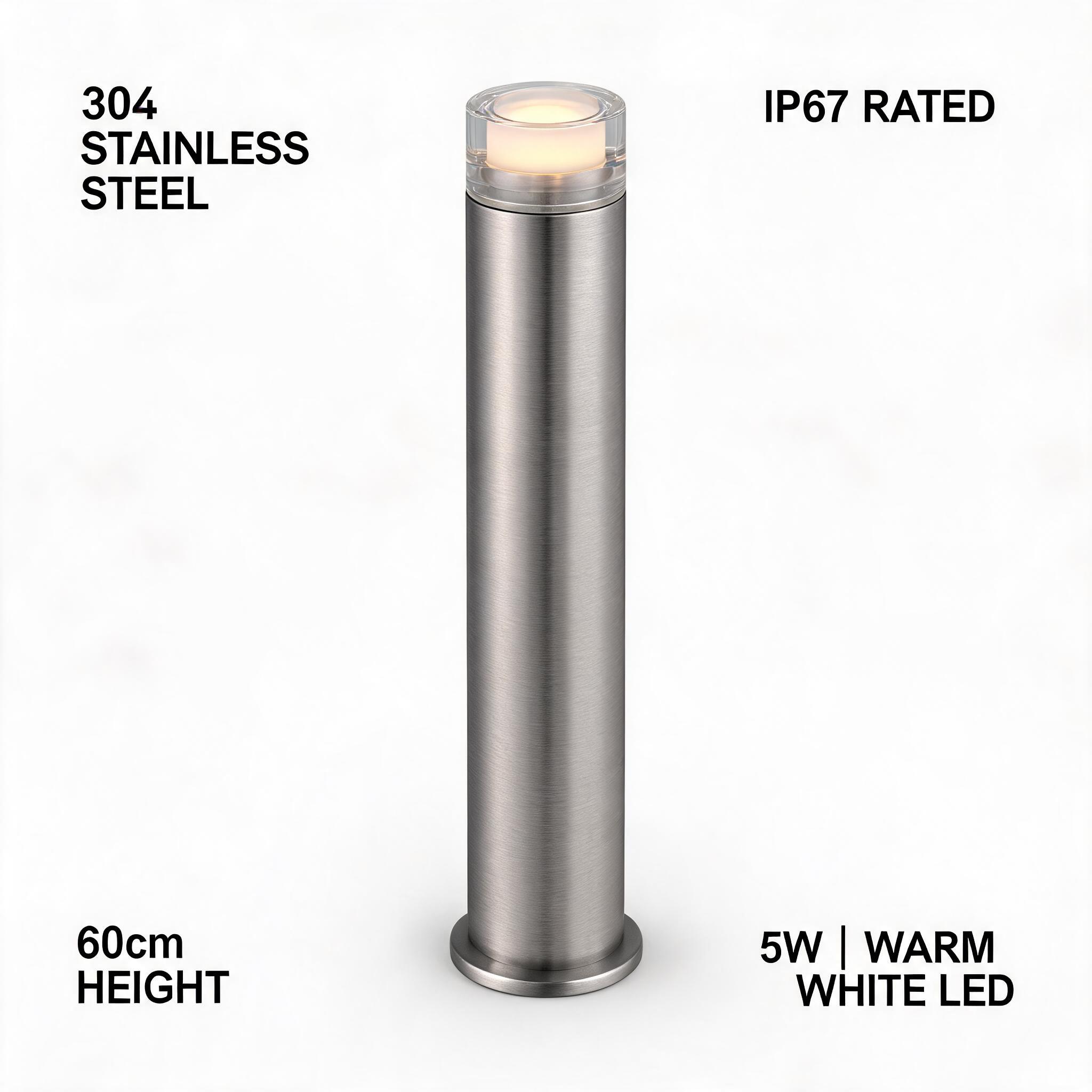
The OKELI bollard range covers these variables with two height-and-wattage points. The 60 cm, 5 W / 500 lm bollard covers standard path layout with a 120° beam at 3000K warm white. For low borders, compact courtyards, and accessible routes where a 60 cm post would rise above the hedge, the 40 cm, 3 W / 300 lm version offers the same Grade 304 stainless steel in a proportionate format. Both use the same tempered-glass diffuser and 120° beam, so mixing heights in a project creates layered path lighting without visual mismatch.
There is also the 6 W garden light — an IP65 stainless steel construction with stake and surface-mount supports — convenient for projects that need a single SKU for both soft ground and paving.
IP Rating: What IP67 Actually Gives You
IP ratings are not marketing labels but specific test conditions. Here is what the numbers mean for outdoor bollards:
| Rating | Solid particles | Water | Practical meaning for pathways |
|---|---|---|---|
| IP54 | Dust protected | Splashes from any direction | Sheltered positions only — entrances under canopies |
| IP65 | Dust-tight | Water jets from any direction | Rain and irrigation — sufficient for most garden paths |
| IP67 | Dust-tight | Immersion up to 1 m for 30 min | Withstands surface flooding, monsoon puddles, direct irrigation |
Moving from IP65 to IP67 is not a small step down in quality. IP67 means the fixture withstands temporary immersion: standing water on the path after a tropical downpour, direct irrigation, flooding from a blocked drain. None of this reaches the LED compartment or the photocell. For monsoon climates, flood-prone sites, and areas with heavy irrigation systems, the difference between IP65 and IP67 is the difference between a maintenance-free fixture and a warranty claim in the first year.
For a more detailed comparison of ratings, see our IP67 vs IP65 guide.
Dusk-to-Dawn Mode: Why Automation Matters
On paper, a light sensor that switches the fixture on at dusk and off at dawn is a minor convenience. In practice, for a resort with 80 bollards, it removes two real cost lines.
The first is staff labor walking the grounds to switch fixtures on and off — or, worse, not doing so, leaving fixtures burning in daylight. The second is energy loss from running 14+ hours a day instead of the 10–12 hours of actual darkness. On a large installation, these losses add up quickly.
All three bollards in the OKELI range have a built-in photocell as standard. There is no timer to program, no app to configure, and no smart hub to install. The sensor reads ambient light and runs each on/off cycle itself, including seasonal changes in day length, with no setup at all.
Bollard Height for the Project Environment
Bollard height is not just aesthetics: it determines where the light falls and how the fixture reads in the landscape:
- 30 cm — ground-level marking. Optimal for solar applications without wiring. See the Grade 304 stainless steel solar fixture as an off-grid solution.
- 40 cm — low-profile path-edge marking. Concealed beneath most hedges and borders. The right choice for compact courtyards, children's routes, accessible paths, and Japanese-style gardens where proportion matters. See the 40 cm bollard.
- 60 cm — standard marking for paths and driveways. Visible above low planting, it gives clear wayfinding for pedestrians and vehicles. The most common specification for hotel paths, driveways, and commercial trails. See the 60 cm bollard.
On mixed-use projects, combining 40 cm and 60 cm heights creates layered path lighting: tall fixtures at intersections and entrances for visibility, low fixtures along borders for soft edge marking. Because both heights share one Grade 304 stainless steel platform, 3000K color temperature, and IP67 rating, the visual language of the installation stays consistent.
LED Lifespan and Maintenance Planning
A 50,000-hour LED lifespan is an easy figure to quote. What it means for a project: at 12 hours of nightly operation, that is roughly 11 years of daily service before the first light source replacement. For commercial installations where replacement requires groundworks, lifting equipment, and coordination with a property manager's schedule, this eliminates the relamping cycle for the life of most service contracts.
This matters most on large installations. A row of 100 bollards across a resort grounds is not something you want to revisit for lamp replacement in year three. The combination of a Grade 304 stainless steel housing (no coating failure) and a 50,000-hour LED (no lamp replacement) makes a bollard installation genuinely maintenance-free rather than merely advertised as such.
Specification by project type
Hotel and resort pathways
Coastal resorts face the toughest combination: salt-air corrosion, irrigation systems, high guest expectations for ambiance, and large fixture counts that make manual maintenance impractical. 304 stainless steel eliminates corrosion failure. IP67 handles irrigation and tropical rain. 3000K warm white delivers the hotel-standard ambiance. Dusk-to-dawn automation removes staff involvement.
Residential estate driveways
Premium residential developments require lighting that looks expensive and stays that way. Painted steel degrades visually within a year; 304 stainless steel preserves its finish indefinitely. A 60 cm height provides clear boundary marking without the institutional look of a taller post.
Commercial plazas and parks
High-traffic commercial environments require fixtures that survive impacts, weather, and neglect. The tempered glass diffuser in the OKELI bollard range offers both impact resistance and sealing. A 120° beam evenly covers wide paths without the glare that narrow beams create for pedestrians walking toward the light.
Common specification mistakes
1. IP65 for flood-prone areas. IP65 withstands rain and splashing, but not standing water. If puddles form on site after heavy rain, only IP67 will keep the LED compartment dry.
2. Mixing color temperatures within one project. 3000K and 4000K bollards on the same pathway create a visible color conflict that looks unprofessional. Specify one temperature for the entire installation.
3. Choosing height by appearance alone. A 60 cm bollard next to a low curb outgrows its setting. A 40 cm bollard on a wide commercial path may not provide sufficient marking. Match the height to the landscape context, not to a catalog photo.
4. Ignoring the photocell. Fixtures without automation either waste energy by running during the day or require manual labor. On a 50-unit installation, that labor cost exceeds the cost of the fixtures within a few months.
What to ask a supplier before ordering
When evaluating bollard suppliers, these questions separate manufacturers from intermediaries:
- What is the actual housing material: solid stainless steel or painted steel presented as a stainless finish?
- What is the tested IP rating, and can the supplier provide documentation?
- Is the photocell built in, or does it require a separate control system?
- What is the rated LED lifespan, and how is the warranty structured (replacement for replacement or repair)?
- Are custom heights, finishes, and private-label packaging available from MOQ?
- Which certifications apply to the target market (CE, ETL, RoHS)?
OKELI manufactures under ISO 9001 quality management at a 35,000 m² facility. CE, ETL, and RoHS certificates are available; specify your target market in the inquiry. MOQ is 100 units for standard configurations; custom heights from 30 to 100 cm, alternative finishes, and private-label packaging are available from MOQ. Samples ship in 7–10 working days; production lead time is 40–45 working days from order confirmation.
Complementary lighting for a complete pathway scheme
Bollards mark the edge of a pathway, but most projects need other fixture types as well. For a complete outdoor scheme, combine bollards with:
- Landscape floodlights for uplighting trees and accent features — see the 10W floodlight or the 20W version for medium-scale sites.
- Solar lights for remote areas where trenching is impractical — the 304 stainless steel solar light enables installation without wiring at the same material quality.
- Step and deck lights for elevation changes — the 3W recessed light mounts flush with risers.
Full catalog on the website OKELI LIGHTING; additional outdoor lighting options are in the range. More procurement guides and technical articles are in the news section.
Next steps
If you are planning a pathway lighting project, the most effective next step is to request samples for pre-production approval. Send your project type, fixture quantity, target market, and custom specification requirements; our technical team responds within one working day with pricing, MOQ confirmation, and lead times.
For more on material selection beyond 304 stainless steel, see our bollard material comparison. For commercial pathway specifics, see the guide to selecting bollards for commercial pathways.
Browse the full OKELI range or request a project quotation — contact our team today.