
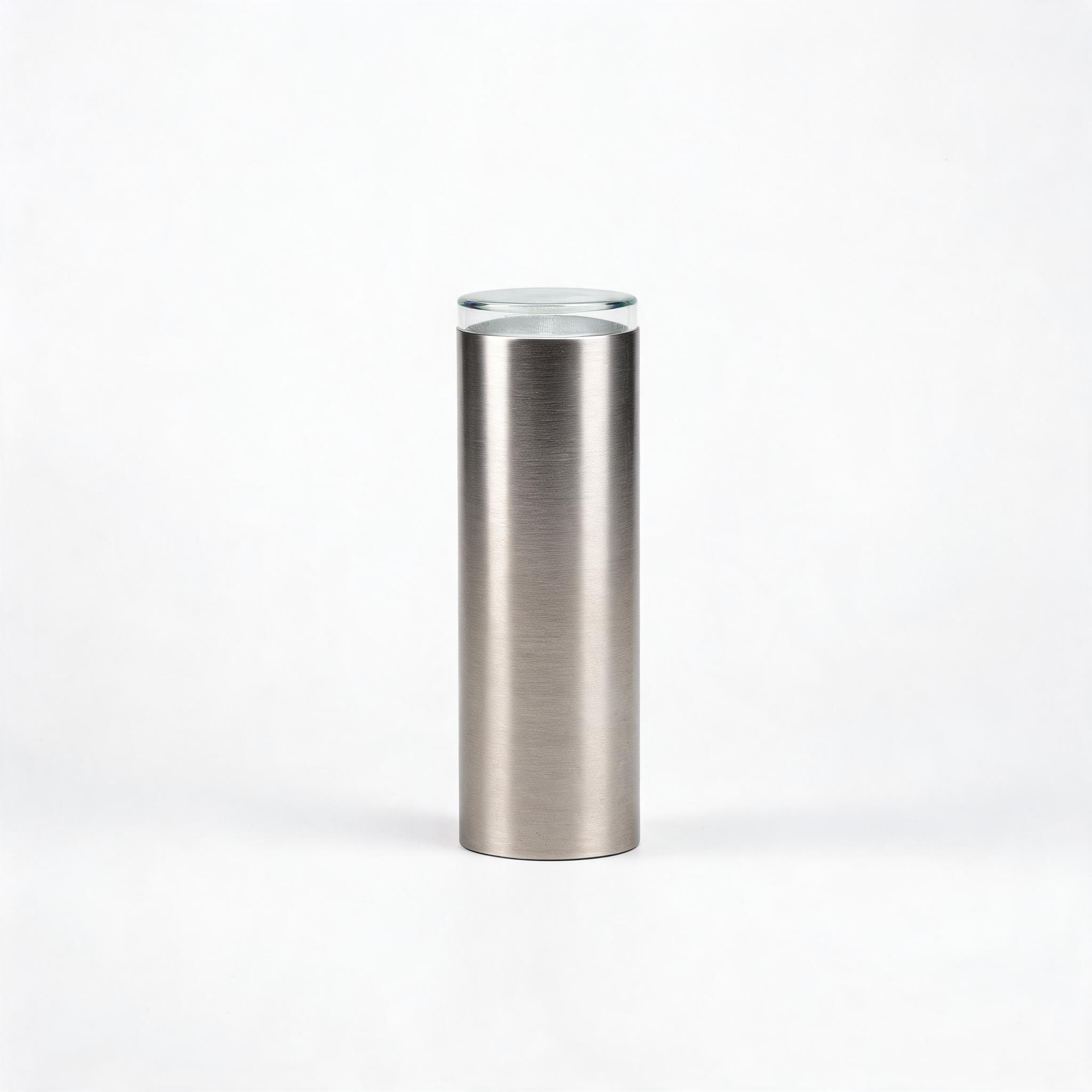
A seven-point guide to specifying bollards for commercial pathways: material, IP rating, wattage, color temperature, beam angle, control method, and a supplier evaluation checklist.
Bollards and Pathway Lighting — A Buyer's Guide
How to Choose LED Bollards for Commercial Pathways
If you are specifying pathway lighting for a resort, residential estate, commercial plaza, or municipal park, the bollard is likely the highest-volume item in your specification. An average resort easily requires 150–300 bollards, so every decision on material, wattage, IP rating, and control method multiplies across hundreds of units. A specification error of EUR 8 per fixture becomes a EUR 2,400 problem — and a material choice that halves the replacement cycle becomes a capital expenditure item over five years.
This guide covers seven specification decisions that determine whether your installation will serve for decades or fail within two seasons, based on real data from the OKELI LIGHTING 304 stainless steel pathway bollard series and experience manufacturing outdoor LED luminaires since 2009.
Guide Contents
- 1. Material: Why 304 Stainless Steel Outperforms Alternatives
- 2. IP Rating: What IP65, IP66, and IP67 Mean for Pathway Lighting
- 3. Wattage and Luminous Flux: Brightness by Pathway Width and Height
- 4. Color Temperature: 3000K, 4000K, and 6500K for Commercial Environments
- 5. Beam Angle and Optics: Glare Control and Light Distribution
- 6. Control Method: Photocell, Timer, or Smart Control
- 7. Supplier Evaluation: What to Ask Before a Large Order
1. Material: Why 304 Stainless Steel Is Better Than Alternatives
The housing material is the most important specification of a pathway bollard: it determines whether the fixture will survive its environment or become a replacement liability. Three materials dominate the market, and each has its own failure profile.
| Material | Typical Service Life (Coastal) | Failure Mode | Best Application |
|---|---|---|---|
| Painted Steel / Zinc Alloy | 2–3 seasons | Rust through coating, structural corrosion | Budget projects, indoor only |
| Die-cast Aluminum (Powder-Coated) | 5–8 years | Coating chalking, pitting in salt air | Inland commercial sites, moderate climates |
| 304 Stainless Steel | 10–15+ years | Minimal surface oxidation, no structural failure | Coastal, tropical, humid climates, premium projects |
Grade 304 steel contains 18% chromium and 8% nickel, forming a passive oxide layer that self-repairs when scratched. The same alloy is used in marine hardware, professional kitchen surfaces, and facade cladding on coastal buildings. For a pathway bollard, this means salt spray on the coast, chlorinated air by pools, and irrigation water chemicals do not penetrate the surface or cause structural corrosion.
Painted steel and zinc alloys, by contrast, rely on a coating. Once the coating is breached — by a lawnmower chip, an installation scratch, or UV degradation of the film — the metal begins to rust. In a coastal environment, visible rust appears within 6–12 months after the coating is breached, and structural failure occurs within two to three seasons. For a project with 200 bollards, that is a full replacement cycle in year three — just when the warranty on cheap fixtures has expired.
OKELI pathway bollards are made entirely of 304 steel throughout the housing, not steel with a stainless finish. Both versions — 40 cm and 60 cm — share this specification, so the material performs equally at either height. For confirmed marine environments, 316 stainless steel (with 2% molybdenum for enhanced chloride resistance) is available as a custom option from MOQ.
2. IP Rating: What IP65, IP66, and IP67 Actually Mean
The IP rating precisely describes dust and water resistance. For pathway bollards, this is not theory: irrigation systems spray directly onto fixtures, tropical downpours create water pooling at the base, and storm drainage can temporarily submerge low-mounted fixtures.
| Rating | Dust | Water Protection | Significance for Pathways |
|---|---|---|---|
| IP54 | Dust protected | Splashes from any direction | Sheltered locations only; not suitable for open pathways |
| IP65 | Dust-tight | Water jets (6.3 mm nozzle) from any direction | Rain and irrigation; standard for general outdoor use |
| IP66 | Dust-tight | Powerful jets (12.5 mm nozzle) | Withstands washdown; for high-traffic commercial areas |
| IP67 | Dust-tight | Immersion up to 1 m for 30 minutes | Withstands flooding and water pooling; best rating for low pathway fixtures |
The key difference for pathway bollards is between IP65 and IP67. IP65 protects against jets, which covers most rain and irrigation. But bollards stand at ground level — they are the first to encounter surface water pooling during downpours and drainage overflow. IP67 adds a 1-meter, 30-minute immersion tolerance: even if the pathway floods during a storm, the LED module and driver compartment remain dry.
OKELI specifies IP67 for both versions (40 cm and 60 cm) as standard. This is a deliberate choice: the cost difference between IP65 and IP67 is negligible, while the operational difference for ground-level fixtures is substantial. The tempered glass diffuser with gasket sealing and impact resistance ensures that thermal cycling between hot days and cool nights does not degrade the seal over the service life.
3. Wattage and Luminous Flux: Matching the Task
Pathway bollards are not floodlights. Their task is to mark the edge of the pathway and provide enough light for safe navigation, not to flood the surrounding landscape. Excess wattage creates glare for guests walking toward the fixture and for anyone looking from windows — a common complaint in hotels and resorts.
The two OKELI bollard versions are calibrated for different pathway scales:
| Version | Height | Wattage | Flux | Optimal Pathway Width | Best Application |
|---|---|---|---|---|---|
| Low-Profile | 40 cm | 3 W | 300 lm | 0.8–1.2 m | Compact courtyards, garden borders, accessible paths, children's areas |
| Standard | 60 cm | 5 W | 500 lm | 1.0–1.5 m | Standard pathways, driveway edges, landscape accents, plaza edges |
For most commercial pathways, the working specification is the 60 cm, 5 W / 500 lm version: it clearly marks a 1–1.5 m wide pathway without glare spots, and the 60 cm height is visible above low planting without dominating the landscape. The 40 cm version is the right choice when the bollard should blend into the landscape: low hedges, Japanese gardens, accessible routes, intimate courtyards where a tall post breaks sight lines.
Experienced landscape designers often specify both heights in one project: 60 cm at intersections and entrances where visibility matters, 40 cm along borders and plantings where a low profile is more appropriate. Since both versions share the same 304 stainless steel platform and 3000K temperature, mixing heights delivers a consistent light tone without visual mismatch.
4. Color Temperature: 3000K, 4000K, or 6500K
Color temperature is one of the most frequently mis-specified parameters in pathway lighting, and the wrong choice can undermine the entire spatial concept. The three common options serve different purposes:
- 3000K warm white — the standard for HoReCa and residential areas. Soft amber light that flatters stone, wood, plantings, and architectural details. This is the temperature that makes a hotel pathway welcoming rather than institutional. For a resort, estate, or boutique hotel courtyard, 3000K is the correct specification.
- 4000K neutral white — a clean, modern tone. Suitable for contemporary commercial architecture, retail, and public spaces. But in a hospitality setting it can feel clinical.
- 6500K cool white — daylight tone with maximum visibility. Correct for functional and security applications — parking lots, perimeters, industrial sites — but usually wrong for hospitality pathways, where it reads as harsh and unwelcoming.
OKELI specifies 3000K as standard for both bollard versions — consistent with HoReCa and premium residential expectations. For commercial and public projects where 4000K is preferred, alternative temperatures are available on request from MOQ. The key principle: specify temperature for the environmental concept, not for maximum raw lumens.
5. Beam Angle and Optics: Glare Control
The beam angle of a pathway bollard determines how light is distributed across the pathway surface. A wide beam (100°–120°) evenly covers the pathway width — what a bollard needs, since its primary task is edge marking. A narrow beam creates hot spots beneath the fixture and leaves the edges dark.
OKELI bollards use a 120° diffuse beam through a tempered glass diffuser, delivering even, glare-free coverage across a 1–1.5 m pathway width. Downward-directed optics mean light goes where it is needed — onto the pathway surface — not into pedestrians' eyes or neighboring windows. This is especially important in hotels where ground-floor rooms open directly onto pathways.
The tempered glass diffuser also serves a practical function: it withstands debris impacts (lawnmower stones, hail, accidental kicks) and thermal cycling without cracking. Cheap acrylic diffusers yellow under UV and become brittle within two to three seasons, degrading both the light and the structure.
6. Control Method: Photocell, Timer, or Smart Control
For most commercial pathways, the simplest control method is the most reliable. A built-in dusk-to-dawn photocell requires no programming, network, or seasonal adjustment; it works at any latitude and through any seasonal cycle without intervention.
Timer control requires seasonal readjustment — an ongoing labor cost on a large installation. Smart systems (app, network) add complexity and a point of failure and are usually overkill for pathway bollards: their function is to light up in darkness and switch off in daylight.
OKELI bollards use a built-in photocell as standard. For projects requiring centralized control (dimming schedules, occupancy sensors, building management system integration), a custom option is available from MOQ. Recommendation for most buyers: start with the photocell — it covers about 90% of pathway lighting needs with zero maintenance — and reserve smart control for projects that genuinely require it.
7. Supplier Evaluation: What to Ask Before a Large Order
Before placing a large order, evaluate the supplier against five criteria that separate a reliable manufacturing partner from a trading company that will disappear after the first shipment:
Supplier Evaluation Checklist
- Production capabilities — does the supplier have its own factory with a full chain from raw material to finished product? OKELI operates a 35,000 m² facility with a full production chain.
- Quality management system — is the factory ISO 9001 certified? This is the baseline for consistent quality between batches. OKELI has been ISO 9001 certified since its founding.
- Product certification — are there certificates for your target market? OKELI products carry ETL, CE, CB, RoHS, and BIS certifications. State your market in your inquiry to confirm the applicable status.
- OEM/ODM track record — has the supplier manufactured under other brands? OKELI is an OEM partner to major retailers, including Home Depot and Lowe's, which means its processes meet the standards of large retail procurement.
- Sample policy — does the supplier provide pre-production samples for specification approval? OKELI supplies samples in 7–10 working days. Always order and approve samples before confirming a large batch.
Common specification mistakes
- Choosing IP65 for in-ground fixtures — IP65 withstands rain and splashes but not surface flooding. For ground-level bollards, IP67 is safer: it covers temporary immersion during storm drainage.
- 6500K for hotel pathways — cool white reads as security lighting, not ambiance. For a hotel, resort, or estate, 3000K warm white is the right choice.
- One height for all pathways — a 60 cm bollard beside a low curb looks out of proportion; a 40 cm bollard at a driveway intersection is too easy to miss. Match the height to the setting and mix heights where the landscape calls for it.
- Ignoring the replacement cycle — a bollard with a 30,000-hour LED needs replacement in year 7 (at 12 h/night); a 50,000-hour LED in year 11. For large installations, the four-year difference is significant maintenance savings.
- Skipping the sample stage — always order samples, check them against the specification, and approve them before mass production begins. Sample orders cost a small fraction of a large batch and catch specification errors before they are replicated across hundreds of units.
FAQ
Q: How many bollards do I need for a 100-meter pathway?
A: For standard marking with 60 cm bollards, a 3–4 meter staggered spacing gives continuous edge delineation. Over 100 m, that is 25–33 bollards per side or 50–66 on both sides. Dense spacing (2–3 m) creates a more continuous band of light; wide spacing (5–6 m) is sufficient for low-traffic residential pathways.
Q: Can 40 cm and 60 cm bollards be mixed in one project?
A: Yes. Both versions use the same 304 stainless steel housing, IP67 rating, and 3000K color temperature. Place 60 cm at intersections and entrances for visibility, and 40 cm along curbs where a lower profile is more appropriate. The light tone stays consistent across both heights.
Q: What is the lead time for a large order?
A: Sample orders take 7–10 working days. Mass production takes 40–45 working days from order confirmation. Fast-moving configurations may be in stock — ask about current availability.
Q: Are custom heights and finishes available?
A: Yes. Custom heights from 30 to 100 cm, alternative finishes (brushed, mirror, black PVD), logo engraving, and private-label packaging are available from MOQ. Send your specification and we will confirm feasibility within one working day.
Next steps
If you are specifying bollards for a commercial pathway, the most effective next step is to request samples of both versions (40 and 60 cm), evaluate them against your pathway width and installation environment, and then discuss wholesale pricing and custom options with our team. OKELI LIGHTING has manufactured outdoor LED lighting under ISO 9001 quality management since 2009, with OEM partnerships including Home Depot and Lowe's, and a 35,000 m² production facility capable of supporting project-scale orders.
Request bollard samples or a project quotation
Send us your pathway lengths, preferred spacing, height requirements, and target market. Our team will confirm quantities, pricing, MOQ, and lead times within one working day.
Contact OKELI Lighting