
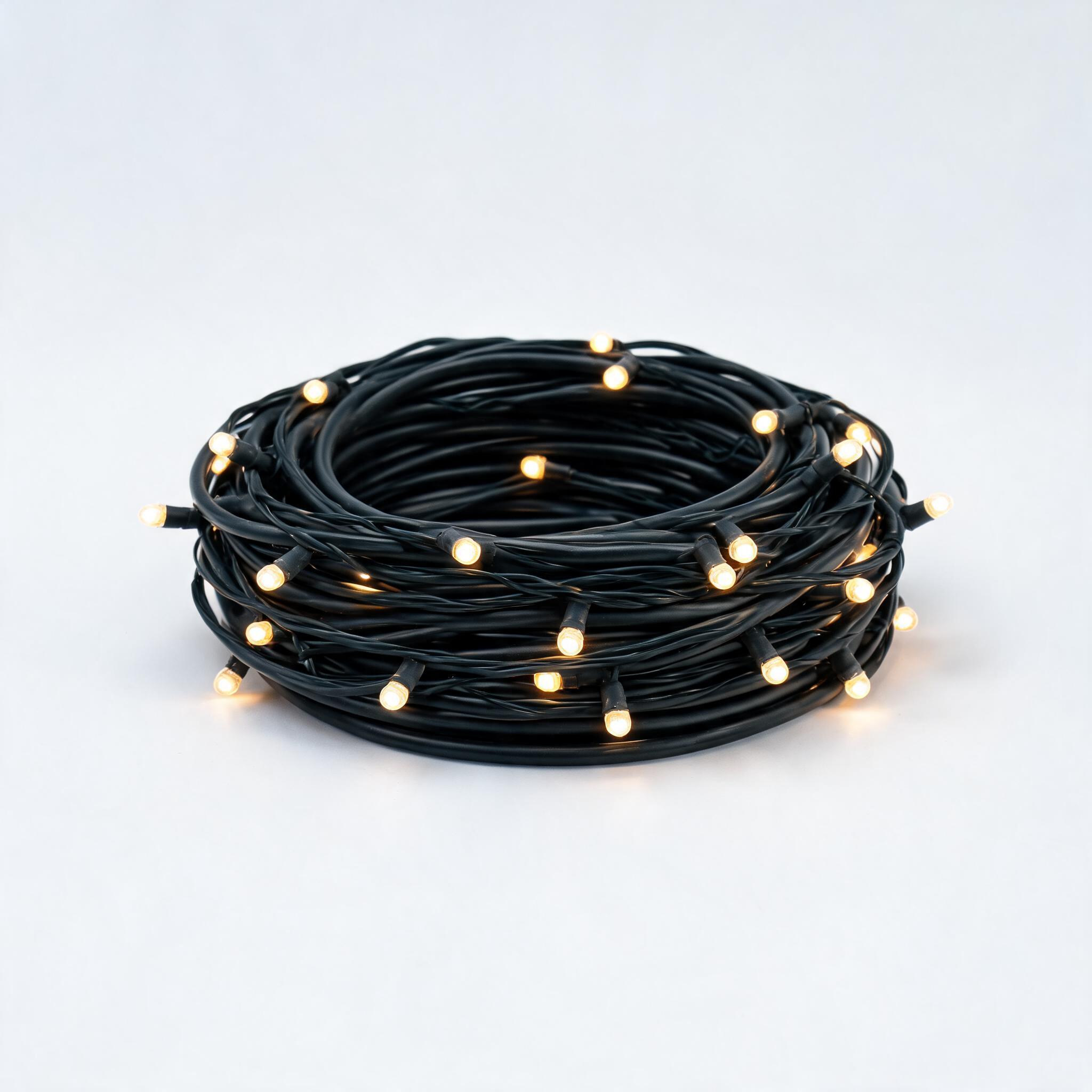
LED string lights cost about USD 3–4 per year at typical usage — roughly nine times less than incandescent bulbs. The real cost factor is service life. Full calculations for buyers and distributors.
Question by question
When a buyer asks how much it costs to run LED string lights, it usually comes down to one of two questions: “Will my electricity bill notice this?” (a private owner or venue) or “Can I sell this to customers who count operating costs?” (a distributor or installer). The same arithmetic answers both, so let us work it out properly — with real numbers you can reuse in your proposals and product pages.
The basic math
Operating cost = wattage × hours × tariff. That is the whole formula. Everything else is plugging in honest numbers.
Take a typical outdoor LED set: 100 LEDs at roughly 0.1 W each — about 10 W total. Our 100 LED set, 10 m, warm white is a representative example. Running 6 hours a day:
- 10 W × 6 h = 60 Wh per night = 0.06 kWh
- At the average US tariff of about USD 0.17/kWh, that is roughly USD 0.01 per night
- Over a year of 365 nights, about USD 3.70 per year
This is not a rounding error in someone's budget — it is effectively free lighting. Compare it with incandescent bulbs of the same length: 100 bulbs at ~0.9 W draw 90 W, which at the same usage costs about USD 33 a year. The LED set costs nine times less to run, so the LED premium pays for itself in the first season of intensive use.
Commercial-scale numbers
For a restaurant terrace or event venue with 20 LED string light sets at 10 W, 8 hours a day, 300 nights a year:
- 20 × 10 W × 8 h × 300 = 480 kWh per year
- At USD 0.17/kWh, about USD 82 per year for all the venue's atmospheric lighting
The same venue with incandescent strings would draw about 1,800 W and pay roughly USD 730 a year. For a HoReCa operator, going LED saves more than USD 600 a year on every terrace — before even counting the saved replacement of burnt-out incandescent bulbs, which LED sets simply do not have.
What actually drives operating cost
Three variables move the number:
- Total wattage: the number of LEDs × the draw of each. Look at the set's total consumption in the specification, not just the LED count — a “100 LED” set with a poor driver can draw more than a well-designed set of the same size.
- Hours of operation per day: a timer or photocell matters more than many expect. Cutting runtime from 8 to 5 hours reduces consumption by 37%. Our commercial string lights work well paired with simple photocell timers.
- Local tariff: tariffs range from under USD 0.10/kWh in some markets to over USD 0.30/kWh in parts of Europe. At USD 0.30, the venue example above costs USD 144/year — still negligibly cheap, but European customers should be given the exact figures.
Where the real cost is: durability
Here is what matters to a B2B buyer: operating cost is a rounding error, but replacement is not. A set that lasts two outdoor seasons for USD 15 costs USD 7.50 a year; a set that dies in one season for USD 8 costs USD 8 a year plus the labor to rehang it. Durability — UV-resistant PVC cable, sealed lampholders, IP65 rating — is where the money actually is.
That is why commercial buyers specify IP65 and UV-protected sets — our warm white and cool white commercial sets: electricity is nearly free, so the product that simply keeps working wins.
Answers to your customers' questions
If you distribute or install string lights, here are the numbers your customers will ask about — keep them to hand:
- “How much does it cost to leave a string light on all night?” A 10 W set for 12 hours: about USD 0.02 per night, USD 7 per year.
- “Do LED string lights use a lot of power?” No — a typical set draws less than a phone charger.
- “Are solar string lights cheaper to run?” They draw no mains electricity, but they cost more to buy and give lower, weather-dependent brightness. For permanent commercial installations, wired LED sets are more reliable.
- “What about voltage?” Our sets run on 220 V mains; 24 V low-voltage options suit markets and applications where mains access is limited or safety standards require it.
Frequently asked questions
How much electricity do LED string lights use? A typical 100 LED, 10 m set draws about 10 W — roughly one tenth of an equivalent incandescent set. Ten hours of operation costs about one cent at average US tariffs.
How much does it cost to run outdoor string lights per month? One 10 W set for 6 hours a day: about USD 0.30 per month. A commercial terrace with 20 sets: about USD 7 per month.
Do string lights noticeably raise the electricity bill? Not with LEDs. Even a large private installation of 10 sets costs less than USD 5 per month at typical usage.
Is it better to leave LED string lights on or switch them off? The savings from switching off a 10 W set are pennies; use a timer for convenience, not for savings. For total cost, durability and weather conditions matter far more.
What should commercial buyers compare besides operating cost? IP rating, UV resistance of the cable, sealing of the lampholders, LED lifetime (25,000–50,000 hours), and warranty terms. Operating cost is a solved problem; durability is not.
Specification for your market
For distributors, the operating cost story is a selling point worth packaging: “running costs under USD 4 a year.” For installers, it is the reason to recommend LED to every customer without hesitation. And for anyone comparing suppliers, a reminder: wattage in a datasheet is a promise; request the measured consumption of the full set including the driver. See full specifications in the OKELI LIGHTING range, and other buying guides in our news section.