
Solar pathway light lifespan depends on battery chemistry, LED quality and housing material. Learn what fails first, what shortens life, and how to specify fixtures that last 5+ years.
The short answer, up front
Buyers ask this question because they have been burned before: a solar path light set that looked great in spring was dead by the second summer. The honest answer is that the service life of a solar light is determined by three components — the battery, the LED, and the housing — and they age at very different rates. A well-built product with a good lithium battery and a 304 stainless steel housing delivers 3–5 years of full performance and 8–10 years of useful service. A cheap plastic product with a NiCd cell often fails within 12–18 months.
Understanding which component fails first and why is what lets commercial buyers select solar lights that survive real projects, not showrooms.
Component 1: the battery (2–4 year service life)
The battery always degrades first. Three chemistries are common in solar path lights:
- NiCd (nickel-cadmium): the cheapest option, prone to memory effect, 300–500 charge cycles. Expect 1–2 years. Increasingly restricted in the EU due to cadmium content.
- NiMH (nickel-metal hydride): better capacity and 500–1000 cycles, typically 2–3 years of service. A reasonable mid-range choice.
- LiFePO4 (lithium iron phosphate): 2000+ cycles, stability under temperature extremes, 4–6 years of service. The specification to require for commercial projects.
When evaluating a supplier, ask which chemistry is inside and whether the battery can be replaced. A fixture with a replaceable battery pack can serve for a decade with two battery replacements; a sealed housing with a soldered-in NiCd cell is effectively disposable. This single question separates professional solar lighting from gift-shop products.
Component 2: the LED (50,000+ hour rating)
The LED itself rarely becomes the limiting factor. Quality LED modules are rated for 50,000 hours — at 10 hours of operation per day, that is more than 13 years of service. The perceived drop in light usually comes from the lens and diffuser: cheap acrylic yellows under UV within two seasons, cutting luminous flux even while the LED still works. Lenses made of UV-stabilized polycarbonate or glass eliminate this failure entirely.
Component 3: the housing and seals (5–10 year service life)
The housing material determines whether water kills the electronics before the battery reaches its natural end of life. The failure chain is familiar: the gasket compresses, water enters, the circuit board corrodes, the light dies — often with a battery that still works.
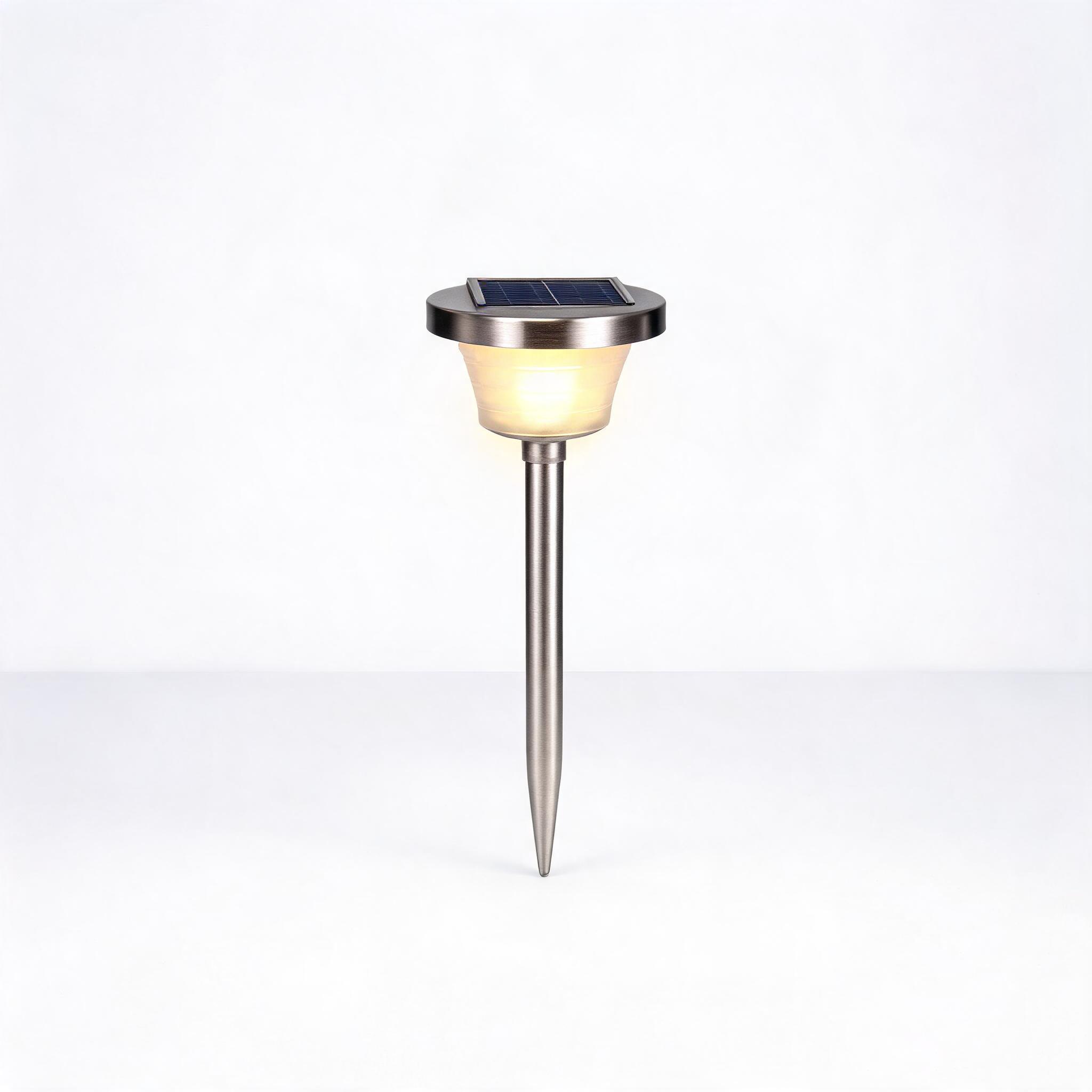
- 304 stainless steel with IP67 sealing: withstands irrigation, rain, snow, and temporary flooding. Our 304 stainless steel solar path light is built to this standard for HoReCa projects and private properties.
- Plastic housings with IP44: UV weathers the surface within 1–2 seasons, the gaskets fail, and water finds the circuit board. These are the lights that give solar lighting a bad name.
What shortens service life in real installations
Even good lights fail early when installed incorrectly. The four most common killers from our warranty analysis experience:
- Shade: a panel that receives 4 hours of sun instead of 8 never charges fully, the battery goes into deep discharge at night and loses roughly half its life. Place panels away from tree canopies and building shadows.
- Standing water: lights installed in low spots or planter drainage zones sit in water that will sooner or later defeat any gasket. Level the ground or raise the base.
- Winter abandonment: in cold climates, batteries left discharged over winter sulfates and lose capacity. Either operate the lights regularly or remove the batteries for the off-season.
- Salt exposure: on coastlines and sites treated with de-icing agents, 304 steel corrodes; specify 316 steel or powder-coated aluminum there.
Runtime and service life: two different questions
Buyers often confuse daily runtime with product service life. Runtime — how many hours the light burns after sunset — depends on that day's charge and the battery's current capacity. A new quality product delivers 8–10 hours; our solar light with automatic 8–10 h mode is designed for exactly this. As the battery ages, runtime shrinks first: a product that burns 5 hours instead of 9 is telling you the battery is at half capacity and due for replacement — not that the whole fixture should be thrown away.
How to specify long-lasting solar lights
For commercial buyers — municipalities, hotels, HOAs, landscape contractors — this checklist turns the question “how long will it last” into a purchasing specification:
- Battery: LiFePO4 chemistry, replaceable pack, capacity in mAh stated on the datasheet.
- Housing: 304 stainless steel minimum, 316 for coastal sites; IP67 rating with test evidence.
- Lens: UV-stabilized polycarbonate or glass, not pure acrylic.
- Panel: monocrystalline silicon, sized so that an average sunny day fully charges the battery.
- Photocell: automatic dusk-to-dawn switching, so the light cannot be left on and drained.
- Spare parts: order 5–10% spare batteries with the first shipment; they cost little and extend the life of the fleet by years.
Total cost of ownership: the number that decides
A plastic light at USD 12, replaced every 18 months, costs USD 8 per year of service plus the labor to remove and reinstall it on site. A steel light at USD 25 with one battery replacement at USD 4 in the third year comes to roughly USD 5.5 per year — and looks professional the whole time. For any maintained site, the durable light wins on total cost of ownership before we even count the reputational value of lighting that simply works.
Frequently asked questions
How long do solar path lights last on average? Consumer grade: 1–2 years; professional grade with LiFePO4 batteries and steel housings delivers 3–5 years of full performance and 8–10 years with battery replacement.
Can the batteries in solar lights be replaced? In well-designed products, yes: the pack is removable or unscrews. In cheap sealed units, no — which makes them disposable. Ask before you buy.
Why did my solar lights dim after a year? Almost always battery capacity loss, sometimes combined with a yellowed lens or a dirty panel. Clean the panel; if runtime is still short, replace the battery pack.
Do solar lights work in winter? They work, but for fewer hours: days are shorter and panels charge less. LiFePO4 handles cold far better than NiCd. In cold climates, keep panels clear of snow and expect 4–6 hours of runtime.
Are solar lights bright enough for commercial sites? For path navigation and boundary marking, yes — 100–200 lm is the standard. For security lighting or tree uplighting, wired fixtures remain the right tool.
Choosing a supplier
If you are sourcing solar lights for a project or for distribution, ask every supplier the same three questions: which battery chemistry, which ingress protection rating and with what test evidence, and is the battery replaceable. A manufacturer like OKELI LIGHTING publishes these specifications openly on every product page — compare our models in warm white and cool white or browse the full range on the products page. For further buying guidance, see our article on how to choose outdoor solar lights.