A buying guide for solar dusk-to-dawn lights: IP67 protection, 304 stainless steel construction, NiMH battery specifications, and color temperature selection.
Solar Pathway Lights — A Procurement Guide for Commercial Projects
Solar Lights with Automatic Dusk-to-Dawn Mode: A Guide to Selecting IP67-Sealed Fixtures for Commercial Projects
Solar pathway lights look simple. They are not. A buyer who specifies the wrong battery chemistry, an insufficient ingress protection rating, or steel that cannot withstand the installation environment will face failures in the first season — and replacing 200 bollards across a resort property is not a minor line item.
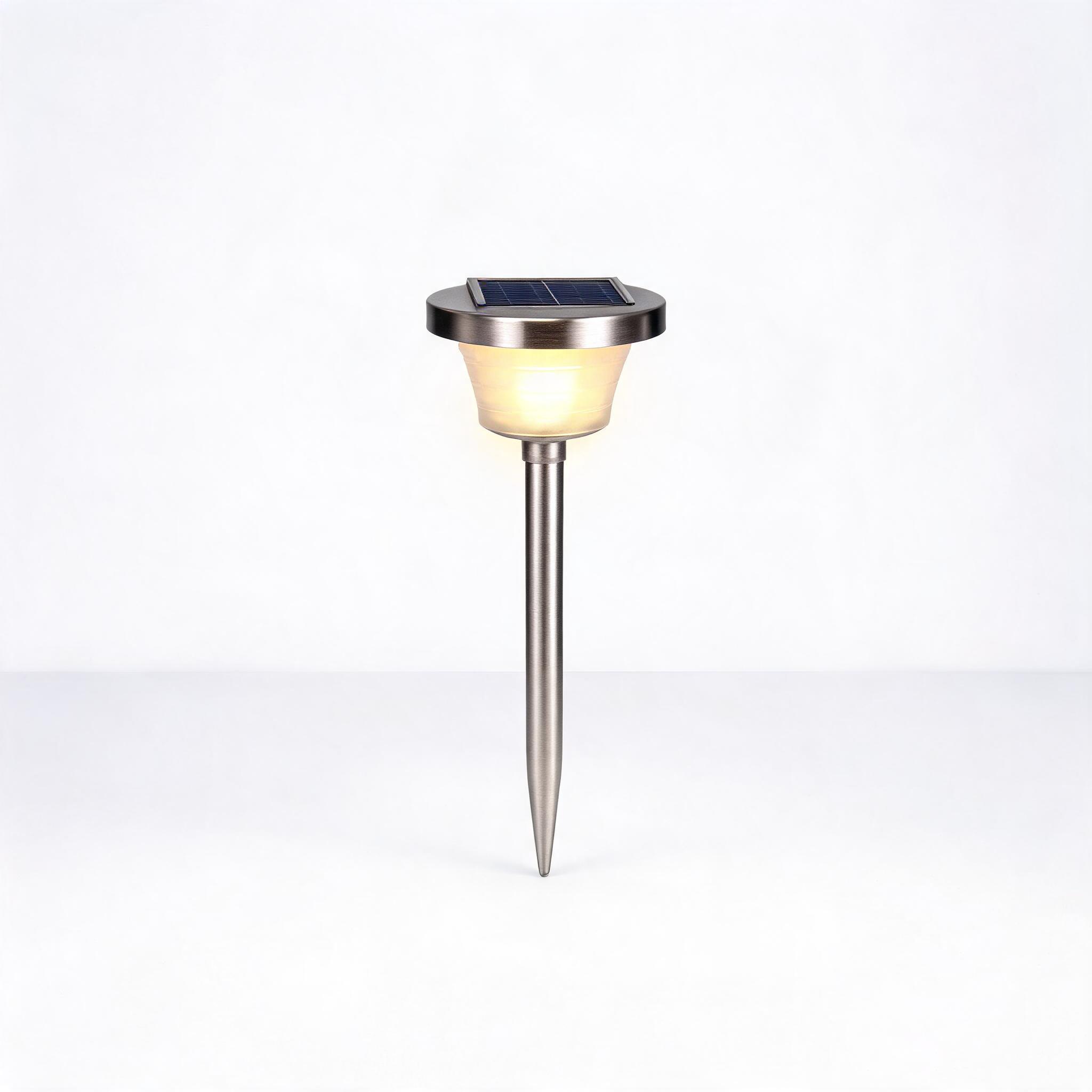
This guide covers what actually matters when purchasing solar lights with automatic mode for commercial projects: photocell operation, IP67 sealing, 304 stainless steel housing, battery specifications, and the practical difference between warm white and cool white options. Throughout, we reference the 3000K warm white light fixture and 6500K cool white fixture from OKELI — both built on the same 304 stainless steel platform with IP67 rating.
Key points: for commercial projects, three specifications separate fixtures that last a decade from those that fail in a single season: IP67 sealing (not IP44 or IP65), 304 stainless steel housing (not painted steel or plastic), and NiMH battery chemistry (not NiCd). If a supplier cannot confirm all three, the product is not commercial grade.
Why Automatic Mode Matters for Commercial Sites
Manual control is impractical on a commercial site. A resort with 150 pathway lights cannot send staff across the property every evening. Timer-based systems require seasonal readjustment as daylight hours change and reset after power outages.
Automatic dusk-to-dawn mode solves this. A built-in photocell monitors ambient light levels and switches the fixture on at dusk, off at dawn. No timer, no app, no staff involvement. The sensor handles seasonal changes automatically — whether sunset is at 17:00 or 21:00, it responds to actual light.
For facility managers, this means:
- Zero operational labor: staff do not spend time switching lights on and off. On a site with 200 fixtures, this is measurable payroll savings.
- No energy waste: fixtures never burn during the day because someone forgot to turn them off.
- No drifting timers: the photocell requires no seasonal adjustment and tracks actual daylight.
- Reliability in remote locations: for off-grid sites, glamping grounds, and rural estates, there is no control system that can fail: each fixture operates independently.
IP67 Rating — What It Means on Site
IP ratings are the most commonly embellished specification in solar lighting. A supplier may claim water-resistant without stating a rating — and IP44 (splash protection) is formally water-resistant in marketing language too. For commercial projects, IP44 is insufficient. Even IP65, which protects against water jets, does not cover ground-level fixtures in areas of heavy rain and irrigation systems.
IP67 means two things:
- Complete dust tightness (first digit 6): dust, sand, and particles cannot enter. This matters in desert conditions, construction zones, and arid climates where dust gradually reduces light output.
- Immersion up to 1 meter for 30 minutes (second digit 7): the fixture withstands temporary immersion. On a pathway, this means surface flooding after heavy rain, direct irrigation, and water pooling at the base of the bollard will not reach the LED module, battery, or solar panel connections.
Why this is critical: solar pathway lights are installed at ground level — the lowest fixtures on the site. Water flows downward. Irrigation sprays sideways. If the unit is not rated for immersion, water will enter through the battery compartment seal, panel cable entry, or diffuser gasket — and once inside, it corrodes the battery and kills the fixture.
OKELI Solar Lights warm white and cool white carry an IP67 rating: all electronics — LED, battery, photocell, and charge controller — are sealed against immersion.
304 Stainless Steel — Why Material Determines Service Life
Housing material is the single best predictor of how long an outdoor solar fixture will last. Three common options, and the difference between them is not subtle:
| Material | Corrosion Resistance | Typical Outdoor Service Life | Visual Degradation |
|---|---|---|---|
| Plastic / ABS | UV degradation within 1–2 seasons | 1–2 years to cracking | Yellowing, brittleness, fading |
| Painted steel / zinc alloy | Coating fails within 6–12 months in coastal areas | 2–3 years to structural corrosion | Rust streaks, coating peel, pitting |
| 304 stainless steel | No coating to fail — the metal itself resists corrosion | 10+ years in most environments | None — the finish is the metal |
304 stainless steel is the same alloy used in professional kitchen equipment and marine hardware. It contains 18% chromium and 8% nickel, forming a passive oxide layer that self-heals when scratched. Sea air, monsoon rain, irrigation chemicals, and pool splash do not cause surface corrosion, pitting, or staining.
For commercial projects, this matters in three respects:
- Replacement savings: replacing 200 plastic bollards every two years costs more than a one-time purchase of stainless steel.
- Visual consistency: rusting painted fixtures create a neglected appearance; stainless steel maintains its finish indefinitely.
- No staining of adjacent surfaces: rusting steel leaves orange streaks on light-colored paving and concrete. Stainless steel does not.
Battery: NiMH vs. NiCd and Li-ion
The battery determines how long the fixture runs each night and how many years before it must be replaced. Three chemistries are common in solar fixtures:
- NiCd (nickel-cadmium): the cheapest option. Prone to memory effect — loses capacity with repeated partial discharge. Cadmium is toxic and restricted by RoHS in many markets. Not recommended for commercial specifications.
- NiMH (nickel-metal hydride): no memory effect, higher capacity per cell, stable operation from −10°C to +50°C, withstands 500–1,000 charge cycles (1.5–3 years of daily operation). The correct specification for commercial fixtures. OKELI uses a 600 mAh NiMH battery providing 8–10 hours of operation on a full charge.
- Li-ion: highest energy density and cycle life, but requires a protection circuit and costs more. Overkill for low-power pathway fixtures: NiMH provides sufficient runtime at lower cost and complexity.
The 600 mAh NiMH battery in OKELI fixtures provides 8–10 hours of operation on a full day of sunshine. In most climates, daylight hours (including overcast periods) are sufficient to charge the battery for a full night. In areas of persistently low insolation — high-latitude winters, constant fog — runtime may be reduced; for such projects, discuss panel size options with the manufacturer.
Warm White vs. Cool White — Choosing Color Temperature
Color temperature is not a technical detail: it determines whether the fixture suits the project environment. OKELI offers the same fixture in two temperatures:
| Specification | 3000K warm white | 6500K cool white |
|---|---|---|
| Visual tone | Soft amber, close to incandescent | Crisp daylight, bright white |
| Best application | HoReCa, resorts, private estates | Functional, commercial, and security areas |
| Material rendering | Flattering to stone, wood, plantings | Accurate but cooler rendering |
| Atmosphere | Inviting, intimate | Composed, functional |
| Typical project | 5-star hotel, villa, wedding venue | Park, parking lot, municipal pathway |
For HoReCa and residential projects, the standard is 3000K warm white. Cool white at a resort entrance reads as security lighting — it kills the atmosphere the landscape design was created for. The warm white option — the default choice for hotels, resorts, and premium residential developments.
For functional applications — commercial perimeters, parking lots, municipal pathways — the cool white option provides higher perceived brightness and a composed tone. Some projects mix both: warm white in guest areas, cool white in service and perimeter areas.
Zero Wiring — Infrastructure Savings
The hidden cost of wired pathway lighting is not the fixture. It is trenching, cable conduit, cable, junction boxes, a licensed electrician, and in many jurisdictions an electrical permit. For a project with 200 fixtures, these costs can triple the cost of the fixtures themselves.
Solar fixtures eliminate each of these line items:
- no trenches or earthworks required;
- no sewers or cable runs required;
- no electrician needed — installation with a driven stake;
- electrical permits are not required in most jurisdictions;
- no ongoing electricity costs;
- fixtures can be repositioned as the landscape evolves — with no rewiring.
For remote sites, off-grid locations, and projects with restrictions on groundworks (heritage sites, protected landscapes), solar fixtures are not just a saving — they may be the only viable option.
OKELI Solar Fixture Specifications
Both color temperature versions share these specifications:
- Housing: Grade 304 stainless steel
- Height: 30 cm (custom heights available from MOQ)
- LED power: 0.6 W
- Sealing: IP67 (with immersion rating)
- Battery: NiMH 600 mAh, rechargeable
- Runtime: 8–10 hours on a full charge
- Operating temperature: −10°C to +50°C
- Control: automatic dusk-to-dawn (built-in photocell)
- Power: built-in solar panel, no external wiring
- Custom options: height, finish, color temperature, private-label packaging
OKELI LIGHTING has manufactured outdoor lighting since 2009 at a 35,000 m² facility with ISO 9001 certification. Products are certified to CE, ETL, and RoHS. The company supports OEM/ODM programs: custom heights, finishes, logo engraving, and private-label packaging from MOQ. Samples are available: 7–10 working days; mass production: 40–45 working days.
Frequently Asked Questions
How long does the battery last before replacement?
NiMH typically withstands 500–1,000 charge cycles. At one cycle per day, that is 1.5–3 years of daily operation before noticeable capacity loss. Spare batteries are available — request spare-part pricing.
Do the fixtures work in cloudy weather?
Yes. The panel charges from diffused daylight, not only direct sun. During prolonged cloudy periods, runtime is reduced, but the charge is sufficient for operation in normal overcast weather. For climates with consistently low insolation, discuss panel options with us.
Can warm and cool white be mixed in one project?
Yes. Both versions use the same Grade 304 stainless steel housing and dimensions. Mixing is common in HoReCa projects: warm white in guest areas, cool white in service areas. Send us the distribution and we will prepare a consolidated quotation.
What is the minimum order quantity?
The MOQ is 100 units for standard configurations. Custom heights, finishes, or packaging may have a higher MOQ. Send your project volume and we will prepare an exact quotation.
Can I get samples for specification approval?
Yes. Samples are available for approval before mass production. Lead time is 7–10 working days. Request sample pricing and shipping options.
Are these fixtures suitable for coastal areas?
Yes. The Grade 304 stainless steel housing is resistant to corrosion from sea air. IP67 sealing prevents moisture ingress. These fixtures are designed for beach resorts, marinas, and tropical humid environments where painted steel fails within a single season.
Need help selecting solar fixtures for a commercial project? Send us the site type, fixture quantity, color temperature preference, and target market. The OKELI technical team will confirm specifications, pricing, and lead times within one working day. Contact Us.