A wholesale buyer's guide to commercial outdoor string lights: construction differences, channel-specific specifications, supplier evaluation questions, MOQ and logistics, and common buying mistakes.
Why Commercial String Lights Are a Product Category of Their Own
Walk down any restaurant street in Austin, Barcelona, or Sydney, and you will see the fastest-growing category in outdoor lighting: commercial string lights. But the sets strung above terraces are not the string lights sold in gift shops. Commercial-grade products differ in four parameters that become critical after the first season of use: cable construction, socket sealing, LED quality, and electrical certification. This guide is for distributors, installers, and venue owners who need a genuinely commercial product and know how to evaluate a supplier.
How Commercial Grade Differs from Consumer Grade
Four design decisions create the difference:
- Cable: commercial sets use UV-stabilized PVC cable or rubber-jacketed cable that withstands years of sun without chalking or cracking. Consumer cable becomes brittle within one or two summer seasons, which is the number one cause of failure in returns.
- Sockets: sealed all-weather sockets with gaskets. Open sockets collect water, contacts corrode, and intermittent faults appear that are very difficult to trace on a 30-meter run.
- LEDs: commercial sets use LEDs rated for 25,000–50,000 hours with consistent color temperature along the entire length. Cheap sets are assembled from mixed bins, so one string visibly drifts in color.
- Ingress protection: IP65 minimum for permanent outdoor installation. Anything lower is an indoor product.
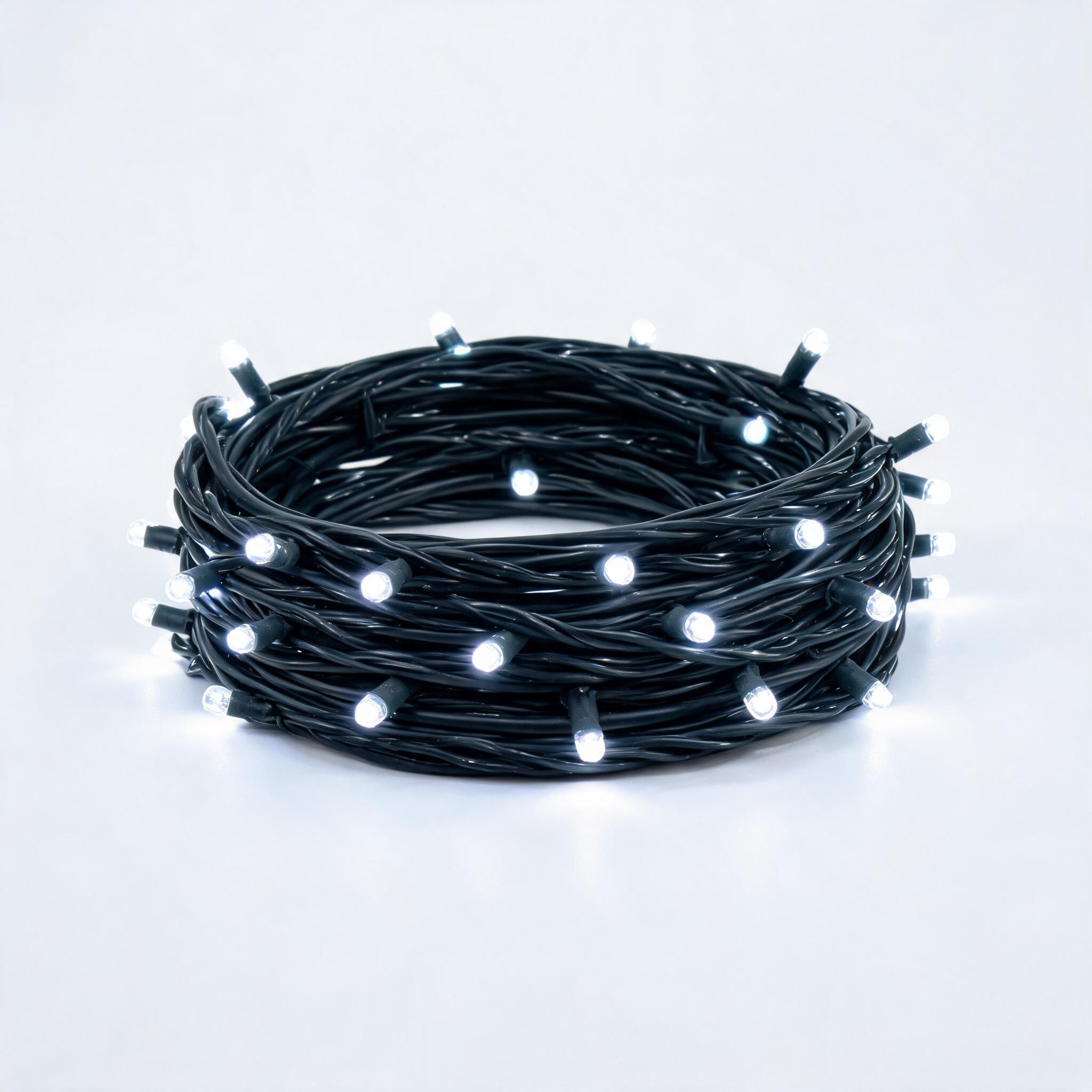
Our commercial string light 100 LED warm white and cool white version are 10 meters, IP65, UV-resistant PVC, exactly matching the specification level discussed in this guide.
The Market Opportunity in Numbers
For distributors weighing the category: commercial string lights combine pronounced seasonal demand peaks (November–December and the northern hemisphere summer) with virtually zero operating cost for the end user. A 10 W set costs roughly USD 4 a year, as we explain in our cost of ownership analysis. This combination of strong visual impact, negligible expense, and repeat sales through replacement explains why the category keeps growing across HoReCa, municipal, and premium consumer channels.
Specification by Channel
Different channels need different specifications:
- HoReCa (restaurants, hotels, venues): IP65, UV-stabilized cable, warm white 2700–3000K, dimmable drivers where atmosphere control matters, and replaceable sockets for long service life.
- Municipal sites and events: reinforced cable with high tensile strength for long spans and stable color across large installations. Cool white 6500K for modern streets; warm white for squares and markets.
- Premium private segment / retail: commercial specification in consumer-friendly lengths (10 m is the volume optimum) and packaging that communicates the durability difference, which is where the margin lies.
Evaluating a String Light Supplier
The category is crowded with resellers who simply resell the cheapest product. Separate the manufacturer from the middleman with these questions:
- Cable specification: jacket material and UV stabilization? Is there a UV aging test report?
- Socket construction: which gasket? What ingress protection rating, and what test evidence?
- LED sourcing and binning: a single color bin per batch? What is the rated life?
- Electrical certification: CE/UKCA/ETL for your market. Ask for certificate numbers, not logos.
- Customization: lengths, LED spacing, color temperature, plug types for target markets, private label packaging.
- Sample policy: will they send samples from the production line rather than showroom samples?
A manufacturer such as OKELI LIGHTING publishes full specifications on every product page and supports custom OEM/ODM manufacturing: plug types, lengths, color temperatures, and packaging. That is because distributors need a product that matches the plugs, voltages, and aesthetics of their market, not a one-size-fits-all export SKU.
Logistics and Ordering
String lights are bulky but not heavy, so freight efficiency is a real cost lever. Ask the supplier about combined carton packing and about adjusting LED spacing and coil length to reduce packaging volume. Typical MOQs at established factories are 100–500 sets depending on the level of customization; standard lead times are 25–40 days, longer for fully custom tooling. Order samples from the actual production line before confirming a batch and test them outdoors for at least two weeks. A balcony test will reveal UV and sealing failures that a desk inspection will never show.
Common Purchasing Mistakes
Three mistakes are costly for distributors in this category. The first is buying on price per meter without checking cable UV stabilization: the sets fail in the field and poison repeat sales. The second is ignoring plug and voltage compatibility with the target market: European 220 V plugs do not sell in North America, and vice versa. The third is skipping the sample stage with the reasoning that it is just a string light: the difference between a good set and a bad one is invisible in photos and obvious in the third week outdoors.
Frequently Asked Questions
What makes a string light commercial grade? UV-stabilized cable, sealed all-weather sockets, single-bin LEDs rated for 25,000+ hours, and IP65+ ingress protection. A set missing any of these is a consumer product at a commercial price.
What MOQ should I expect when importing string lights? 100–500 sets from established manufacturers, depending on the scope of customization; lower for stock configurations, higher for private label tooling.
Can I order non-standard lengths and plug types? Yes, from manufacturers with OEM/ODM capabilities. Confirm plug certification for the target market in advance, as it affects lead time.
Warm white or cool white for commercial installations? Warm white (2700–3000K) for HoReCa and squares; cool white (6500K) for modern streets and areas adjacent to security functions. Consistency across the whole installation matters more than the choice itself.
How long do commercial LED string lights last? The LEDs are rated for 25,000–50,000 hours; actual service life is determined by the cable and sockets, so these components deserve the most attention when comparing suppliers.
Request a Wholesale Quotation
If you are building a string light program for distribution, HoReCa, or municipal channels, send us your target specification: length, LED count, color temperature, plug type, and packaging, and request production samples. Compare the warm white and cool white commercial sets as reference specifications, browse the full range on the OKELI product page , and find other purchasing guides in our news section.