
Guide to choosing the material for outdoor LED bollards: a comparison of 304 stainless steel, 316 stainless steel, and die-cast aluminum by corrosion resistance, cost, and application. Includes a project-environment selection system and a 10-year cost analysis.
Bollard Light Housing Material Selection Guide
The housing material of an outdoor LED bollard light is not a cosmetic choice. It determines whether the fixture survives two seasons or twelve, whether rust streaks appear on the client's paving by year three, whether a coastal resort passes its first-year warranty inspection or faces a full replacement order. For B2B buyers specifying pathway lighting for hotels, residential estates, and municipal projects, material selection is the first line of defense against premature failure.
This guide compares the three materials most commonly used in LED bollard housings — 304 stainless steel, 316 stainless steel, and die-cast aluminum — on corrosion resistance, strength, thermal conductivity, cost, and project suitability. The goal is to help you specify the right material for each project environment rather than using one option for all sites.
Why housing material matters more than wattage
Wattage determines how much light the fixture delivers; the IP rating determines how well it keeps water out. But neither specification addresses the most common cause of outdoor pathway lighting failure: housing degradation. A 5 W IP67 bollard with perfect internal sealing is useless if the housing corrodes, cracks, or separates from its base after two winters.
The failure pattern is predictable: painted steel and zinc alloys show surface rust within 6–12 months in coastal or humid environments. Rust penetrates the housing, weakens the structure, and reaches the LED chamber through cracks and seal degradation. The IP67 that looked impressive in the spec sheet becomes meaningless once the housing has failed. This is why material selection comes first: the right material ensures that the IP rating, LED lifetime, and warranty get the chance to do their job.
Material comparison at a glance
- Corrosion resistance: 304 — excellent (general outdoor grade); 316 — superior (marine/coastal); aluminum — good with powder coating.
- Salt spray (test): 304 — 500+ hours; 316 — 1,000+ hours; aluminum — depends on coating quality.
- Strength: 304 and 316 — high (impact resistant); aluminum — moderate (can crack on impact).
- Thermal conductivity: 304/316 — moderate; aluminum — excellent (housing acts as a heat sink).
- Surface finish: 304/316 — brushed/mirror, no coating required; aluminum — powder coating (can chip and scratch).
- UV resistance: 304/316 — inherent to the metal; aluminum — depends on the coating.
- Relative cost: 304 — medium; 316 — high; aluminum — low/medium.
- Best application: 304 — hotels, resorts, residential estates, general commercial grade; 316 — beaches, marinas, chlorinated pool areas; aluminum — budget projects, high-wattage fixtures, inland sites.
304 stainless steel — the hospitality standard
Alloy 304 is the most widely specified material for premium outdoor bollards, and with good reason: 18% chromium and 8% nickel provide inherent corrosion resistance without a surface coating. The metal is the finish — no paint to chip, no powder coating to scratch, no plating to wear through. What you see on day one is what you see in year ten.
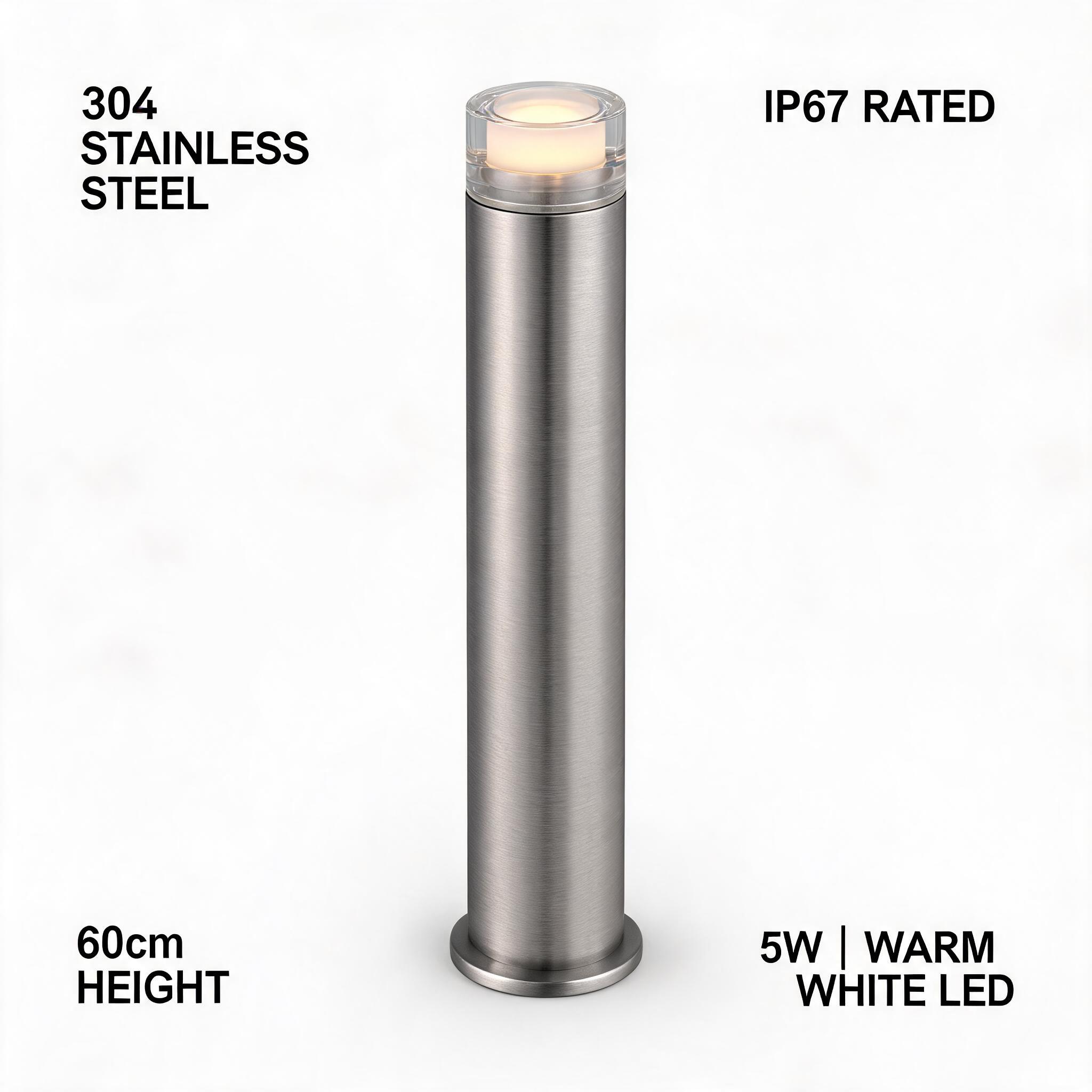
The OKELI 304 stainless steel bollard light (60 cm, 5 W, IP67) is built on this principle. The housing passes a 500-hour salt spray test, covering most outdoor environments including coastal areas with moderate salinity. The brushed finish is low-maintenance: dirt is removed with standard stainless steel cleaners, and oxygen exposure passivates the metal so minor scratches do not turn into spreading corrosion.
Where 304 stainless steel is the right choice: hotel and resort pathways; residential estate driveways and garden paths; high-traffic commercial plazas and office campuses; golf courses and country clubs; general outdoor environments up to 5 km from the coastline.
Where 304 is not enough: direct beachfront installation, areas of intense industrial salt exposure, or chlorinated pool environments where chlorine concentration creates a more aggressive environment than salt air. In these cases, step up to 316.
316 stainless steel — the marine grade
316 stainless steel adds 2% molybdenum to the 304 composition — that single addition sharply increases resistance to the chloride corrosion typical of seawater, chlorine, and de-icing salts. 316 passes 1,000+ hours of salt spray testing — twice the 304 standard. There is virtually no visual difference between 304 and 316: the same brushed and mirror finish options. The difference is entirely in durability under aggressive corrosive exposure: a 316 bollard on a beach path will maintain its structure and finish for years longer than 304 in the same location.
Where the 316 premium is justified: beach and seafront properties (direct salt exposure within 500 m of the shore); poolside lighting (chlorinated water is more aggressive than salt air); marinas and waterfronts; regions with winter de-icing salts (road salt runoff creates a chloride load comparable to a marine environment); industrial areas with chemical airborne pollutants.
Economics: 316 stainless steel typically costs 20–30% more than 304. For a 100-fixture project, that is a noticeable line item. However, the cost of premature replacement of failed 304 units in a marine environment — including labor, disposal, and re-procurement — almost always exceeds the 316 premium. Either specify 316 from the start, or specify 304 with replacement in three years. For a true marine environment, the math favors 316.
Die-cast aluminum — the commercial workhorse
Die-cast aluminum is the most common material in the budget and mid-range segments: lighter than stainless steel, cheaper to produce, and with excellent thermal conductivity — the housing acts as a heat sink, drawing heat away from the LED module. For high-wattage fixtures (30 W and above), this thermal advantage matters: lower junction temperature extends LED life.
Aluminum's weakness is corrosion protection: bare metal oxidizes quickly outdoors, so the housing is powder-coated to create a barrier between the metal and the environment. The problem is that the coating is surface protection, not a property of the material: a chip from impact, a scratch during installation, or UV degradation over time exposes the aluminum and corrosion begins.
Where die-cast aluminum is the right choice: budget projects where upfront price is the deciding factor; high-wattage fixtures (30 W+), where heat dissipation is critical and steel's lower thermal conductivity is a drawback; inland commercial sites with low salinity and moderate humidity; flood and area lights mounted out of reach (lower impact risk).
Where aluminum is a risk: coastal environments, areas of frequent pressure washing, impact zones near traffic, and any project where the client expects 10+ years without maintenance: powder-coated aluminum bollards in a coastal area degrade within 3–5 years, whereas stainless steel maintains its finish indefinitely.
Matching material to project environment
- Inland hotel or resort (5+ km from the shore) — 304 stainless steel: excellent corrosion resistance, premium finish, economical level of protection.
- Coastal hotel or resort (within 5 km of the shore) — 316 stainless steel: salt spray demands the molybdenum alloy; 304 will show pitting within 2–3 years.
- Beachfront property (within 500 m of the coastline) — 316 stainless steel: direct salt spray and splash; 316 is the minimum acceptable specification.
- Pool/spa area — 316 stainless steel: chlorine is more aggressive than salt; 316 resists chloride pitting.
- Inland residential estate — 304 stainless steel: balance of aesthetics and durability; buyers expect a metal finish.
- Commercial plaza (inland, high traffic) — 304 for premium projects; aluminum acceptable for budget projects with a planned replacement cycle.
- Municipal park (inland) — aluminum or 304: aluminum for budget projects, 304 for a longer life cycle.
- Marina or waterfront — 316 only: constant salt-laden moisture rules out other materials.
- Cold climate with winter de-icing salts — 316: road salt runoff creates a chloride load equivalent to a marine environment.
Cost: purchase price versus lifecycle cost
The cheapest fixture in the order is rarely the cheapest over the project lifecycle. A simplified comparison for a 100-bollard installation over 10 years:
- Relative unit price: powder-coated aluminum — 1.0×; 304 stainless steel — 1.4×; 316 stainless steel — 1.8×.
- Expected housing service life (coastal area): aluminum — 3–5 years; 304 — 5–8 years; 316 — 10+ years. (Inland: 7–10 / 10+ / 15+ years.)
- Recoating: aluminum requires it (typically in year 4–6); stainless steels do not.
- Risk of full replacement within 10 years (coastal): aluminum — high (1–2 full replacements); 304 — medium; 316 — low.
- Maintenance labor: aluminum — highest (inspection and coating touch-up); stainless steels — low (cleaning only).
For a coastal project, aluminum's low upfront price is consumed by the first replacement cycle: the cost of removing 100 bollards, disposing of corroded units, and reinstalling them — including rewiring and resetting anchors — often exceeds the material price difference between aluminum and 316 stainless steel. And that is before accounting for the relationship damage from visible failure on the client's site. The counterarguments for aluminum are valid in specific scenarios: inland projects in mild climates, budget municipal contracts with planned replacement cycles, and large volume orders where the unit price difference is significant. In these cases, specify aluminum with a high-quality multi-layer powder coating (not the cheapest available) and plan a 7–10 year replacement cycle.
FAQ
Can 304 stainless steel bollards be used in a coastal project? It depends on proximity to the shore. At 2–5 km inland with moderate salt exposure, 304 stainless steel is usually sufficient and provides 5–8 years of reliable service. Within 1 km of the shore or directly on the beach, step up to 316. If in doubt, specify 316: the premium is small compared to the cost of replacement.
How should stainless steel bollard finishes be maintained? Maintenance is minimal: periodic washing with mild soap and water removes surface dirt. In areas with salt deposits, rinsing with fresh water every 3–6 months prevents chloride accumulation. Avoid abrasive cleaners and metal brushes. Unlike painted and powder-coated finishes, stainless steel does not require recoating.
Can powder-coated aluminum ever be better than stainless steel? Yes, in two scenarios. The first is high-power fixtures (30 W+), where heat dissipation is critical: aluminum keeps the junction temperature lower and extends service life. The second is budget projects in a mild inland climate with a planned and budgeted replacement cycle. In both cases, specify a high-quality multi-layer powder coating, not the cheapest option.
What is the difference between a brushed finish and a mirror finish? Brushed has a satin, non-reflective texture that hides fingerprints and minor scratches — the standard for commercial and hospitality installations. Mirror is highly polished and reflective: striking, but requires more maintenance to keep it clean. The alloy under the finish is the same (304 or 316), and corrosion resistance is identical.
Does OKELI offer bollards in both 304 and 316? Standard OKELI bollard lights are made of 304 steel, covering most outdoor applications. 316 steel is available as a custom specification for marine projects — contact our technical team with a description of the operating conditions, and we will confirm material options and lead times.
Need help choosing a material?
Send us the project location, distance to the coastline, and environmental conditions. We will recommend the correct housing material and provide samples for evaluation within one business day.
Request material consultation