
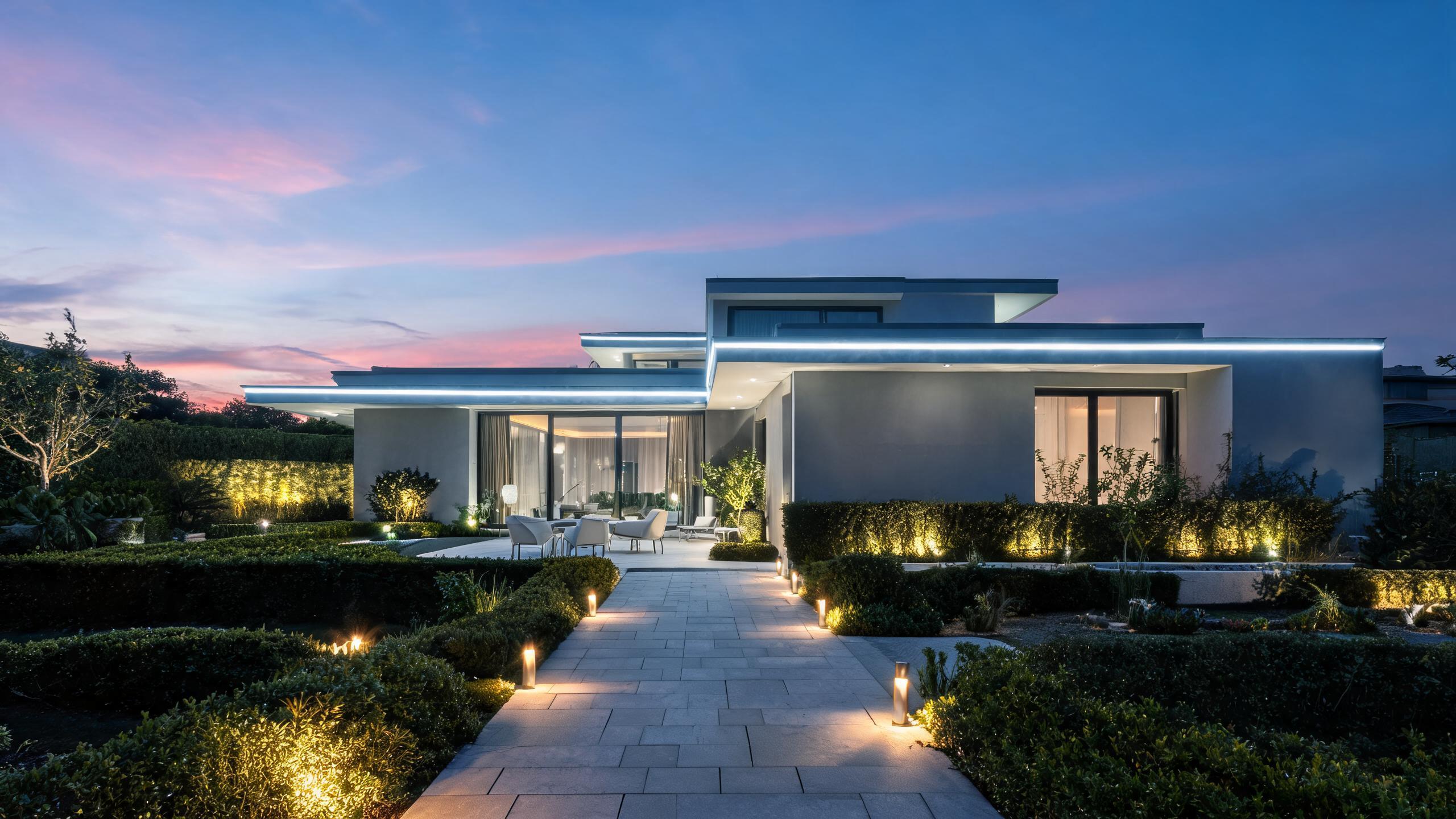
Minimalism becomes an engineering requirement
In 2026, outdoor lighting is visibly moving in two directions at once: visual simplicity and engineering performance. Specifiers and buyers are no longer willing to choose between them — a luminaire must blend into the architecture by day and deliver documented photometric and ingress-protection performance at night. For distributors and contractors, this means the range you offer your customer must be both visually understated and specification-heavy.
In this article, we break down the specific decisions behind the "minimalism plus performance" trend and what to look for in a specification when a customer asks for something "neat and reliable."
Concealed mounting and a low profile
Exposed brackets, visible cabling, and protruding housings are disappearing from premium projects. In their place come luminaires with concealed fixings, a slim profile, and a matte finish: in-ground fixtures, step lights mounted flush, and bollards with a clean silhouette line. Such a luminaire does not compete with the landscape by day — and that is precisely why it is chosen for hotel grounds, resorts, and private estates.
An example from the OKELI range: 40 cm stainless steel bollard provides a low visual line for borders and courtyards, while the 60 cm model covers standard pathways where the luminaire must mark the edge of the route. Both luminaires are brushed stainless steel with no paint: the finish cannot peel because there simply is none.
Performance: IP67, 304 stainless steel, and honest lumens
A minimalist housing leaves no room to cut corners on protection. Low mounting means contact with irrigation, rain, and temporary water accumulation at the base — which is why, for ground-level luminaires, the 2026 standard is IP67 backed by verified testing. The second element is material: 304 stainless steel or die-cast aluminum with a quality powder coating, depending on the environment.
The third element is luminous flux without "marketing" lumens. For pathways, 100–200 lm per luminaire is sufficient; for accent lighting of trees and façades, 800 to 4000 lm depending on scale. The OKELI floodlight range of 10/20/50 W with an adjustable beam angle covers this range and lets a single SKU serve several scenes in a project.
Warm white as the standard for atmosphere
Warm white 3000K has firmly established itself as the default color temperature for HoReCa, residential grounds, and premium retail: it renders foliage, stone, and wood naturally. Cool white 6500K remains for modern architectural solutions, retail rows, and security zones. The 2026 rule: one color temperature per zone, not a mix along a single view line. The pair of OKELI solar lights — warm white and cool white — is built on a single hardware platform precisely for this choice.
Smart control without excess
Presence sensors, dusk-to-dawn photocells, and networked dimming are no longer premium options. Minimalism in control looks like this: automation that runs on its own and requires no staff training, plus protocols (WiFi/Zigbee/Matter) that do not lock the customer into a closed ecosystem.
Sustainability in tender requirements
Sustainability requirements have moved from marketing into tender documentation: energy efficiency, no light pollution into the sky, material durability, and end-of-life recycling. A buyer who offers documented specifications instead of general statements wins such tenders.
What this means for your procurement
The practical takeaway for distributors and contractors: build your 2026 range around a few proven SKUs — a low-profile bollard, a solar light for scenes without wiring, an adjustable floodlight for accents, and a string light for atmosphere. OKELI's four categories — bollards, solar lights, floodlights and string lights — are built precisely around this matrix.
Frequently asked questions
Does a minimalist luminaire mean a less durable one? No. Durability is determined by the housing material, the ingress protection rating, and the quality of the seals, not by the silhouette. A 304 stainless steel bollard with IP67 can be modest in appearance and withstand a decade of service.
Is IP65 sufficient for ground-level luminaires? For in-ground and low-mounted fixtures, we recommend IP67: irrigation and temporary puddles at the base fall outside the scope of IP65 test conditions.
Where should I start when selecting products for the trend? Start with one color temperature per zone, honest lumens for the task, and a housing material suited to the environment. Then request samples of two or three items and test them on site before confirming the volume.
Discuss your 2026 project with OKELI LIGHTING
If you are building a specification for a new project or updating your range for 2026 trends, send us a list of zones and tasks. The OKELI team will select configurations, provide samples, and supply test data within one business day. Browse the full range on the products page.